HAL Q4 Results: Net Profit Drops 7.8% to Rs 3,958 Cr; Revenue Drops 7.2%

HAL Q4 FY25 Results: Net Profit Falls 7.8% to ₹3,958 Crore, Revenue Slips 7.2%; Operational Headwinds Impact Margins
Despite temporary challenges, Hindustan Aeronautics maintains strong market momentum backed by robust order book and defense sector tailwinds.
Hindustan Aeronautics Ltd (HAL), India’s state-owned aerospace and defense manufacturing giant, reported its financial results for the fourth quarter of the fiscal year 2024–25 (Q4 FY25), revealing a decline in both net profit and revenue.
The dip in financial performance was attributed largely to delays in key aircraft deliveries and pressure on operating margins.
However, the company continues to hold a strong position in India’s defense manufacturing ecosystem and remains optimistic about the upcoming fiscal year.
Key Financial Highlights: Q4 FY25 vs Q4 FY24
- Net Profit: ₹3,958 crore, down 7.8% year-on-year from ₹4,291 crore
- Revenue from Operations: ₹13,700 crore, down 7.2% from ₹14,768 crore
- EBITDA (Earnings Before Interest, Taxes, Depreciation, and Amortization): ₹5,292 crore, down 10.2%
- EBITDA Margin: 38.6%, a drop of 140 basis points from the previous year’s 40.0%
- Earnings Per Share (EPS): ₹59.52
- Market Capitalization: Approx. ₹3.20 lakh crore
- Cash and Cash Equivalents: ₹25,000 crore (approximate figure, per analyst estimates)
Although both profit and revenue declined, the revenue figure surpassed HAL’s earlier provisional estimate of ₹13,118 crore, which had raised concerns among analysts and investors about a steeper shortfall.
The performance, while weaker than the previous year’s quarter, provided a degree of relief given the provisional outlook.
Operational Performance and Challenges
The drop in earnings can be attributed to several operational challenges:
- Aircraft Delivery Delays: A key contributor to the revenue decline was a delay in the supply of Tejas Mk 1A fighter aircraft, part of a massive defense order. The delays stemmed from supply chain constraints, particularly in sourcing avionics and key sub-systems from domestic and international vendors.
- Rising Input Costs: HAL faced inflationary pressure on materials and components, further exacerbated by currency volatility. These factors drove a decline in operating margins.
- Execution Lag on New Orders: Several new contracts, including helicopter systems and engine upgrades, are still in early execution phases and have not yet begun contributing meaningfully to revenue.
Despite these headwinds, HAL management emphasized in their earnings call that corrective measures are being taken.
These include enhancing in-house manufacturing capacities, onboarding new suppliers, and streamlining project timelines to ensure future deliveries are not compromised.
Stock Market Reaction
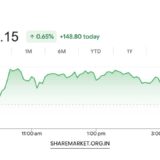
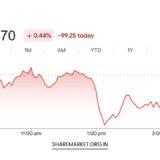
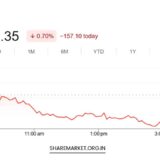
Investors appeared to take the results in stride. HAL’s stock, after initially fluctuating post-earnings release, traded higher by 3.14% at ₹4,754.70 on the NSE as of 2 PM on Wednesday.
The stock has delivered approximately 13% gains in the past month, buoyed by optimism around India’s defense modernization efforts and fresh order inflows.
Analysts suggest that the stock performance reflects long-term confidence in HAL’s business fundamentals, underpinned by its strategic role in India’s defense infrastructure and consistent government backing.
Order Book and Strategic Outlook
One of HAL’s key strengths continues to be its robust order book, which provides significant revenue visibility for the next 3–5 years.
As of March 31, 2025, HAL’s total order book stands at over ₹84,000 crore, covering a wide range of platforms, including:
- Tejas Mk 1A Light Combat Aircraft
- Prachand Light Combat Helicopters (LCH)
- Advanced Light Helicopters (ALH)
- Rudra Weaponized Helicopter Variants
- Upgrades for Su-30MKI and Jaguar aircraft
- HTT-40 basic trainer aircraft
In a major development, the company received a fresh order of ₹62,700 crore for 156 Prachand helicopters during the quarter, strengthening its forward earnings potential.
Strategic Initiatives and Future Roadmap
HAL continues to align its operations with the Government of India’s Aatmanirbhar Bharat (self-reliant India) vision. The company is actively working on the following fronts:
- Production Ramp-up: HAL is investing in automation and production-line efficiency at its Bengaluru and Nasik plants to accelerate delivery schedules.
- New Product Development: The company is collaborating with the Defence Research and Development Organisation (DRDO) on next-generation platforms such as the Advanced Medium Combat Aircraft (AMCA) and the Twin Engine Deck-Based Fighter (TEDBF) for the Indian Navy.
- Export Expansion: HAL has signed Memoranda of Understanding (MoUs) with countries in Southeast Asia, Africa, and Latin America for potential exports of helicopters and maintenance services.
- Joint Ventures and Global Partnerships: Strategic tie-ups with global aerospace firms are underway to jointly produce high-end components and explore offset agreements under foreign military sales.
Sectoral Outlook and Government Support
The Indian aerospace and defense sector is witnessing a period of rapid transformation. The central government has significantly increased the defense capital outlay in Budget 2025–26, with a marked emphasis on indigenization and reducing reliance on foreign imports.
HAL stands to benefit immensely from these policy shifts, as more projects get approved under the ‘Make in India’ initiative.
Furthermore, geopolitical tensions and India’s push for military modernization are expected to continue driving demand for combat aircraft, helicopters, and indigenous systems—all areas where HAL is a key player.
Final Thoughts
While HAL’s Q4 FY25 numbers reflect short-term operational stress, the long-term narrative remains solid.
Backed by a strong order pipeline, strategic government alignment, and ongoing modernization of its manufacturing capabilities, HAL is well-positioned to rebound in the coming quarters.
For investors with a long-term horizon, HAL continues to represent a high-conviction opportunity in India’s defense manufacturing growth story.