BHEL Stock Forecast: Kotak Warns of 53% Drop, Analysts Divided on Future

BHEL Stock Faces Potential 53% Decline, Warns Kotak Institutional Equities — Analysts Remain Divided
Bharat Heavy Electricals Limited (BHEL), a key public sector engineering and manufacturing firm, is under the spotlight following fresh analyst reports warning of significant downside potential in its stock.
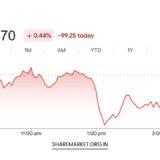
On Monday, May 19, BHEL shares declined nearly 3% intraday, touching a low of ₹243.15 on the Bombay Stock Exchange (BSE), before settling slightly higher at ₹243.70 by the session’s close.
This dip comes amid a strong performance over the past few months, but leading brokerages now warn that BHEL’s stock may be overvalued, with Kotak Institutional Equities slapping a “sell” rating and forecasting a sharp decline of up to 53%.
Kotak’s Bearish View: 53% Downside Implied
Kotak Institutional Equities has taken a decisively bearish stance on BHEL, setting a target price of just ₹115 per share.
Compared to the closing price of ₹243.70 on May 19, this target implies a 53% downside, a rare and significant gap that signals strong pessimism regarding the stock’s near-term performance.
According to Kotak, the primary issue lies in BHEL’s execution weakness, particularly in the power segment—a core area for the company.
This is despite BHEL enjoying a healthy order backlog, which ideally should support strong revenue visibility.
The brokerage noted that BHEL’s EBITDA for Q4 FY25 (January–March 2025) came in 8% below expectations, suggesting operational inefficiencies.
While Kotak acknowledged a modest improvement in working capital, largely due to healthy customer advances, it emphasized that the overall business fundamentals remain weak.
As a result, Kotak has revised down its earnings estimates for the company, cutting FY26 EPS by 19% and FY27 estimates by 3%.
CLSA’s Mixed Signals: Positive Orders, But EPS Miss
While Kotak’s stance is clearly bearish, CLSA offered a more nuanced view. The global brokerage downgraded BHEL to a “reduce” rating, yet raised its target price from ₹166 to ₹198.
The upgrade in price target reflects some optimism, particularly regarding BHEL’s order inflows in the thermal segment, but it still implies a downside from current levels.
CLSA noted that execution improved 9% year-on-year in Q4 FY25, a notable achievement in an industry often plagued by project delays.
However, net profit growth was a modest 4%, and more significantly, earnings per share (EPS) fell short of expectations by a staggering 50%. This underperformance raises concerns about cost control, margins, and scalability of recent improvements.
On a positive note, CLSA highlighted that BHEL is a major beneficiary of India’s renewed focus on fossil fuel-based energy infrastructure, which is gaining importance due to the country’s energy security strategy.
In FY25, thermal power orders peaked at 26.6 gigawatts (GW)—a substantial figure that could provide a pipeline of future revenue.
Divergent Analyst Sentiment
The contrasting outlooks from Kotak and CLSA are reflective of a broader division among market analysts regarding BHEL’s stock. Out of the 17 analysts tracking the company:
- 7 have a “buy” rating
- 2 have assigned a “hold” rating
- 8 have a “sell” rating
This near-even split underscores the market’s uncertainty about BHEL’s future. While some see the stock as a value buy backed by government reforms and infrastructure initiatives, others question the company’s ability to deliver results consistently.
Recent Stock Performance: Short-Term Gains vs Long-Term Risks
Despite the recent negative analyst commentary, BHEL’s stock has performed strongly in the short term.
Over the last three months, it has risen by about 25%, and in the past week alone, it has gained more than 4%.
The rally has largely been fueled by robust order wins, expectations of increased capital expenditure by the Indian government, and optimism surrounding the energy sector.
The company now commands a market capitalization of nearly ₹85,000 crore, cementing its status as one of India’s major public sector enterprises.
However, such rapid gains in a short period have also raised valuation concerns, especially in the face of lackluster profitability and execution issues.
Government Stake and Strategic Importance
As of the end of March 2025, the Government of India holds a 63.17% stake in BHEL, making it a strategic asset in the country’s industrial and energy infrastructure.
The company is integral to India’s Make in India and Atmanirbhar Bharat (self-reliant India) initiatives, particularly in sectors like power generation, defense, railways, and heavy industry.
This significant government ownership offers both stability and policy support, but it also means the stock’s performance can be influenced by non-commercial factors, including political priorities, regulatory changes, and delays in project execution due to bureaucratic hurdles.
Outlook: Proceed With Caution
The outlook for BHEL remains mixed. On one hand, the company stands to benefit from India’s massive infrastructure push, the revival of the thermal power sector, and its legacy as a key public sector engineering powerhouse.
On the other hand, weak profitability, subpar execution, and concerns about earnings visibility are weighing on investor confidence.
For potential investors, the current situation presents a classic risk-reward scenario. The bullish case hinges on strong government support and improved order execution.
The bearish case, however, centers on continued inefficiencies, valuation concerns, and declining profitability despite a strong order book.
Bottom Line
BHEL is at a crossroads. Despite impressive recent gains and strong order inflows, top brokerages like Kotak Institutional Equities and CLSA are urging caution.
With a potential downside of up to 53%, according to Kotak, investors must carefully evaluate the risks before increasing exposure to this PSU stock.
In a market driven increasingly by performance and execution, BHEL will need to prove that it can convert its large order book into meaningful, timely, and profitable growth. Until then, investor caution remains warranted.