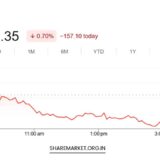
Share Market Crash: Sensex Falls 644 Points, Investors Lose Rs 2 Lakh Crore – May 22, 2025
Share Market Crash: Heavy Fall in Stock Market, Investors Lose ₹2 Lakh Crore, Sensex Closes Down by 644 Points
Indian Stock Market Overview – May 22: A Day of Massive Losses
On May 22, Indian stock markets experienced a dramatic fall, with the BSE Sensex and NSE Nifty witnessing heavy losses throughout the trading session.
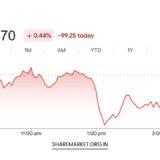
The Sensex plunged by a massive 644 points, closing at 80,951.99, while the Nifty dropped by 175.70 points, settling at 24,637.75.
This marked a day of significant turbulence for investors, with the total market capitalization plummeting by ₹2.09 lakh crore, reflecting the widespread fear and uncertainty in the market.
The scale of losses was not only felt by individual investors but also by institutional players, signaling a broad-based market correction.
During the session, the Sensex saw an intra-day decline of 1,100 points, adding to the volatility that gripped the markets. The sharp fall in the indices has shaken investor confidence, leading to widespread sell-offs in multiple sectors.
Market analysts have attributed this crash to a combination of global factors, including a surge in US bond yields and a general slump in international markets, which spilled over into the Indian market.
This global contagion has sparked concerns over a potential slowdown in economic growth, both in India and globally, pushing investors to reassess their positions in the stock market.
Global Cues and Their Impact on Indian Markets
The primary reason behind the market crash was a sharp increase in US bond yields, which triggered a wave of selling in global markets.
Higher yields often signal expectations of higher interest rates, which can dampen investment sentiment and increase borrowing costs, ultimately affecting the profitability of companies. This led to a pullback in equities, not just in India, but across emerging and developed markets alike.
The ripple effect of this global phenomenon hit Indian investors hard, who saw their portfolios take a beating in today’s session.
The US bond yield surge has been driven by concerns over inflationary pressures, along with the possibility of the US Federal Reserve raising interest rates further.
This has added a layer of uncertainty to global markets, creating a risk-off environment where investors are becoming increasingly cautious.
As a result, Indian markets, which had previously been riding on positive momentum, were unable to withstand the selling pressure caused by these external factors.
Key Sectors Hit Hard
In India, the hardest-hit sectors were IT, FMCGs, Oil & Gas, and Consumer Durables. These sectors have been key drivers of the Indian economy and stock market performance for several years, but on May 22, they experienced significant losses.
Companies in these sectors have faced headwinds due to global factors like rising input costs, supply chain disruptions, and shifting consumer demand.
- IT Sector: The IT sector, which has been a consistent performer in the Indian market, took a sharp hit as global markets reassessed the outlook for tech companies in light of rising interest rates. Stocks of major IT players like Tata Consultancy Services (TCS), Infosys, and Wipro saw sharp declines.
- FMCG Sector: The FMCG sector, which is usually considered a safe haven in times of market uncertainty, also saw declines. Rising raw material costs, combined with the global sell-off, weighed heavily on the stocks of leading FMCG companies like Hindustan Unilever, Dabur, and ITC.
- Oil & Gas: The Oil & Gas sector was impacted by fluctuating global oil prices and the rising cost of production, leading to a negative sentiment in stocks of companies like Reliance Industries and Indian Oil Corporation.
- Consumer Durables: The Consumer Durables sector also faced a downturn, with companies like Godrej Consumer Products and Asian Paints witnessing a drop in their stock prices. Consumer demand remains uncertain, and rising inflationary pressures have put a strain on the purchasing power of consumers.
In contrast, smallcap stocks managed to post a modest gain of 0.17%, bucking the trend seen in larger stocks. Smallcap companies are often considered more volatile, but today’s performance suggests that some investors may have viewed the dip as an opportunity to buy into companies with higher growth potential at attractive valuations.
However, the overall trend was overwhelmingly negative, and the smallcap sector’s performance couldn’t offset the heavy losses seen elsewhere in the market.
Market Performance at Close of Trading
As trading ended, the BSE Sensex closed at 80,951.99, down by 644.64 points or 0.79%. Meanwhile, the NSE Nifty closed at 24,637.75, reflecting a drop of 175.70 points or 0.71%.
These losses were felt across the board, with 27 out of the 30 Sensex stocks closing in the red. This broad-based decline highlights how the downturn was not limited to a few sectors but rather affected nearly every segment of the market, signaling a broader loss of investor confidence.
The crash was a reminder of the volatility that can occur in the stock market, particularly in the face of global macroeconomic changes.
While the Indian market has seen strong performance over the past few years, today’s decline underscores the sensitivity of equity markets to global economic events.
Investor Wealth Erosion: ₹2.09 Lakh Crore Lost
The most striking feature of today’s market crash was the sharp erosion of investor wealth. The total market capitalization of all companies listed on the BSE fell from ₹441.18 lakh crore on the previous day to ₹439.09 lakh crore, a decrease of ₹2.09 lakh crore.
This represents a 0.47% drop in the total market value, indicating that investors lost a significant amount of wealth in a single day of trading.
This loss in market capitalization is a stark reminder of how quickly market sentiment can change, and how investors can see their portfolios swing drastically in response to global economic shifts.
For retail investors who may not have the same access to information or resources as institutional players, such swings can be particularly painful.
Top Sensex Losers and Gainers
Among the 30 Sensex stocks, Mahindra & Mahindra (M&M) was the biggest loser of the day, shedding 2.59% of its value. Other notable decliners included Bajaj Finserve, Tech Mahindra, Power Grid, and ITC, which fell by 1.58% to 1.80%.
These stocks contributed heavily to the Sensex’s overall loss, reflecting the broad-based weakness in key sectors.
On the other hand, IndusInd Bank emerged as the top gainer among Sensex stocks, rising by 1.82%. Bharti Airtel and Ultratech Cement followed with modest gains of 0.44% and 0.10%, respectively. These gains, though small, were among the few positive signs in an otherwise dismal market.
Market Breadth: Over 2,000 Stocks Decline
The breadth of the market’s downturn was reflected in the number of stocks that closed lower. Out of 4,086 stocks traded on the BSE, 2,165 stocks ended in the red, signaling a widespread decline.
While 1,767 stocks saw gains, the number of decliners far outweighed the advancers. Additionally, 163 stocks closed flat, showing no movement in either direction.
Interestingly, despite the broader market slump, 82 stocks managed to reach new 52-week highs, while 34 stocks hit new 52-week lows.
This indicates that while most stocks were struggling, some individual companies were still able to perform well in the face of overall market challenges.
Market Prediction: What Lies Ahead for Investors?
Looking ahead, market analysts are urging caution. The global economic environment remains uncertain, with concerns about inflation, interest rates, and geopolitical tensions continuing to loom large.
For Indian investors, the key to navigating these turbulent times will be staying informed and avoiding knee-jerk reactions to daily market fluctuations.
As the market adjusts to rising bond yields and other global uncertainties, investors may want to focus on diversifying their portfolios and staying patient.
While the market may take some time to recover from this sharp decline, long-term investors who can ride out the volatility may ultimately benefit from the rebound once global conditions stabilize.
In conclusion, May 22 was a day of massive losses for Indian investors, with ₹2.09 lakh crore wiped off the market capitalization.
As global factors continue to drive market sentiment, investors must remain vigilant and prepared for continued volatility in the coming weeks.