Sensex Down 138 Points, Nifty at 24,812; Nifty Prediction for Tomorrow
Sensex and Nifty Close in the Red: What to Expect on June 19
On June 18, the Indian equity markets ended in the red, reflecting a cautious sentiment among investors. While both Sensex and Nifty faced slight declines, the broader market showed significant sectoral divergence.
Notably, Auto and Bank Nifty stocks bucked the downward trend, posting gains, while most other sectors closed lower, with IT, Media, Metal, Oil & Gas, and Realty stocks experiencing significant losses.
This divergence points to underlying market concerns, largely driven by global economic uncertainties and domestic macroeconomic conditions.
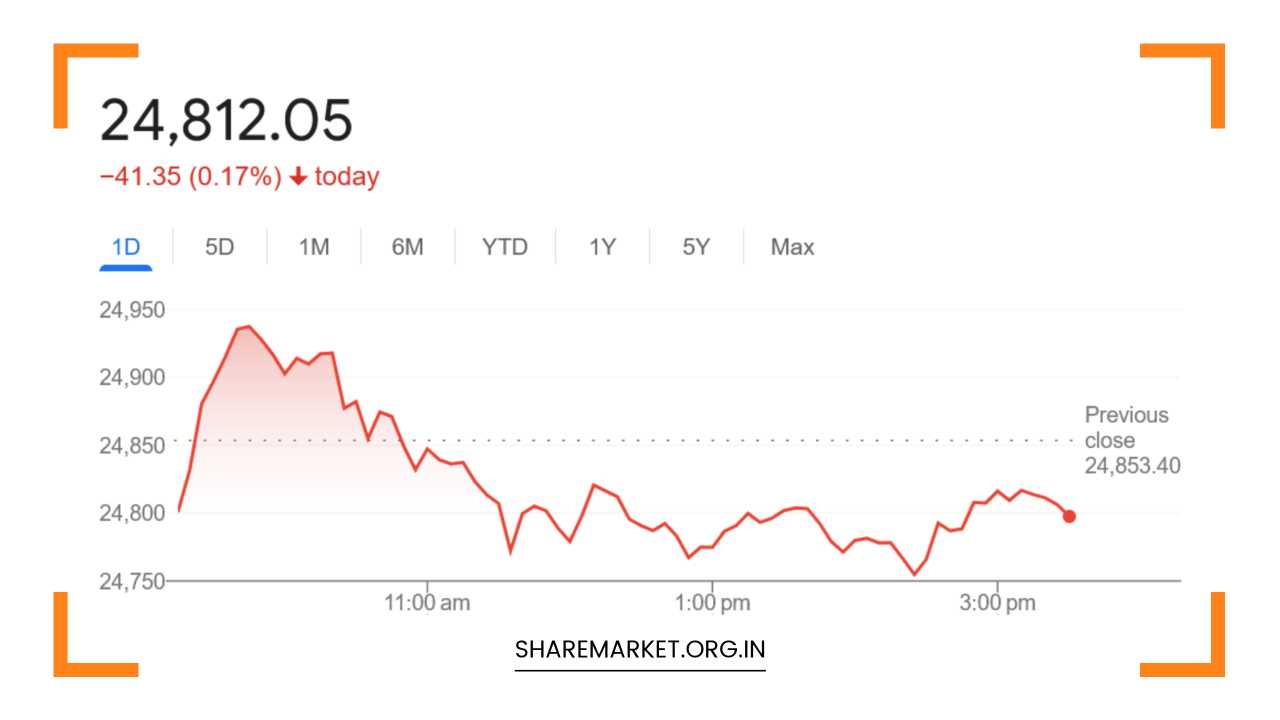
At the close of trading, Sensex stood at 81,444.66, marking a drop of 138.64 points or 0.17%. Meanwhile, Nifty ended the session at 24,812.05, down by 41.35 points or 0.17%.
The broader market exhibited weakness, with 2,342 stocks declining, 1,486 stocks advancing, and 131 stocks remaining unchanged.
This suggests that the selling pressure was more widespread than the buying interest, even as select stocks and sectors showed resilience.
Key Stock Movers: The Gainers and Losers
While the overall market ended lower, there were notable stock-specific movements. Among the biggest losers in the Nifty 50 index were prominent stocks like TCS, Adani Ports, JSW Steel, Hindustan Unilever (HUL), and Adani Enterprises.
These companies, which have been part of India’s major growth story over the past decade, faced pressure due to a mix of factors including concerns over demand and rising input costs, especially in the case of sectors like steel and technology.
The decline in TCS, which is one of the largest tech stocks in India, was especially noteworthy, signaling some caution in the IT sector.
On the other hand, some gainers managed to buck the trend. Stocks like IndusInd Bank, Trent, Titan Company, Maruti Suzuki, and Mahindra & Mahindra (M&M) recorded gains during the day, driven by various sector-specific developments.
IndusInd Bank, for instance, benefitted from positive momentum in the private banking space, while Titan and Trent showed resilience due to optimism in the consumer discretionary and retail sectors.
Maruti Suzuki and M&M, both auto giants, saw a boost on expectations of a demand recovery in the post-pandemic period.
Sectoral Performance: Divergence in Market Movements
A key highlight of June 18’s market session was the divergence in sectoral performance. Auto, Private Banks, and Consumer Durables were among the few sectors to buck the broader negative trend and close higher.
This suggests that there are still pockets of optimism in specific sectors, primarily driven by improving demand trends and positive earnings expectations.
The Auto sector, in particular, has shown resilience, with stocks like Maruti Suzuki and M&M outperforming the broader market.
This can be attributed to improving demand in both the domestic and export markets, along with positive developments in terms of new model launches and government policies that support the auto industry.
Similarly, Private Banks like IndusInd Bank and HDFC Bank showed strength amid a stable interest rate environment and increasing credit demand.
Consumer Durables stocks also managed to close higher, with Titan Company seeing a solid uptick due to positive consumer sentiment in the retail and luxury segments.
However, the overall market sentiment was marred by significant declines in several other key sectors.
The IT sector, which has been one of the strongest performers in recent years, faced a setback with stocks like TCS and Infosys falling sharply.
Rising global uncertainties, including potential tightening in the US, and demand concerns in key markets, such as the US and Europe, led to the fall.
Similarly, the Media, Metal, Oil & Gas, and Realty sectors also saw significant losses, with the sectoral indices falling between 0.5% to 1%.
The BSE Midcap and Smallcap indices also ended in the red, reflecting weakness across smaller stocks.
The midcap index, in particular, underperformed, as it lost more than the broader market, signaling a lack of confidence in smaller companies.
This underperformance in the mid-cap and small-cap segments is often seen as a cautionary sign, as institutional investors tend to stay away from riskier assets during uncertain times.
Market Sentiment: Global and Domestic Factors
The pullback in the Indian equity market on June 18 can be largely attributed to global economic uncertainties, particularly geopolitical tensions in the Middle East and volatility in oil prices.
Rising oil prices, driven by fears of supply disruptions and OPEC+ production cuts, have the potential to affect global growth and inflation, which in turn can impact Indian markets.
As a major importer of crude oil, India is particularly sensitive to fluctuations in global oil prices, which can have wide-reaching implications for inflation and trade balances.
Domestically, India’s macroeconomic fundamentals remain robust, with steady growth in key indicators like GDP, manufacturing, and consumption.
However, the global headwinds continue to affect investor confidence. According to Vinod Nair, Research Head at Geojit Investments, the domestic market failed to maintain its early momentum due to the ongoing global issues.
He pointed out that auto and consumer discretionary stocks saw a rebound, reflecting investor optimism regarding a potential demand recovery, particularly in rural and semi-urban areas.
Furthermore, Nair emphasized that, despite short-term challenges, India’s long-term market outlook remains positive, driven by strong domestic consumption, a young workforce, and stable macroeconomic conditions.
He suggested that investors should focus on quality large-cap stocks until the global uncertainties are resolved.
Expert Views: The Way Forward
Market expert Aditya Gaggar, Director at Progressive Shares, highlighted the index’s directionless nature on June 18. After a sluggish start, the index did recover initially but eventually lost all the gains, closing lower.
He noted that apart from Auto and Bank Nifty, the broader market struggled to maintain momentum. While small-cap stocks showed a similar movement to the index, the midcap segment lagged considerably, signaling investor reluctance to take on risk in uncertain times.
Looking ahead, Gaggar stated that Nifty’s immediate resistance is seen at the 25,000 level, while the support lies at 24,670.
The market is likely to face volatility, with key resistance at higher levels and support at lower levels.
Investors should remain vigilant and prepared for more volatility, with any break above 25,000 potentially signaling a return to bullish momentum. Conversely, a breach of the 24,670 support could lead to a deeper correction.
Technical Outlook for Nifty: What to Watch
The technical outlook for Nifty 50 suggests that the index remains in a range-bound zone, with immediate resistance at 25,000 and support at 24,670.
Until the market breaks out of this range, it is likely to remain volatile and directionless, reacting to both global and domestic factors.
If the support level of 24,670 is breached, traders could expect a further pullback, potentially testing lower levels.
In conclusion, the market is at a crossroads, influenced by global geopolitical tensions, domestic economic resilience, and the ongoing uncertainty around interest rates and inflation.
Investors are advised to remain cautious, focusing on high-quality stocks, particularly in sectors like auto, banking, and consumer durables, while keeping an eye on the global developments that could dictate the market’s next move.