Sensex Gain 63 Points, Nifty at 25,212; Nifty Prediction for Tomorrow
Stock Market Update: Flat Close – What to Expect on July 17th
The stock market closed in a narrow range today, signaling continued consolidation ahead of the Nifty’s weekly expiry.
Both the Sensex and Nifty ended the day flat, showing minimal movement, while the midcap and smallcap indices also closed in a similar pattern.
Despite the flat closing, some sectors managed to outperform the broader market, with gains seen in sectors like PSU banks, IT, and auto stocks.
In contrast, metal, pharma, and public sector enterprise (PSE) stocks faced some pressure, dragging down the overall sentiment.
As the market remains in a holding pattern, investors are looking for cues in the form of corporate earnings, global trade tensions, and broader economic indicators.
Key Market Data & Sector Performance:
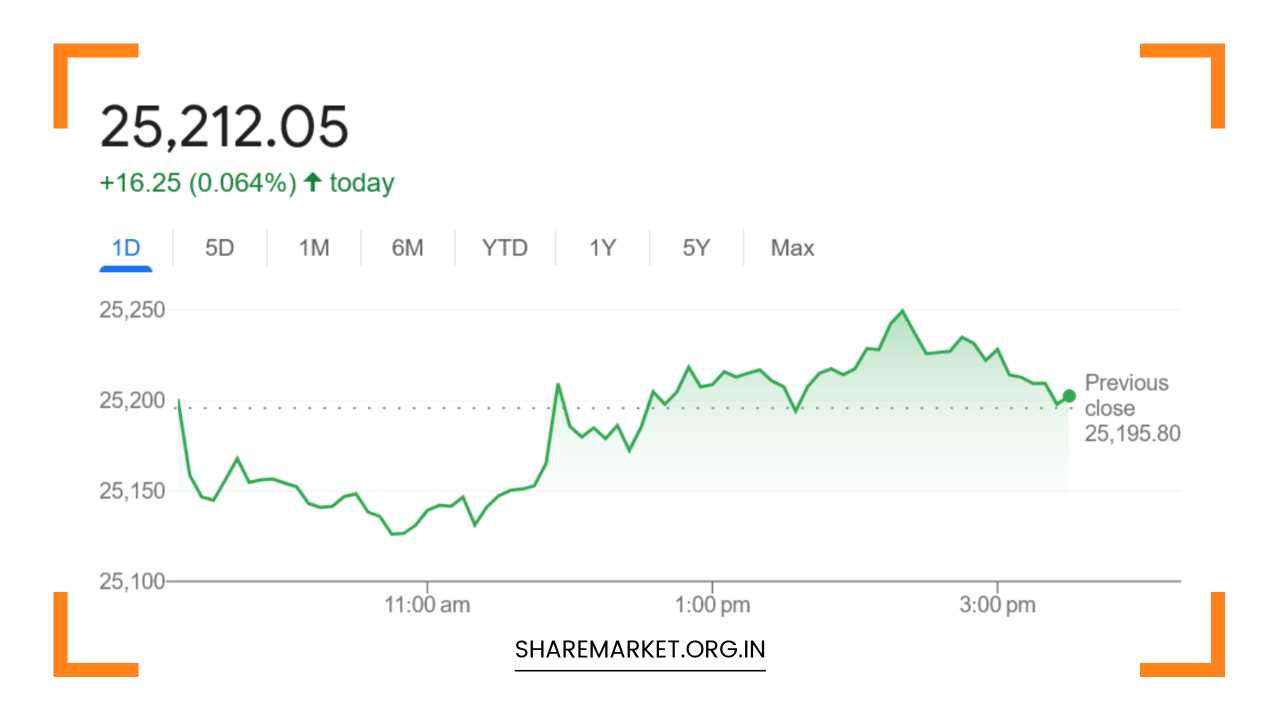
- Nifty: Closed up by 16 points at 25,212.
- Sensex: Ended 64 points higher at 82,634.
- Nifty Bank: Gained 162 points, closing at 57,159.
- Midcap Index: Closed 8 points higher at 59,621.
Despite these gains, the broader market sentiment remains mixed. While major indices showed a slight uptick, internal breadth was weaker:
- 29 out of 50 Nifty stocks saw a decline.
- 16 out of 30 Sensex stocks ended in the red.
- However, 8 out of 12 Nifty Bank stocks posted gains.
The divergence in sectoral performance highlights the ongoing rotation within the market. Investors are increasingly focusing on specific sectors that can outperform the broader market, while other sectors are being weighed down by external factors like global uncertainties and domestic economic challenges.
Macroeconomic Overview and Market Drivers:
Vinod Nair, Research Head at Geojit Investments, remains optimistic about India’s macroeconomic outlook. According to him, the market is being supported by a combination of positive factors including:
- Falling Inflation: India has experienced a steady decline in inflation over the last eight consecutive months, which has played a crucial role in boosting investor confidence.
- Low Interest Rates: The interest rate environment remains accommodative, allowing for easy access to capital and continued investment in the market.
- Favorable Monsoon: The ongoing monsoon season is expected to be strong, which bodes well for agriculture and allied sectors, further strengthening the economy.
- Softening Oil Prices: A drop in global oil prices provides relief for India, a major oil importer. This decline helps lower the country’s import bill, which in turn supports the rupee and eases inflationary pressures.
Despite these positive tailwinds, corporate earnings for the first quarter of FY 2026 are now the main point of focus for investors.
The market is currently trading at premium valuations, and earnings growth will be a critical factor in determining whether the market can sustain these levels or if a correction is due.
Global Sentiment and Tariff Concerns:
On the global front, market sentiment is decidedly mixed. Trade and tariff concerns remain a significant risk, particularly following the recent announcement of a 50% tariff on copper.
This move has caused concerns about the broader implications for global trade and has added to uncertainty in commodity markets.
Additionally, while the global economy is stabilizing, the ongoing US-China trade tensions continue to weigh on investor sentiment.
In the U.S., hopes of an interest rate cut by the Federal Reserve have begun to fade. The softening of inflation, which was initially expected to prompt a more dovish stance from the Fed, has led to growing uncertainty.
While many investors were anticipating an interest rate cut in the near future, the fading likelihood of this event could further complicate market dynamics, especially for emerging markets like India.
Technical Analysis: Key Levels to Watch:
VK Vijayakumar, an analyst from Geojit Investments, pointed out that the Nifty has been oscillating within a limited range for the past two months.
According to him, a positive catalyst is required for the Nifty to break out of this range and move past the upper band of 25,500.
This range-bound movement has kept the market in a state of consolidation, with investors keenly watching for any signals that might trigger a directional move.
From a technical standpoint, the market is at a crossroads. Hardik Matalia, a derivative analyst at Choice Equity Broking, provided an insightful analysis of the Nifty’s key support and resistance levels:
- Support at 25,000: This psychological level has now become a crucial support point for the Nifty. If the index falls below this level, it could open the door for further downside, potentially testing levels around 24,700.
- Immediate Resistance at 25,200: On the upside, 25,200 is the immediate resistance that the Nifty needs to break through in order to gain momentum.
- Critical Resistance Zone (25,378 – 25,500): Beyond this point, a major resistance zone exists between 25,378 and 25,500. For the market to break free from its consolidation phase, it would need to decisively breach this zone.
According to Matalia, a breakout above this range would likely set the stage for a new upward momentum, as the market would be able to clear the overhead resistance and create space for further upside movement.
However, until that happens, the market may continue to trade within this tight range, with caution prevailing.
Market Prediction for July 17:
Looking ahead to July 17, the market is expected to remain in its consolidation phase, with investors awaiting more concrete triggers for direction.
Corporate earnings will remain a major focus, as Q1 FY 2026 results could either support or challenge the current bullish outlook. A
dditionally, developments related to global tariff concerns and any signals from the U.S. Federal Reserve regarding interest rates will likely keep the market in a state of flux.
On the technical side, the market is at a critical juncture. A breakout above 25,500 would be a bullish signal, but a failure to move past key resistance levels could result in further consolidation or even a pullback.
In the meantime, sectoral rotations are expected to continue, with sectors like IT, auto, and PSU banks likely to lead the charge while others like metal and pharma may face continued headwinds.
Final Thoughts:
In conclusion, the market remains in a wait-and-watch mode as investors balance macroeconomic factors, earnings expectations, and geopolitical risks.
While India’s economic fundamentals appear strong, global uncertainties and valuation concerns are likely to keep the market in a range-bound phase for now.
Investors should keep an eye on key support and resistance levels, as well as the unfolding corporate earnings season to gauge the market’s next move.
The coming days could bring either a breakout or a pullback, depending on how these factors evolve. As always, caution and patience will be key in navigating the current market environment.