Sensex Gain 539 Points, Nifty at 25,219; Nifty Prediction for Tomorrow

Market Update: Positive Close and Market Prediction for July 24
The stock market wrapped up today’s session with impressive gains, reflecting a positive sentiment driven by strong global cues and easing trade tensions.
As the market continues to show resilience, it’s crucial to assess what factors are contributing to the current upward momentum and what lies ahead for July 24 and beyond.
With trade negotiations progressing and investor sentiment lifting, the outlook remains cautiously optimistic, though expensive valuations are an ongoing concern.
Key Global Developments Impacting Market Sentiment
One of the primary drivers of today’s market rally is the progress made in global trade talks. Investors have welcomed the recent announcement of a trade agreement between the United States and Japan.
This deal, designed to enhance economic cooperation between the two nations, is expected to reduce trade tensions and contribute to broader market stability.
The positive reception of the agreement has been reflected in global stock markets, providing an additional boost to investor confidence.
Beyond the US-Japan deal, there are also encouraging signs on the horizon with respect to the India-UK free trade agreement.
As both countries work towards finalizing this deal, expectations are rising that it could bring long-term economic benefits, especially in areas like trade, investments, and technology.
The developments on these fronts have contributed to a more favorable global sentiment, which has, in turn, positively impacted domestic markets.
Domestic Market Performance: Sensex, Nifty, and Sectoral Insights
Today, the Indian stock market performed strongly, supported by these global tailwinds. Both the Sensex and Nifty indices ended the session with significant gains.
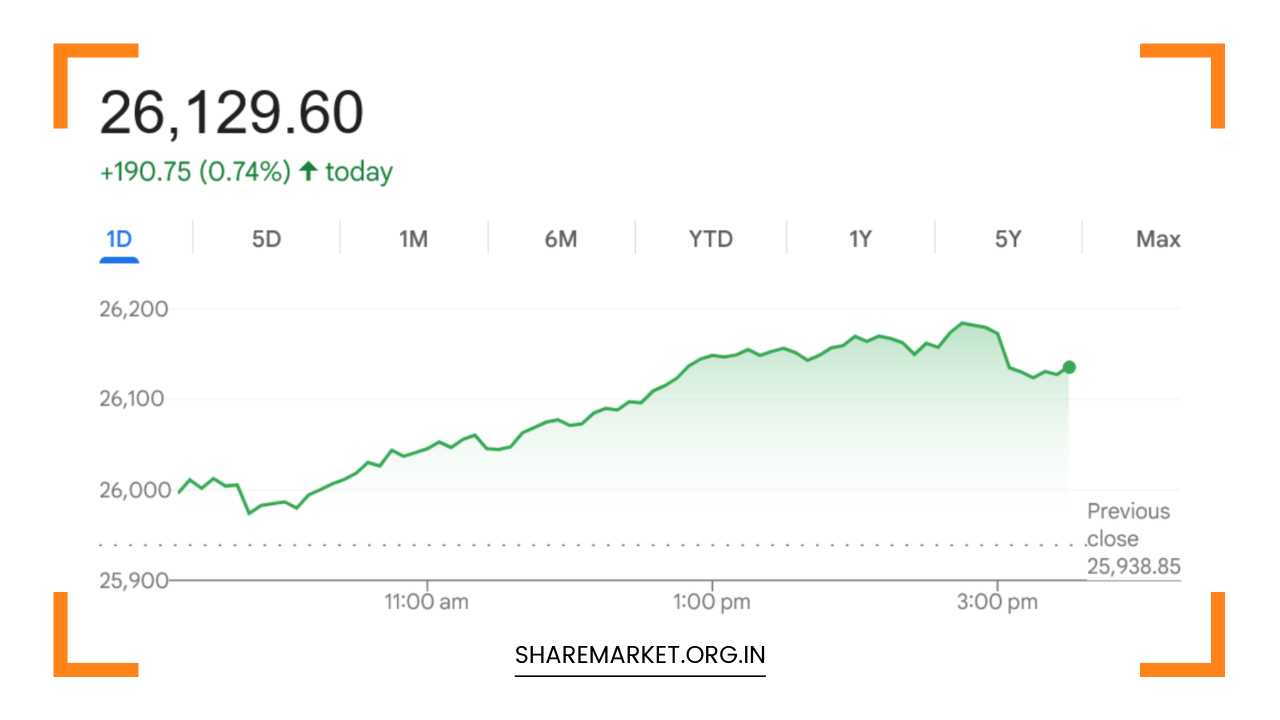
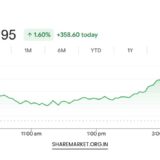
The Sensex closed 540 points higher at 82,727, while the Nifty rose by 159 points to 25,220. The Nifty Bank index was particularly strong, closing up by 454 points at 57,210.
The Midcap index also posted a solid gain of 204 points, finishing at 59,307, indicating broad-based strength across various sectors.
The buying interest was predominantly seen in the pharma, auto, and banking sectors, with investors flocking to stocks in these industries due to their potential for solid earnings growth.
The pharma sector benefited from positive news regarding increased demand for healthcare products globally, while the auto and banking stocks rallied on the back of favorable macroeconomic factors and stable interest rates.
However, not all sectors shared in the market’s upward movement. The real estate and FMCG (Fast-Moving Consumer Goods) stocks faced some selling pressure, reflecting ongoing concerns in these sectors.
Real estate, in particular, has been grappling with rising input costs and tighter liquidity conditions, while FMCG companies are facing margin pressures due to inflationary headwinds.
Despite these sector-specific challenges, the broader market’s performance has been overwhelmingly positive.
A total of 22 out of the 30 Sensex stocks ended the day higher, and 38 out of the 50 Nifty stocks saw gains. The banking sector showed impressive strength, with 11 out of the 12 Nifty Bank stocks posting gains.
On the currency front, the Indian Rupee closed 4 paise weaker at ₹86.41 per dollar, indicating some pressure on the currency despite the overall upbeat market sentiment.
The rupee’s depreciation could be a reflection of global economic uncertainties, as well as local factors such as high inflation and rising interest rates.
Technical Analysis: Nifty’s Immediate and Long-Term Outlook
The technical indicators suggest that the market could see a continuation of the upward trend, but with a few potential hurdles along the way.
Anand James, Chief Market Strategist at Geojit Financial Services, highlighted that while the market saw gains today, Nifty’s path may not be completely smooth.
The 10-day Simple Moving Average (SMA) had earlier signaled a decline, but the 50-day SMA acted as a strong support level, halting further downward movement. This combination of moving averages raises expectations for a potential rise in the near term.
James suggests that Nifty could target 25,215 in the short term, with the next resistance level at 25,400.
However, the ultimate direction of the market will depend heavily on how the descending broadening wedge pattern unfolds.
A broadening wedge typically suggests increasing volatility, and its formation could either lead to further upward movement or a correction.
Looking at longer-term technical indicators, the 200-day SMA is located around the 24,000 level, acting as a critical support zone. Intermediate support levels for Nifty are at 24,800 and 24,450, and a breakdown below these levels could signal a correction.
Traders and investors will be closely monitoring these levels, as they could indicate whether the current bullish trend is sustainable or if a pullback is on the horizon.
Earnings Expectations and Market Fundamentals
While technicals paint a generally positive picture, the broader market fundamentals remain a topic of discussion.
Vinod Nair, Head of Research at Geojit Investments, pointed out that despite a mixed start to FY 2026, Indian stocks are showing notable strength.
He attributed this resilience to positive global sentiment, particularly from the US-Japan trade deal, which has helped improve investor outlook globally, including in India.
Additionally, the potential India-UK free trade agreement is likely to play a pivotal role in fostering long-term growth.
However, despite the optimism, the issue of expensive valuations remains a significant concern. The Indian stock market has been trading at relatively high price-to-earnings (P/E) multiples, which means that while earnings growth expectations are high, any disappointment in corporate results could lead to heightened volatility.
Investors will need to carefully assess corporate earnings reports and global economic developments, as these will ultimately determine whether the market can sustain its current momentum.
The current strength of the market suggests that companies could see improved earnings in the coming quarters.
However, the pace of this improvement, as well as the strength of global trade and economic recovery, will be crucial in shaping the market’s future trajectory.
If corporate earnings grow in line with expectations, the market could continue to climb, but any setbacks in earnings growth or global trade talks could result in downward pressure.
Final Thoughts: What Lies Ahead?
The outlook for the market in the short term remains positive, driven by favorable global developments, including the US-Japan trade deal and the India-UK free trade agreement.
These factors, combined with strong sectoral performances, particularly in banking and pharma, suggest that the market could continue to climb in the coming days.
However, the high valuation levels and the need for strong corporate earnings growth remain critical factors to watch.
If the market manages to sustain its momentum, Nifty could continue to test resistance levels at 25,215 and 25,400.
Conversely, any setbacks in global trade negotiations, corporate earnings, or economic conditions could lead to a correction.
Traders and investors alike will need to stay vigilant, watching both technical indicators and the broader macroeconomic environment, to navigate the evolving landscape in the second half of July.