Sensex Down 721 Points, Nifty at 24,837; Nifty Prediction for Monday
Markets Close on a Weak Note: What to Expect on July 28
Indian equity markets ended the final trading session of the week on a somber note, reflecting intensified selling pressure across most sectors.
Major indices like the Sensex and Nifty recorded sharp losses as investor sentiment turned cautious amid persistent foreign selling, disappointing earnings, and global uncertainty.
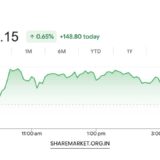
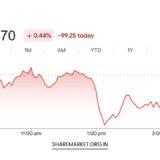
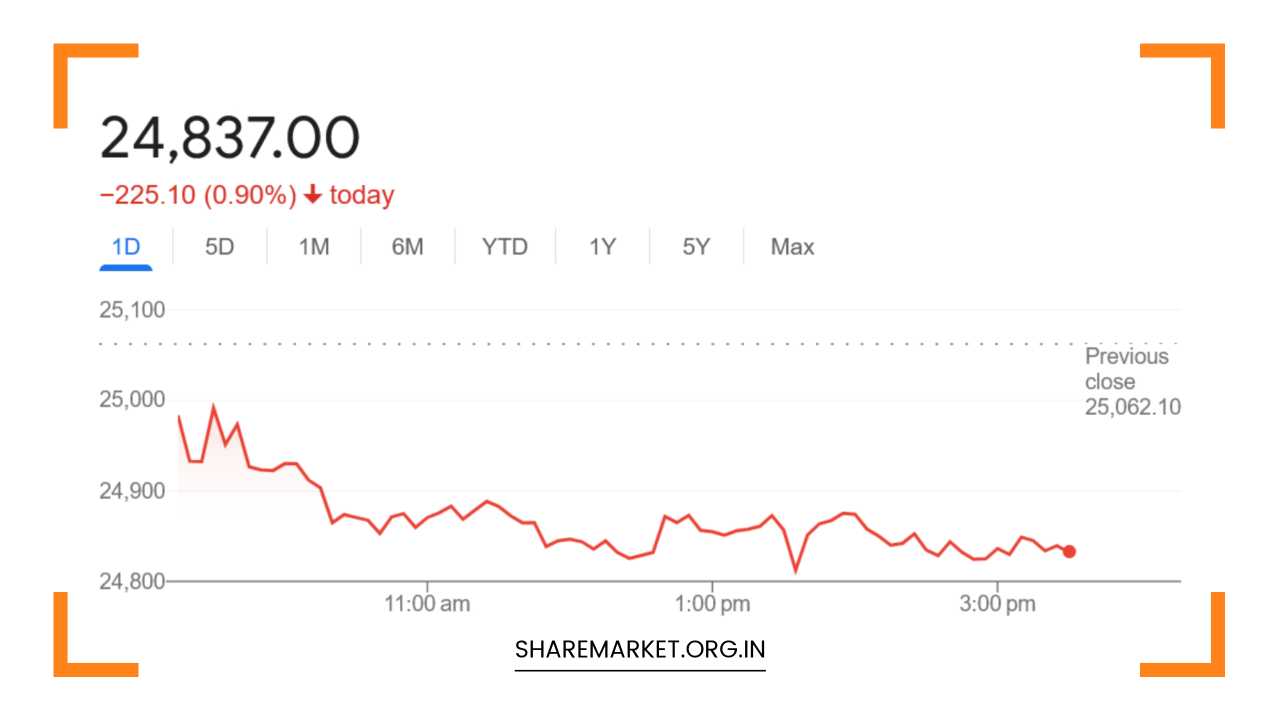
On Friday, July 25, the Sensex fell 721 points, or 0.88%, to close at 81,463, while the Nifty 50 dropped 225 points to settle at 24,837.
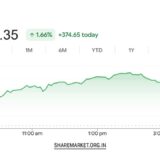
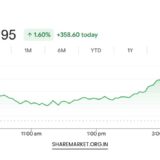
The broader market suffered even more, with the Nifty Midcap index declining by 951 points to close at 58,009, highlighting the intense pressure on mid- and small-cap stocks.
Market Breadth Turns Deeply Negative
Market breadth was heavily skewed toward sellers:
- 29 of 30 Sensex stocks ended in the red
- 43 of 50 Nifty stocks saw losses
- All 12 components of the Nifty Bank index declined
This broad-based weakness reflected rising uncertainty among institutional and retail participants alike. Selling pressure was widespread, cutting across sectors such as banking, FMCG, IT, energy, and metals.
Sectoral Performance: Pharma the Lone Gainer
On the sectoral front, most major indices ended lower:
- PSE, Oil & Gas, and Metal indices witnessed notable losses.
- IT and FMCG stocks were also under pressure, reflecting concerns about valuations and near-term growth prospects.
- Banking stocks, both public and private, continued to struggle amid FII outflows and lackluster earnings.
- Pharma stocks, however, offered a rare bright spot, with the sector index ending marginally higher, suggesting some defensive buying.
Key Reasons Behind the Market Decline
1. FII Selling Pressures
One of the biggest drivers of the current market weakness is the sustained selling by Foreign Institutional Investors (FIIs).
According to market data, FIIs have been continuously offloading equities over valuation concerns and global risk aversion.
Santosh Meena, Head of Research at Swastika Investmart, noted, “The main reason for today’s decline is the persistent sell-off by FIIs in both the equity and derivatives (F&O) markets. Despite improvements in domestic macroeconomic indicators, foreign investors remain wary due to stretched valuations.”
2. Global Caution and Trade Uncertainty
Global market sentiment has also turned cautious due to geopolitical tensions and uncertainty over the ongoing trade agreement deadlock between the US and India.
Investors are staying on the sidelines, awaiting clarity on international trade relations that could impact key export-driven sectors.
3. Earnings Season Fails to Impress
The ongoing quarterly earnings season has delivered mixed results. While some companies have met or exceeded expectations, a significant number have issued conservative guidance or underwhelmed on key performance metrics.
Ajit Mishra, SVP of Technical Research at Religare Broking, said, “The recent decline reflects disappointment with corporate results and growing concerns over cautious commentary by managements. This has weakened investor confidence further.”
4. Domestic Revaluation and Macro Watch
Bhavik Joshi, Business Head at INVasset PMS, emphasized that the sell-off is more of a recalibration than a sign of panic.
“Today’s market decline stems from domestic revaluation and global caution rather than structural weakness. Investors are looking for direction—clear signs from macroeconomic data and earnings to decide the way forward.”
Technical View: Key Levels to Watch
From a technical analysis standpoint, the Nifty’s breakdown below the 24,900 level is a bearish signal.
According to analysts, the index now faces stiff resistance and limited immediate upside unless key levels are reclaimed.
Key Technical Levels:
- Immediate support: 24,700
- Major support zone: 24,450–24,550
- Upside resistance: 25,150
- Breakout level for bounce: 25,255–25,350
Srikant Chauhan, Head of Equity Research at Kotak Securities, explained, “Since the Nifty has broken below the 24,900 level, the market could trend down toward 24,800 or even 24,550 in the near term.
However, if we see a close above 25,150, a bounce toward 25,350 cannot be ruled out.”
Technical experts caution traders against making fresh long positions unless the index breaks above the immediate resistance.
Instead, they advise watching for a retest of lower support levels and being prepared for further consolidation or correction.
What to Expect on July 28
Heading into the next trading session on Monday, July 28, markets are likely to remain volatile. Key factors that could influence movement include:
1. Global Cues
Overseas markets, particularly the US and Asia, will be critical to watch. Investors should monitor developments in the US-India trade talks and global interest rate commentary for signs of risk appetite returning.
2. Corporate Earnings
More corporate results are due in the coming week. Strong numbers from heavyweight sectors like banking, IT, and consumer goods could provide temporary relief, while weaker results could add to the current pressure.
3. Macroeconomic Indicators
Markets will also be looking for clarity from upcoming macroeconomic releases such as inflation data, fiscal deficit numbers, and potential GDP revisions. These indicators will influence both domestic investor sentiment and foreign capital flows.
4. FII/DII Activity
The tug-of-war between FIIs and Domestic Institutional Investors (DIIs) will continue to play a pivotal role. Sustained FII outflows could keep sentiment muted, but strong DII buying may help cushion deeper falls.
Investor and Trader Strategy
Given the prevailing uncertainty and bearish undertone:
- Traders should be cautious and avoid aggressive long positions unless key resistance levels are taken out.
- Positional investors should focus on fundamentally strong companies and avoid averaging down in declining trades.
- Short-term strategies may include tight stop losses and capital preservation as volatility remains high.
- Long-term investors may find opportunities during deeper corrections, but must be selective and patient.
Final Thoughts
The market’s latest pullback appears to be a combination of valuation concerns, external uncertainty, and earnings-related disappointment.
However, experts suggest there’s no sign of structural weakness. The coming sessions, especially July 28, could offer further clarity on whether this is a deeper correction or a healthy consolidation.
Until then, caution is warranted, with a close eye on global cues, earnings performance, and key technical levels.