Sensex Down 296 Points, Nifty at 24,768; Nifty Prediction for Tomorrow
Indian Markets Decline as US Tariffs Spark Investor Caution and Volatility
July 31, 2025 – Indian equity markets extended losses for the second straight session on Wednesday, weighed down by renewed global trade tensions after the United States announced fresh tariffs and penalties on select Indian goods.
The development unsettled investor sentiment, triggering a volatile trading session that ended with both key indices in negative territory.
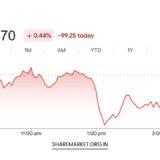
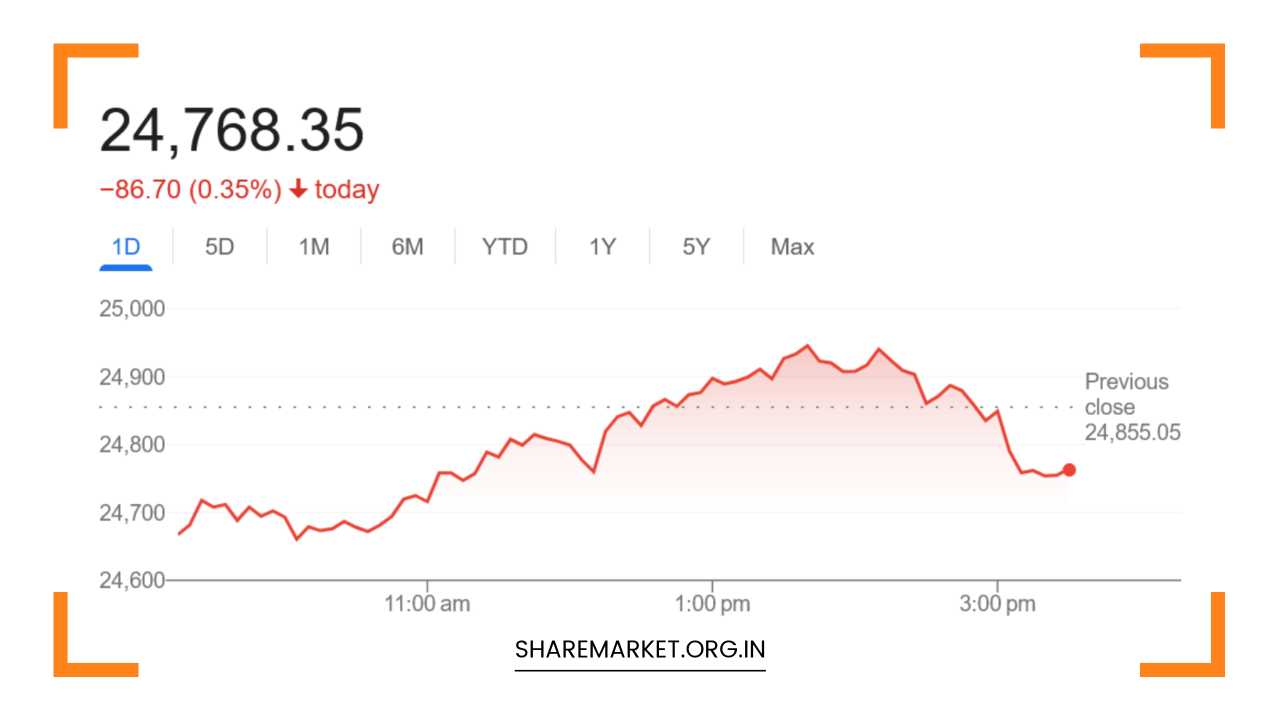
The Nifty 50 index shed 86.70 points, or 0.35%, to close at 24,768.35, while the BSE Sensex fell 296.28 points, or 0.36%, to end the session at 81,185.58.
The broader market also mirrored the weak trend, with 2,365 stocks declining, 1,490 advancing, and 135 remaining unchanged on the Bombay Stock Exchange.
Volatile Session on Derivatives Expiry Day
Wednesday’s trading session was marked by heightened volatility due to the monthly F&O (futures and options) expiry, which was further amplified by the unexpected U.S. trade announcement.
The market opened on a weak note following news of the tariffs but briefly turned positive during mid-session as large-cap stocks across sectors attempted a recovery.
However, the rebound proved short-lived, and selling pressure resumed in the final hours of trade, pushing the indices back into the red.
Sectoral Performance: Defensive Buying in FMCG, Pressure on Export-Linked Sectors
On the sectoral front, FMCG stocks were the day’s standout performers, gaining 1.4% on defensive buying amid uncertainty. In contrast, sectors with higher international exposure bore the brunt of the sell-off.
- Information Technology (IT), Metals, Oil & Gas, Public Sector Banks (PSU Banks), Pharmaceuticals, Real Estate, and Telecom sectors fell between 0.5% and 1.8%.
- Midcap and Smallcap indices underperformed, both declining 0.7%, reflecting broader risk aversion among investors.
Key Gainers and Losers
Among the Nifty 50 constituents:
- Top Gainers: Hindustan Unilever (HUL), Jio Financial Services, Eternal, JSW Steel, and ITC posted gains, supported by their relatively low exposure to global trade risks and stronger domestic demand outlook.
- Top Losers: Adani Enterprises, Dr. Reddy’s Laboratories, Adani Ports, Tata Steel, and Sun Pharma were among the worst performers, hurt by their sensitivity to global trade dynamics and export dependence.
US Tariffs Disrupt Market Sentiment
The sudden announcement by the U.S. President of increased tariffs and penalties on Indian goods sent shockwaves through global and domestic markets.
The move, seen as a geopolitical and economic maneuver ahead of upcoming U.S. elections, has led to fresh uncertainty over the stability of India-U.S. trade relations.
Utsav Verma, Head of Research at Choice Institutional Equities, emphasized that investor sentiment is now entering a recalibration phase:
“After the imposition of tariffs and penalties on Indian exports, investors are expected to reassess their allocation strategies. While there is caution in the short term, many are holding on to hope that upcoming trade dialogues could ease tensions. Portfolio rebalancing toward domestic-facing sectors may become more pronounced.”
Caution Among FPIs and Sector Rotation Expected
Foreign Portfolio Investors (FPIs), who have been net sellers in recent sessions, are now expected to tread carefully until there is clarity on the trade front.
The risk of prolonged negotiations or retaliatory measures could lead to further outflows from export-linked stocks.
Waqar Javed Khan, CFA and Senior Fundamental Analyst at Angel One, said:
“Export-oriented companies may underperform in the near term. FPIs are likely to adopt a cautious approach and may shift allocations toward domestic plays until the outlook on trade improves. Sector rotation into more insulated sectors like infrastructure, banking, and consumption is probable.”
Khan also pointed out that while Indian equities have shown resilience in the face of global headwinds in the past, the current situation adds a new layer of complexity:
“With weak global cues and policy uncertainty, investors may prefer companies that derive the bulk of their revenues from the domestic economy. It’s a tactical shift that could persist if trade tensions linger.”
Possibility of Indian Retaliation Raises Stakes
Concerns over a potential tit-for-tat response from India have added to market nervousness. While India has yet to announce any countermeasures, speculation is rife that sectors like U.S. agri imports, dairy products, and even defense contracts may be in the spotlight.
Amnish Agarwal, Head of Research at PL Capital, echoed these concerns:
“We cannot rule out the possibility of retaliatory measures from India, especially given the complex issues at play in the agri, dairy, and defense sectors. The path to a trade resolution appears difficult, and that could keep markets in a volatile range for the foreseeable future.”
He added that stocks with high export dependency—especially to the U.S.—may continue to face selling pressure. However, he remains constructive on sectors aligned with domestic demand:
“Even though the ongoing earnings season hasn’t shown broad-based improvement in domestic demand, expectations of a pickup during the festive period could trigger selective buying. Sectors like consumer staples, hospitals, capital goods, asset management companies (AMCs), and private banks may act as defensives in this uncertain phase.”
Festive Demand, Policy Support Could Provide Tailwinds
Despite current headwinds, analysts see some silver linings. The upcoming festive season may revive consumer sentiment and spending, while the Indian government’s continued focus on infrastructure, manufacturing, and rural development could provide structural support to the economy.
Market participants also anticipate that the Reserve Bank of India (RBI) will continue to monitor global developments closely, and any worsening in external conditions may prompt the central bank to take a more accommodative stance.
Outlook: Volatility Ahead, Focus Shifts to Domestic Themes
As trade tensions with the U.S. dominate headlines and monthly F&O expiry adds to short-term volatility, Indian markets are likely to remain on edge in the coming sessions.
Investors are expected to favor a bottom-up stock-picking approach with an emphasis on companies linked to domestic demand and policy tailwinds.
While global uncertainties persist, India’s long-term structural story remains intact. The near-term focus, however, will be on managing risk, navigating volatility, and watching trade developments unfold.