Sensex Gain 150 Points, Nifty at 24,734; Nifty Prediction for Tomorrow
Markets Close Marginally Higher Amid Profit Booking; GST Reforms & Global Cues to Guide Trend on September 5
Despite a strong opening on September 4, Indian equity benchmarks ended the session with only marginal gains as profit-booking emerged at higher levels.
While the Sensex and Nifty managed to close in the green, the broader market and sectoral indices reflected weakness, suggesting an undercurrent of caution among investors.
Analysts attribute the mixed market sentiment to short-term consolidation, ongoing global uncertainties, and sector rotation ahead of key economic reforms.
Key Indices Snapshot – September 4
- BSE Sensex: ▲ 150 points | Closed at 80,718
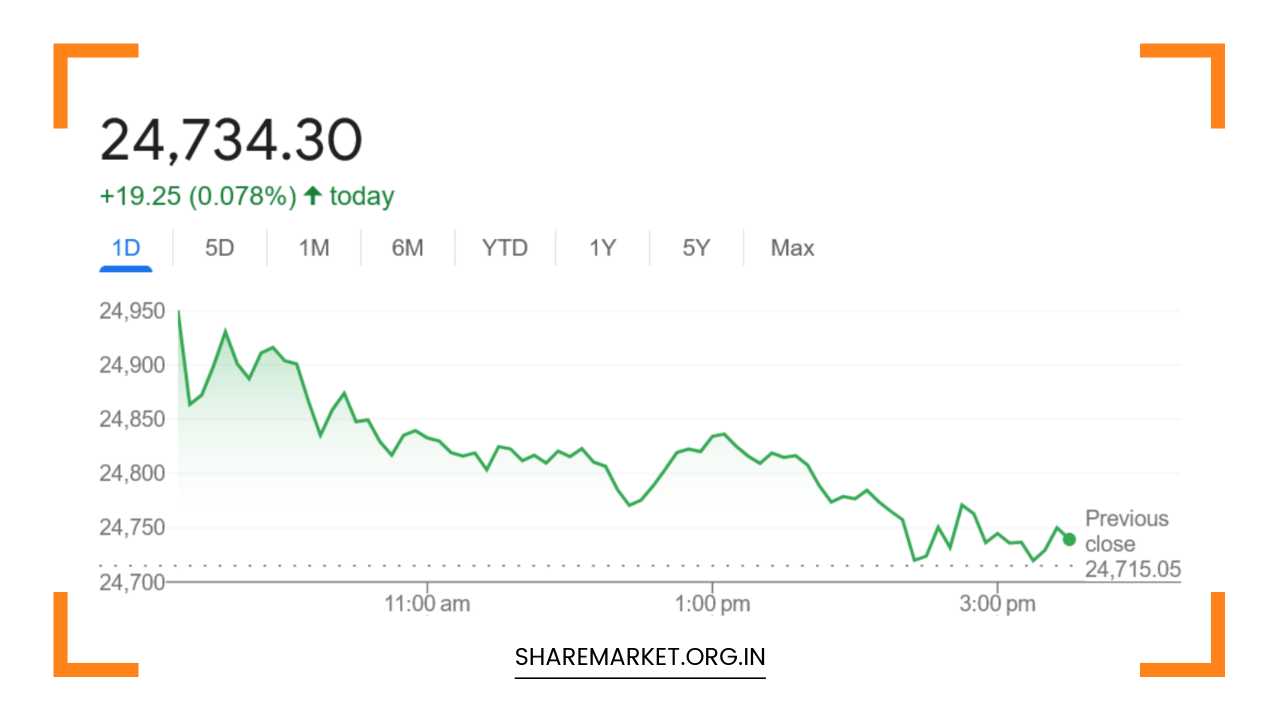
- NSE Nifty 50: ▲ 19 points | Closed at 24,734
- Nifty Bank: ▲ 8 points | Closed at 54,075
- Nifty Midcap 100: ▼ 386 points | Closed at 56,959
- Rupee: ▼ 8 paise | Closed at ₹88.15 against the US Dollar
Although the frontline indices posted modest gains, they slipped significantly from their intraday highs, underscoring the impact of profit-booking across key sectors.
The rupee also weakened against the dollar, reflecting pressure from a stronger greenback and concerns over crude oil prices.
Market Breadth and Sectoral Performance
The headline index movement belied the broader market weakness:
- 31 of 50 Nifty stocks ended in the red
- 19 of 30 Sensex constituents declined
- 9 of 12 Nifty Bank stocks also saw selling pressure
The selling was broad-based and impacted several sectors:
Sectors in Decline
- Information Technology (IT): Dragged down by weak global cues and a stronger rupee-dollar pair.
- Realty: Investors booked profits after recent gains.
- Metals & Energy: Impacted by global demand uncertainty and softening commodity prices.
- Public Sector Enterprises (PSEs) and Defense: Witnessed selling despite long-term bullish outlook.
Sectors in Gains
- Auto and FMCG sectors emerged as relative outperformers, supported by expectations of a pickup in consumption ahead of the festive season, boosted by the proposed GST reforms.
GST Reform – A Key Structural Trigger
The government’s proposed GST 2.0 reform is being viewed as a potential game-changer by market participants.
The reform aims to simplify the indirect tax regime by merging the current 12% and 28% slabs into broader 5% and 18% categories.
This restructuring is expected to benefit both consumers and businesses by streamlining compliance and reducing ambiguity.
Analyst Views on GST 2.0
Ajit Mishra – Religare Broking
According to Mishra, the GST revamp increases the potential for consumption-led growth, particularly in segments like automobiles, consumer goods, and rural infrastructure. He points out that while the reform is positive, its success hinges on:
- Timely implementation
- The ability of companies to pass on tax benefits to consumers
- Broader macroeconomic stability
Mishra also cautions that global factors, especially the stance of foreign institutional investors (FIIs) and geopolitical developments, will continue to influence sentiment in the near term.
He advises focusing on theme-based, fundamentally sound stocks with favorable risk-reward profiles, especially in a potentially consolidating market.
V.K. Vijayakumar – Geojit Financial Services
Vijayakumar sees the reform as a catalyst that can amplify India’s growth trajectory. He believes that India’s economy, already showing resilience, can get a further push from enhanced consumer spending and corporate earnings growth.
“This reform, combined with earlier fiscal and monetary incentives, could trigger a new cycle of economic expansion,” he said.
He projects India’s GDP growth at 6.5% in FY26, potentially rising to 7% in FY27, assuming stable macroeconomic conditions and corporate profitability.
Santosh Meena – Swastika Investmart
Meena echoed similar optimism, stating that the proposed GST changes will likely boost demand ahead of the festive season. He highlights the potential benefits to:
- Consumer durables
- Automobile
- FMCG sectors
However, he also cautions that stocks in these sectors have already seen significant gains, suggesting that much of the near-term upside may already be priced in.
Currency & Global Watch
The Indian rupee weakened by 8 paise to close at ₹88.15 against the US dollar, weighed down by:
- Stronger dollar index
- Mixed cues from crude oil prices
- Cautious sentiment in emerging markets
Globally, markets remain on edge due to:
- Continued US-China tariff tensions
- Expectations around the US Federal Reserve’s interest rate policy
- Mixed data from global manufacturing and services sectors
These global macro conditions are likely to remain a key overhang in the short term, influencing both FII flows and overall risk appetite.
Technical View: Nifty Near Key Resistance
From a technical standpoint, the Nifty has been showing signs of forming a double bottom pattern in the 24,350–24,500 range—a bullish reversal signal if confirmed.
- Immediate Resistance: 24,770
- Breakout Target: 25,000
- Support Levels: 24,500 and 24,350
A sustained move above 24,770 could lead to a breakout rally toward the psychological 25,000 level.
If this level is breached on a closing basis, it may signal the start of a fresh uptrend. Conversely, a failure to hold above 24,500 could trigger further consolidation or correction.
What to Watch on September 5
Key Triggers for the Next Session:
- Global market cues and US economic data
- FII and DII trading activity
- Rupee movement and crude oil trends
- Updates or announcements related to GST reforms
- Technical breakout or breakdown near the Nifty’s key levels
Trading Strategy
- Bullish bias if Nifty sustains above 24,770
- Cautious approach in midcap and smallcap stocks due to higher volatility
- Prefer consumption-focused sectors (Auto, FMCG, Consumer Durables)
- Avoid sectors under near-term pressure (IT, Metals, Realty) unless strong earnings or guidance emerge
Conclusion
The market’s mild uptick on September 4 masked the underlying cautious sentiment as investors digested the implications of proposed GST reforms amid global uncertainties.
While the broader structure remains bullish, near-term consolidation cannot be ruled out. Going forward, the market will look for cues from both domestic reforms and international developments, especially around tariffs and monetary policy.
Traders and investors would do well to stay selective, focusing on theme-driven opportunities and technically strong setups, while keeping a close eye on macro signals and global sentiment as we head into September 5.