Sensex Down 555 Points, Nifty at 24,890; Tomorrow Nifty Prediction
Markets Decline for Fifth Straight Session – What to Expect on September 26
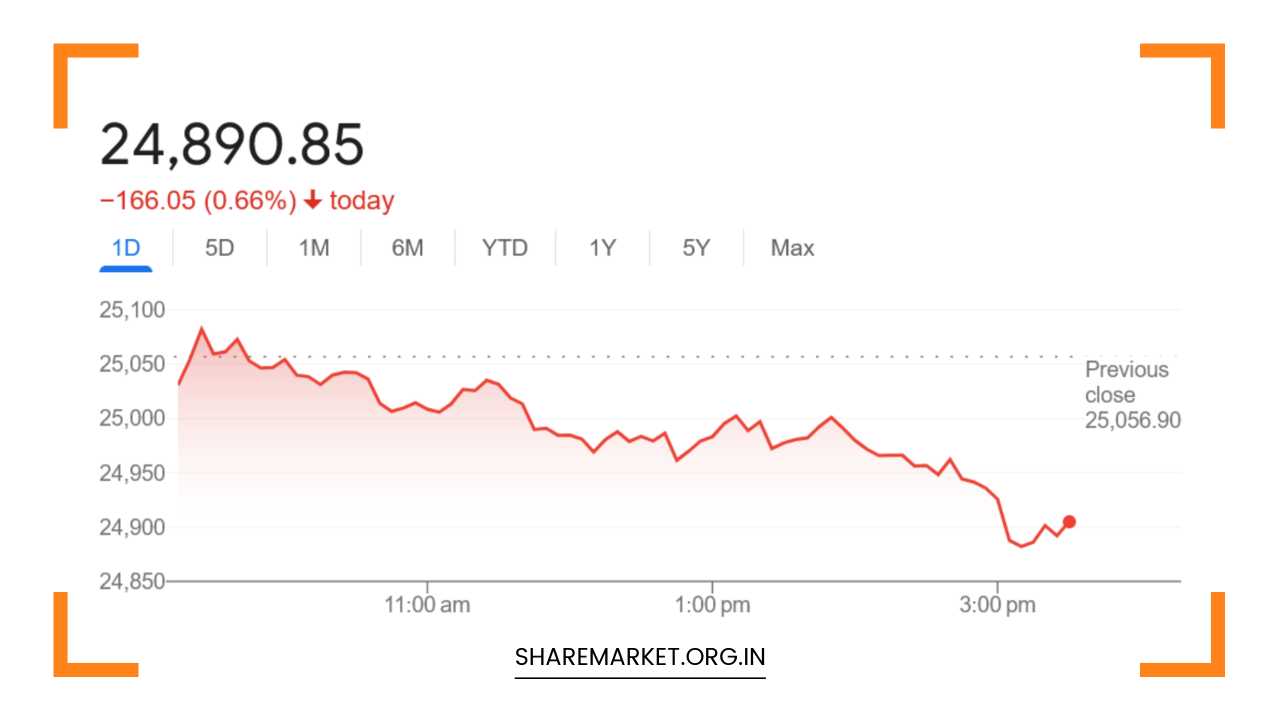
Indian equity markets extended their losing streak for the fifth consecutive trading session on September 25, 2025, as investor sentiment remained subdued amid persistent selling pressure and weak sectoral performance. With the Nifty falling below the psychologically important 24,900 mark and the Sensex losing over 550 points, the short-term trend appears to be under pressure.
As market participants look ahead to September 26, technical indicators and sectoral cues suggest that volatility may persist in the near term. Here’s a comprehensive breakdown of the latest session and what it could mean for the next.
Benchmark Indices Close Deep in the Red
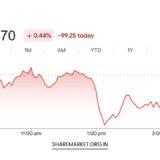
The Sensex declined by 555.95 points, or 0.68%, to settle at 81,159.68, while the Nifty 50 lost 166.05 points, or 0.66%, ending the day at 24,890.85. The breach of the 24,900 mark by the Nifty is seen as a technical sign of further weakness.
Broader market trends reflected the same cautious mood. On the Bombay Stock Exchange, 1,405 stocks advanced, while 2,586 stocks declined, and 125 stocks remained unchanged — highlighting widespread weakness across the board. The BSE Midcap and Smallcap indices each dropped 0.7%, indicating continued profit-booking and underperformance in broader market segments.
Sectoral Performance – Metals Shine, Others Struggle
Sectoral indices mirrored the overall bearish sentiment, with only one major sector managing to close in the green. Nifty Metal rose slightly, gaining 0.22%, offering a rare pocket of strength.
In contrast, nearly all other sectoral indices ended in negative territory. The consumer durables, auto, power, information technology (IT), and realty sectors were among the biggest laggards, each falling by around 1%. These sectors, particularly IT and consumer durables, have been under pressure lately due to concerns around global demand, rising costs, and valuation adjustments.
Stock Movers – Gainers and Losers
The trading session saw mixed stock-specific action within the Nifty 50 index.
Top Nifty Losers:
- Tata Motors
- Trent
- Shriram Finance
- Tata Consultancy Services (TCS)
- Power Grid Corporation
These stocks bore the brunt of the selling pressure, contributing significantly to the benchmark’s decline.
Top Nifty Gainers:
- Bharat Electronics
- Hindalco Industries
- Axis Bank
- ONGC
- Hero MotoCorp
These names managed to buck the trend, providing limited support to the index. Gains in these stocks may indicate sector-specific or company-specific resilience amid broader market weakness.
Technical Breakdown – Weakness Deepens
The current downtrend is being closely watched by technical analysts, as key support and resistance levels come into play.
Osho Krishna – Angel One
According to Osho Krishna, the ongoing weakness in the market is notable, particularly as the Nifty has now slipped below both its 20-day and 50-day Exponential Moving Averages (EMAs). This is often interpreted as a sign of short-term trend deterioration.
“The bearish trend is deepening. Nifty has now fallen below its 20-day and 50-day EMAs, indicating continued weakness in the short term.”
Krishna identified the next important support zone around 24,800, which aligns with a sloping trendline. Should this level break, the next level to watch is the 100-day moving average (DMA) at approximately 24,750.
Conversely, on the upside, the 25,000 mark — a round, psychological number — could now act as immediate resistance. A sustained move above this level would be needed to restore bullish momentum.
Sentiment in the Broader Market
The weakness in the headline indices has been mirrored in the broader market, especially among small-cap and mid-cap stocks, where profit-booking has been prevalent for the past several sessions.
Nandish Shah – HDFC Securities
Nandish Shah, Deputy Vice President at HDFC Securities, emphasized that the broad-based weakness across sectoral indices continues to reflect fragile investor sentiment.
“Sectoral indices are indicating weak sentiment. All indices, except Nifty Metal, closed in the red.”
Shah noted that profit-booking in the broader market is now in its fourth consecutive day, as investors appear to be rotating out of riskier, high-beta segments. The Nifty Midcap 100 index dropped 0.64%, while the Nifty Smallcap 100 declined 0.57%.
“With Nifty closing below the 20 and 50 DEMA, the market’s short-term trend has now weakened.”
He added that the next immediate support lies at 24,803, and the 25,000–25,050 zone could now serve as a resistance band in the short term.
Market Prediction – What to Expect on September 26
With the market having declined for five straight sessions, attention now turns to whether a near-term floor is forming — or if there is more downside ahead.
Key Technical Levels to Watch:
- Immediate Support: 24,800 (trendline)
- Secondary Support: 24,750 (100 DMA)
- Resistance Zone: 25,000 – 25,050
A breach below 24,800 could trigger further selling, particularly from short-term traders and algorithmic funds. Meanwhile, any strong bounce above 25,000 would suggest some relief and may lead to a short-covering rally.
However, traders may remain cautious until there is a clear directional breakout or reversal signal. In the absence of strong positive triggers, markets may continue to trade within a defined range, oscillating between the above support and resistance levels.
Final Thoughts
The consistent selling pressure over the past week has pushed the Nifty and Sensex into technically weak zones, with both indices now trading below key short-term moving averages. The breadth of the market, continued underperformance of broader indices, and sectoral weakness are all indicative of a cautious investor stance.
While select stocks and the metal sector have shown resilience, the overall mood remains negative. For a meaningful reversal to occur, a decisive move above the 25,000–25,050 resistance zone will be needed, along with improved breadth and buying in mid-cap and small-cap segments.
Until then, markets may remain vulnerable to further downside, especially if support levels around 24,800–24,750 fail to hold.