Share Market Today: Sensex Dips, Rs 50,000 Crore Added to Investor Wealth

Share Markets Update: Investors Gain ₹50,000 Crore Despite Market Volatility; Sensex Falls 94 Points, Nifty Ends Below 25,500
Mixed Closing After a Day of Sharp Swings
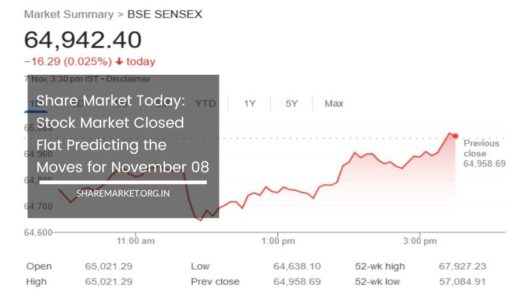
Share Market Today (November 7): The Indian stock market witnessed a roller-coaster trading session on Friday, marked by sharp intraday fluctuations and cautious investor sentiment. Despite a positive start in select sectors and an overall rise in market capitalization, the benchmark indices—Sensex and Nifty—ended marginally lower, weighed down by weakness in heavyweight stocks and persistent foreign investor selling.
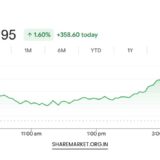
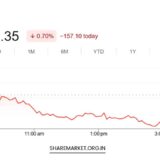
The Sensex declined 94.73 points, or 0.11%, to close at 83,216.28, while the Nifty 50 slipped 17.40 points, or 0.07%, to finish at 25,492.30. Over the week, the Nifty has lost nearly 0.8%, reflecting the cautious mood prevailing across global markets amid economic uncertainty and concerns over interest rate trajectories in major economies.
Investor Wealth Rises by ₹50,000 Crore
Interestingly, even as the benchmark indices ended in the red, the broader market showed resilience. The total market capitalization of BSE-listed companies rose to ₹466.33 lakh crore, compared with ₹465.83 lakh crore in the previous session. This implies that investors’ overall wealth increased by nearly ₹50,000 crore in a single day of trading.
This increase suggests that broader participation outside the benchmark indices helped lift investor sentiment, even though blue-chip stocks remained under mild pressure. Gains in small- and mid-cap segments contributed to this rise, indicating selective buying in fundamentally strong counters at attractive valuations.
Sectoral Performance: Metals and Financials Shine
Sectoral performance remained mixed, with certain pockets outperforming while others dragged. The Nifty Financial Services index advanced 1.25%, driven by renewed optimism in banking and lending sectors amid improving credit growth. Nifty Metal emerged as one of the day’s best-performing sectors, climbing 1.41% on strong global commodity prices and reports of improving demand from China and other emerging markets.
Public sector banks also had a good day, as the Nifty PSU Bank index rose 0.84%, buoyed by positive quarterly earnings and continued government focus on strengthening public sector lenders. Similarly, Nifty Auto gained 0.54%, supported by encouraging sales figures for October and expectations of strong festive-season demand. Nifty Private Bank also edged higher by 0.49%, aided by steady performance in top private lenders such as ICICI Bank and Axis Bank.
Weakness in IT and FMCG Stocks
On the downside, defensives like Nifty Consumer Durables fell 0.71%, weighed down by muted discretionary spending and margin pressures. The Nifty IT index lost 0.59%, extending recent losses amid concerns over slowdown in global tech spending and weak earnings guidance from key players.
Similarly, the Nifty FMCG index slipped 0.48%, as high input costs and subdued rural demand continued to impact profitability. Nifty Pharma, Nifty Media, and Nifty Healthcare also registered minor declines, reflecting sectoral rotation as investors booked profits in recent outperformers and shifted focus to value-driven sectors such as metals and banks.
Top Gainers on the Sensex
Out of the 30 Sensex constituents, only 15 stocks closed in the green. Leading the gainers’ list was Bajaj Finance, which surged 2.40% amid strong quarterly results and optimism surrounding its expansion in consumer lending. Close behind was Tata Steel, which advanced 2.37% as metal prices showed signs of stabilization.
Mahindra & Mahindra (M&M) rose 1.91%, driven by strong sales in both domestic and export markets. Bajaj Finserv also gained 1.76%, following its strong financial performance and steady growth outlook. ICICI Bank added 1.69%, supported by continued strength in loan growth and asset quality improvement.
Top Losers on the Sensex
Meanwhile, Bharti Airtel topped the list of laggards, slipping 4.46%. The fall came amid profit-booking after the telecom major’s recent rally and uncertainty regarding future tariff hikes. Tech Mahindra, Reliance Industries (RIL), Trent, and HCL Technologies also ended lower, with declines ranging between 0.92% and 1.91%.
Reliance, being a market heavyweight, exerted significant pressure on the indices as its stock corrected marginally following reports of weaker-than-expected performance in its petrochemical division. Tech Mahindra and HCL Tech extended their losing streak amid sector-wide weakness in IT counters.
Market Breadth and Broader Participation
The market breadth on the Bombay Stock Exchange (BSE) was slightly negative. Out of 4,315 stocks traded during the session, 2,065 advanced, while 2,105 declined. Around 145 stocks closed unchanged.
Notably, 132 shares touched new 52-week highs, indicating sustained investor interest in select mid- and small-cap counters, while 209 shares slipped to new 52-week lows, reflecting the ongoing volatility and stock-specific movements.
Market experts noted that while the benchmark indices remained range-bound, action was visible in broader markets, where several midcap and smallcap stocks witnessed strong volumes and price movements.
Foreign Investor Activity and Global Cues
One of the key factors weighing on market sentiment was continued foreign portfolio investor (FPI) selling. FPIs have been net sellers over the past several sessions, taking cues from rising U.S. bond yields and a stronger dollar, which have reduced the appeal of emerging market equities.
Additionally, global cues remained weak, with Asian markets trading mixed amid uncertainty over the U.S. Federal Reserve’s next interest rate move. European markets also opened lower as concerns over sluggish economic growth and geopolitical tensions kept investors cautious.
Market Outlook: What Lies Ahead
Analysts believe the near-term outlook for Indian equities will depend on global macroeconomic developments, foreign capital flows, and domestic corporate earnings. The market is expected to remain volatile as investors track key economic data releases, including inflation and industrial production numbers.
However, many experts remain optimistic about India’s medium- to long-term growth prospects. Robust GDP growth, government-led infrastructure spending, and steady improvement in the financial sector continue to provide strong structural support to the market.
Investors are advised to maintain a balanced portfolio, focusing on sectors with strong fundamentals such as banking, capital goods, and infrastructure, while being cautious in high-valuation segments like IT and FMCG.
Final Thoughts
Friday’s trading session reflected the ongoing tug-of-war between cautious global sentiment and domestic economic optimism. While the benchmark indices ended slightly lower, the rise in overall market capitalization and sectoral resilience suggest that Indian markets continue to attract investor confidence despite short-term headwinds.