Sensex Crashes 999 Points, Nifty Falls 275: 5 Key Reasons Behind Market Sell-Off
Market Bloodbath: Sensex and Nifty Crumble Under Global and Sectoral Headwinds
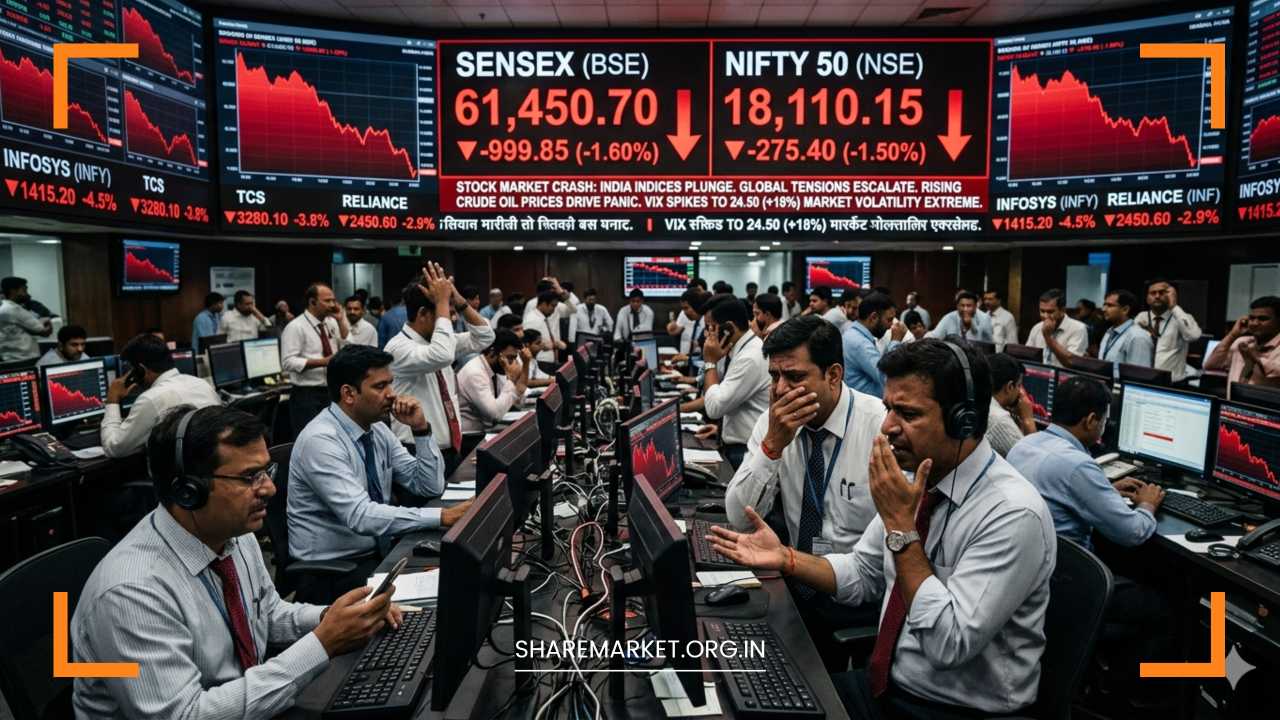
The Indian equity markets witnessed a staggering collapse on Friday, April 24, 2026, as the benchmark indices suffered their third consecutive day of losses. The BSE Sensex crashed 999 points, while the NSE Nifty 50 plummeted 275 points, erasing billions in investor wealth in a single session. This downward spiral effectively halted a two-week rally, leaving investors grappling with heightened volatility and a grim outlook for the short term.
What began as a weak opening in the morning session quickly cascaded into a broad-based sell-off. By the closing bell, the Nifty 50 had slipped below the critical psychological level of 23,900, closing a week where both major indices shed approximately 2% of their value. The carnage wasn’t restricted to blue-chip stocks; the Nifty Midcap and Smallcap indices also succumbed to the pressure, falling 1% each as risk appetite evaporated.
The Technical Breakdown: Support Levels Shattered
From a technical perspective, the breach of the 23,900 mark is more than just a number; it represents a significant shift in market sentiment. Sudeep Shah, Head of Technical and Derivatives Research at SBI Securities, noted that the Nifty has officially slipped below its 20-day Exponential Moving Average (EMA).
Historically, the 20-day EMA serves as a vital cushion during uptrends. On April 13th, this level acted as a floor that propelled a brief recovery. However, with the index failing to hold this support, the technical structure has turned bearish.
-
Immediate Support: The market is now looking at the 23,600–23,550 range.
-
Secondary Support: A breach here could trigger a slide toward 23,350 or even 23,150.
-
Resistance: On the upside, any attempted recovery will face stiff resistance at the 24,200–24,250 zone.
The “Big Five” and the IT Meltdown
The primary weight dragging the indices down came from the Information Technology (IT) sector. The Nifty IT Index saw its most brutal session in months, triggered by a bleak outlook from industry bellwethers.
| Stock | Percentage Decline | Closing Price (Approx.) |
| Infosys | 6.92% | ₹1,154 |
| HCL Tech | 4.20% | — |
| TCS | 3.15% | — |
| Tech Mahindra | 3.50% | — |
| Sun Pharma | 2.80% | — |
Infosys bore the brunt of the onslaught, crashing nearly 7% to hit its lowest level since June 2023. The catalyst was a “weak guidance” report issued on April 23rd, suggesting that global demand for IT services will remain tepid throughout the fiscal year. This sparked a contagion effect across the sector, with TCS, HCL Tech, and Tech Mahindra following suit. Even defensive plays like Sun Pharma were not spared as the sell-off intensified.
5 Crucial Reasons for the Market Chaos
The “perfect storm” that hit the Dalal Street on April 24th was a combination of geopolitical friction, inflationary pressures, and technical indicators.
1. Geopolitical Gridlock: The US-Iran Standoff
The anticipated second round of diplomatic talks between the United States and Iran failed to materialize this week. Instead of de-escalation, tensions have spiked over the Strait of Hormuz—a vital maritime artery for global oil shipments. Market participants fear that any military friction in this corridor could lead to a catastrophic supply shock. The uncertainty regarding this trade route is a primary driver of the current “fear trade.”
2. The Crude Oil Surge and Import Concerns
Energy prices have returned to the forefront of economic anxiety. While Brent crude had briefly dipped below the $100 mark, it has surged back to $106 per barrel, with some intraday spikes reaching as high as $118.
The India Factor: India imports approximately 90% of its crude oil requirements. Every dollar increase in oil prices widens the current account deficit and puts immense pressure on the Indian Rupee. Analysts suggest that if prices remain elevated, a post-election hike in petrol and diesel prices is almost inevitable, which would further stoke domestic inflation.
3. Relentless Foreign Fund Outflows
Foreign Institutional Investors (FIIs) have turned into aggressive sellers. Driven by the rising US Treasury yields and the strengthening dollar, foreign funds are pulling capital out of emerging markets like India. Because FIIs hold significant stakes in large-cap stocks, their exit is most visible in the Sensex and Nifty. In April alone, the volume of selling has reached multi-month highs, leaving domestic institutional investors (DIIs) struggling to provide a sufficient counter-balance.
4. The IT Sector’s “Guidance Ghost”
The IT sector, which typically accounts for a massive portion of the Nifty’s weightage, is facing a structural slowdown. High-interest rates in the West have led to reduced discretionary spending by global clients. When Infosys announced that demand would remain weak for the fiscal year, it confirmed the market’s worst fears. This “growth scare” has led to a re-rating of IT stocks, causing a massive drag on the benchmarks.
5. India VIX: The Fear Gauge Explodes
The India VIX (Volatility Index), often referred to as the “investor fear gauge,” surged by 6% to reach 19.7.
-
The Threshold: In market parlance, a VIX reading above 15 is considered a sign of high risk and instability.
-
The Implication: At nearly 20, the VIX suggests that traders expect wild price swings in the coming weeks. Such high volatility usually discourages long-term investors and encourages short-selling, creating a self-fulfilling prophecy of market declines.
Impact on Oil-Dependent Sectors
Abhinav Tiwari, a Research Analyst at Bonanza Portfolio, highlighted that the crude oil surge is a “double whammy” for the Indian economy. Beyond the direct impact on the rupee, it increases the input costs for several key sectors:
-
Paint and Chemicals: These industries use oil derivatives as raw materials.
-
Aviation: Rising ATF (Aviation Turbine Fuel) prices threaten the profitability of airlines.
-
Logistics and FMCG: Higher transport costs squeeze the margins of companies producing daily consumer goods.
As long as Brent crude remains above the $100 threshold, these sectors will remain under extreme pressure, and their stock valuations will likely continue to face downward revisions.
Final Thoughts: A Testing Time for Investors
The market close on April 24th marks a pivot point. The “Goldilocks” period of steady growth and low volatility has been replaced by a landscape of geopolitical maneuvering and inflationary threats. With the Nifty breaking key technical levels and the IT sector in a tailspin, the path of least resistance currently appears to be downward.
For retail investors, the surge in the India VIX is a clear warning to exercise caution. The coming days will be defined by whether the Nifty can find a floor at 23,600 or if the global macro-environment forces a deeper correction toward the 23,000 mark. Until crude prices soften and FII selling abates, the “chaos” on Dalal Street is likely to persist.