Sensex Down 114 Points, Nifty at 23,618; Tomorrow Nifty Prediction
Sensex and Nifty Close in the Red: Heavyweights Drag Benchmarks Lower; What to Expect on May 20
The Indian equity benchmark indices surrendered their early psychological gains on Tuesday, closing a highly volatile trading session in negative territory. While robust buying interest in information technology (IT), real estate, and public sector undertaking (PSU) banking stocks provided a temporary cushion, it was ultimately outweighed by severe drubbing in private banking heavyweights, select fast-moving consumer goods (FMCG) names, and prominent large-cap counters.
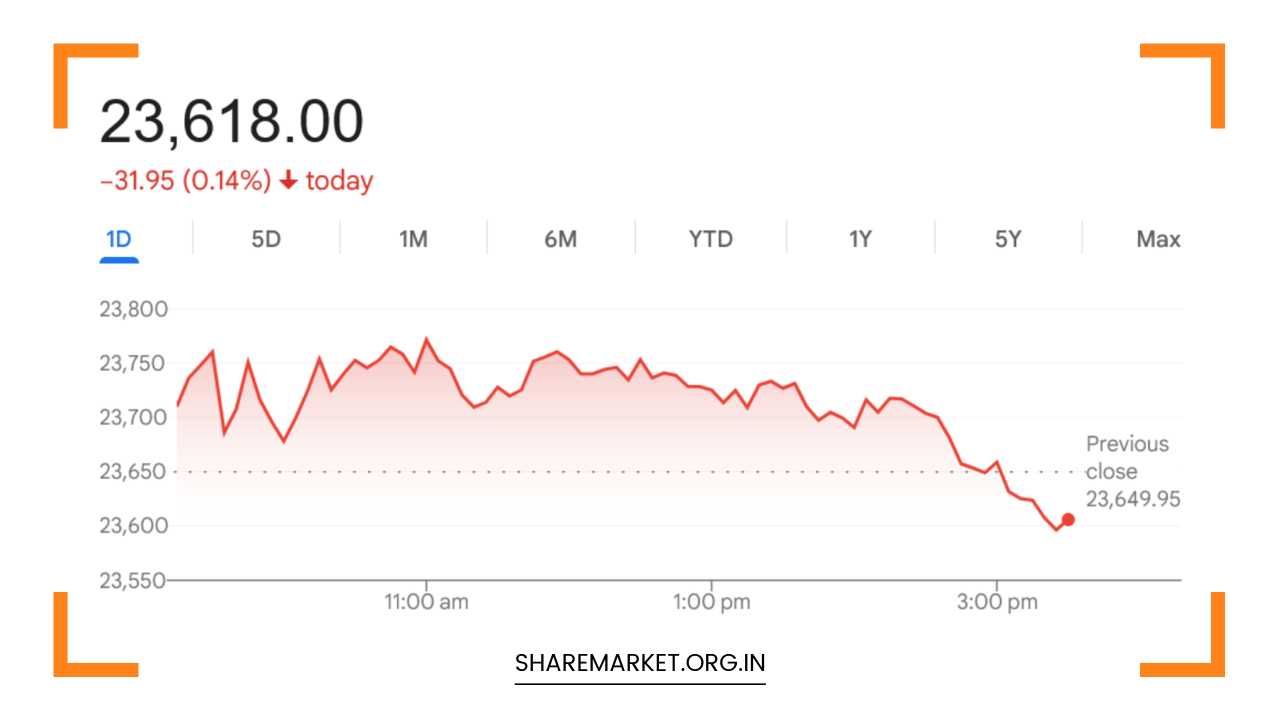
By the closing bell, the BSE Sensex had pared its intraday highs to finish 114.19 points, or 0.15% lower, at 75,200.85. Similarly, the broader NSE Nifty 50 index shed 31.95 points, or 0.14%, to settle at 23,618.00. Despite the minor retreat in front-line indices, the underlying market breadth painted a remarkably resilient picture, with mid- and small-cap segments displaying broad-based buying. On the Bombay Stock Exchange (BSE), 2,477 stocks advanced against 1,526 stocks that declined, indicating that the risk-on sentiment remains vibrant outside the heavyweight space.
Sectoral Performance: IT and Realty Shine While Private Banks Drag
The story of the trading day was one of stark sector rotation. The Nifty Private Bank index finished 0.74% lower, acting as the primary anchor dragging down the benchmark indices. Among individual banking stocks, Kotak Mahindra Bank emerged as the biggest laggard on the Nifty 50, tumbling 2.5% on the back of institutional selling.
Conversely, the technology sector staged a spectacular comeback. The Nifty IT index witnessed a robust surge of 3.23%, comfortably sealing its position as the top-performing sectoral index of the day. This rally was spearheaded by sector bellwether Infosys, which rallied 4.76%. Other technology titans followed suit, with HCL Technologies, Tech Mahindra, and Tata Consultancy Services (TCS) posting solid gains ranging between 2% and 3%.
Beyond IT, several structural sectors managed to beat the benchmark blues:
-
Nifty Realty: Gained 1.43%, driven by strong residential demand projections and corporate expansion plans.
-
Nifty PSU Bank: Advanced by nearly 1%, reflecting sustained retail and institutional confidence in public sector balance sheets.
-
Nifty Media: Rose by approximately 1%, supported by selective short-covering.
Mid-Cap and Small-Cap Outperformance
The broader markets significantly outperformed the large-cap benchmarks, demonstrating that risk appetite among retail and HNIs (High Net Worth Individuals) remains intact. The Nifty Midcap 100 and Nifty Smallcap 100 indices posted impressive gains of 0.9% and 1.2%, respectively.
In the mid-cap universe, Tata Technologies surged a stellar 6.25%, while software peers KPIT Technologies and Coforge advanced by over 4% to 5%, riding on the coattails of the broader IT sector turnaround. On the flip side, specialized pipe and plumbing manufacturer Astral became the top laggard in the BSE Midcap segment, plummeting 6.34%, while conglomerate Godrej Industries and tractor manufacturer Escorts Kubota registered declines of 2% to 3%.
Macroeconomic Headwinds: Rupee Hits Record Low and Oil Surges
The domestic equity market is navigating a complex web of macroeconomic challenges that continue to cap its upside potential. Chief among these concerns is the unprecedented depreciation of the domestic currency. Driven by persistent dollar demand from oil marketing companies and foreign institutional outflows, the Indian Rupee (INR) weakened further on Tuesday to close at a new historic low of 96.53 against the US Dollar.
A weakening currency complicates the import math for India, particularly regarding crude oil. Elevated global crude oil prices, combined with a fragile global risk environment, have stoked fears of imported inflation.
Vinod Nair, Head of Research at Geojit Financial Services, pointed out that the day’s early gains were primarily fueled by geopolitical relief—specifically, hopes that the US would temporarily halt military operations against Iran. However, as the session progressed, domestic realities took over.
“While corporate earnings for the fourth quarter have broadly signaled underlying domestic economic strength, the market’s focus is now rapidly shifting toward mounting inflationary pressures,” Nair observed. “Concerns are growing regarding potential downward revisions to earnings estimates for Q1FY27. The primary drivers behind this are higher-than-expected wholesale inflation, the lagged effect of elevated fuel prices, and domestic bond yields remaining stubbornly high.”
Encouragingly, the fear gauge, India VIX (Volatility Index), recorded a sharp cooling of 5.45%, suggesting that while the market is consolidating, market participants are not bracing for an immediate systemic crash.
Technical Outlook: What to Expect on Wednesday, May 20
As traders prepare for the May 20 session, technical analysts point to an index caught in a tightly defined tug-of-war between crucial moving averages and retracement zones.
Key Technical Levels at a Glance
-
Crucial Bullish Trigger: 23,900
-
Immediate Resistance: 23,800 – 23,850
-
Immediate Support: 23,500 – 23,400
-
Major Base/Floor: 23,300 – 23,100
The Analyst Consensus
Shrikant Chouhan (Head of Equity Research, Kotak Securities):
Chouhan emphasizes that the 23,800 level—which closely aligns with the 50-day Simple Moving Average (SMA)—will continue to act as the primary gatekeeper for the bulls. “If the Nifty manages to scale and sustain above 23,800, it could quickly advance toward the 23,875–23,900 corridor. On the flip side, if the index slips decisively below the 23,500 psychological mark, the doors open for a deeper correction toward 23,300–23,250.”
Rupak De (Senior Technical Analyst, LKP Securities):
From a momentum perspective, De sounds a note of caution, highlighting that the hourly Relative Strength Index (RSI) remains locked in a bearish crossover and is trending downward. “In the ultra-short term, momentum slightly favors the bears. Until the Nifty decisively breaks above the 23,800 resistance zone on a closing basis, selling on rallies will remain the dominant strategy, and bears could claw back control. Immediate protection stands at 23,400, below which selling pressure could intensify rapidly.”
Rajesh Bhosale (Equity Technical and Derivatives Analyst, Angel One):
Bhosale provides a broader chart perspective, viewing the current price action as a healthy consolidation phase on the daily charts. He notes that the Nifty has successfully defended the 23,300 zone multiple times over the past week. This level is highly significant as it represents the 50% Fibonacci retracement mark of the entire structural rally measured from the April lows of 22,180 to the recent lifetime highs of 24,600.
“The 23,300–23,100 band is a formidable support cluster, with its lower edge coinciding with the 61.8% Fibonacci retracement level,” Bhosale explained. “Interestingly, the hourly chart is forming a classic ‘double-bottom’ pattern accompanied by a clear ‘positive divergence’ around 23,300, which indicates that selling exhaustion is setting in at lower levels. On the upside, the 23,850–23,900 range acts as the immediate ceiling, matching last week’s swing high and the 20-day Exponential Moving Average (DEMA). A clean breakout above 23,900 will invalidate the bearish structure and likely propel the Nifty toward its 50 DEMA at 24,150.”
Strategy for Traders
For the upcoming session on May 20, market participants are advised to avoid aggressively chasing momentum in either direction. The index is confined within a well-defined trading band: 23,100–23,300 on the downside and 23,850–23,900 on the upside. A directional trend will only emerge once either of these boundaries is broken on a decisive closing basis. Until then, a stock-specific approach targeting defensive sectors or high-momentum IT counters remains the most prudent path forward.