Sensex Down 249 Points, Nifty at 23,865; Tomorrow Nifty Prediction
Sensex and Nifty Close in the Red; Here’s What to Expect from the Market on July 1
The Indian benchmark indices wrapped up the final session of the first half of the calendar year 2026 (H1CY2026) on a cautious and volatile note. On June 30, persistent selling pressure in heavyweights—predominantly across the information technology (IT) and fast-moving consumer goods (FMCG) sectors—dragged the benchmark indices lower. The National Stock Exchange (NSE) F&O monthly expiry dynamics further accentuated intra-day fluctuations, culminating in the Nifty settling just below the psychologically crucial 23,900 threshold.
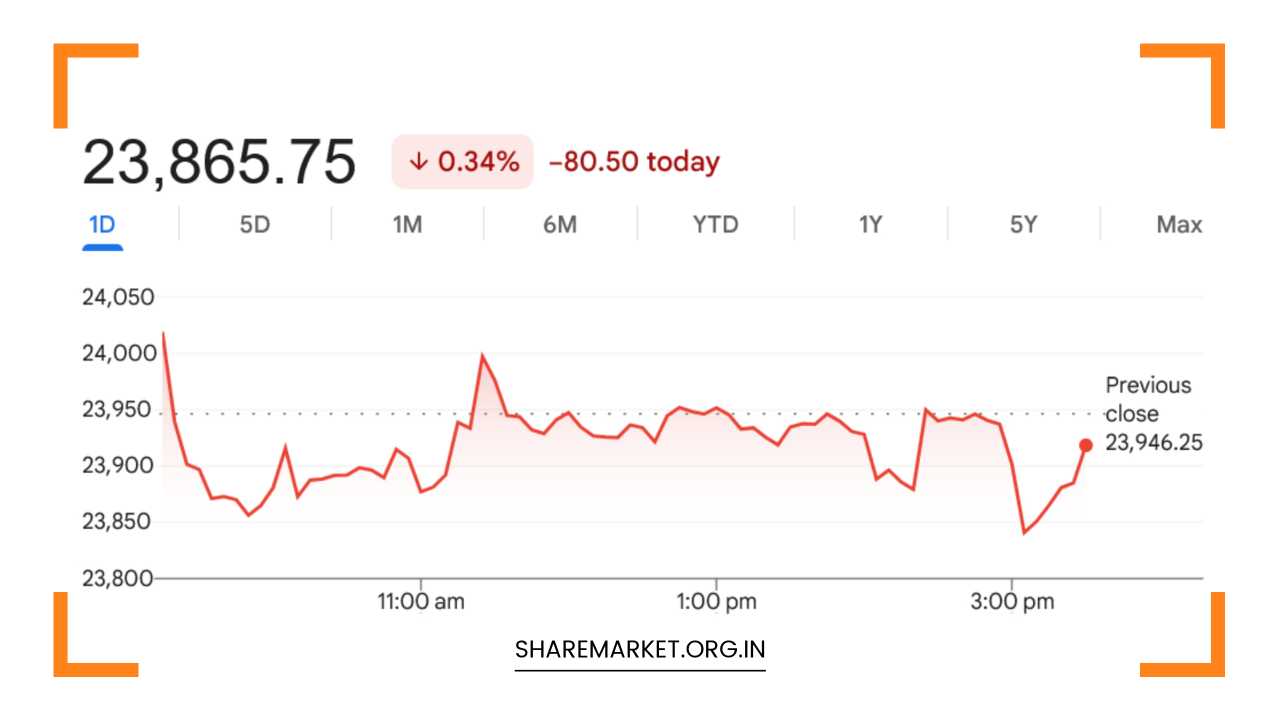
At the closing bell, the BSE Sensex pulled back by 249.70 points, or 0.33%, to finish at 76,478.67. Concurrently, the NSE Nifty 50 shed 80.50 points, or 0.34%, to lock in at 23,865.75. This session rounded off a challenging six-month stretch for Indian equities; over the course of H1CY2026, the Sensex fell roughly 10.2% while the Nifty retreated by 8.6%, largely triggered by persistent macroeconomic challenges and global geopolitical friction in West Asia.
Market Breadth and Sectoral Performance
Despite the losses observed in the headline indices, the broader market painted a considerably more resilient picture, demonstrating positive market breadth. On the Bombay Stock Exchange (BSE), approximately 2,250 stocks advanced, 1,805 declined, and 173 counters closed unchanged. The undercurrent of strength in mid-cap and small-cap segments indicates that mid-tier corporate earnings expectations and local retail participation remain robust, even as institutional investors pull back from large-cap heavyweights.
The Winners and Losers
The pressure on the benchmarks was primarily driven by standard index heavyweights, while buying interest was concentrated in automotive, consumer discretionary, and select financial names.
-
Top Nifty Losers: The downward trajectory was spearheaded by Eicher Motors, Infosys, Tata Consumer Products, Tata Consultancy Services (TCS), and Wipro.
-
Top Nifty Gainers: Providing a strong cushion against a sharper drop were Maruti Suzuki, Titan Company, Adani Enterprises, Bajaj Finance, and Tata Motors Passenger Vehicles.
Sectoral Heatmap
The sectoral configuration during the June 30 trading session highlighted a glaring polarization between export-oriented technology lines and domestic consumer-driven segments:
| Sector / Index | Percentage Change | Market Impact & Key Drivers |
| Nifty IT | -2.5% to -2.7% | Worst Performer: Deep profit-booking over high global interest rate fears and structural enterprise spending reductions. |
| Nifty FMCG | -0.4% | Marginal Decline: Subdued rural demand expectations and impending monsoon deficit concerns. |
| Nifty PSU Bank | -0.7% | Mild Pullback: Profit-booking after a strong multi-quarter run; asset quality remains stable. |
| Nifty Media | -0.7% | Soft Consolidation: Minor profit-taking across key entertainment and broadcasting networks. |
| Nifty Realty | > +1.0% | Outperformer: Strong urban luxury housing demand and steady operational cash flows. |
| Consumer Durables | > +1.0% | Outperformer: Boosted by cooling appliances sales and premium discretionary retail interest. |
| Nifty Midcap 100 | +0.42% | Resilient: High relative strength; demonstrating localized alpha generation away from large caps. |
| Nifty Smallcap 100 | +1.02% | Top Performer: High domestic retail and mutual fund layout pushing lower-tier valuations higher. |
Macroeconomic Headwinds and Catalyst Triggers
Global and domestic indicators continue to dictate the boundary lines for Indian equities. Vinod Nair, Head of Research at Geojit Financial Services, pointed out that the domestic market is caught in a low-volatility, narrow-range holding pattern with a mixed underlying bias.
“Although immediate geopolitical concerns have marginally de-escalated, the fragile state of the US-Iran diplomatic channel continues to cloud market sentiment, checking aggressive long positioning,” Nair observed.
The Global Macro Landscape
Globally, institutional traders are realigning their portfolios ahead of crucial economic indicators. The key variables include:
-
US Employment Prints: Upcoming non-farm payroll data will provide clarity on whether the US labor market is cooling rapidly or sustaining structural resilience.
-
Federal Reserve Directives: Highly anticipated commentary from the Federal Reserve Chair is being analyzed to interpret the forward path of borrowing costs, especially since US inflation remains sticky and above the 2% target, even as macro activity scales ahead at a stable clip.
-
AI Investment Scrutiny: Globally, capital markets are reassessing the multi-billion dollar capital expenditure cycles of global technology firms, triggering localized sell-offs in technology-facing ecosystems, which directly spilled over into India’s IT sector.
Domestic Pressure Points & Support Cushions
On home soil, the primary structural worry stems from climate risks. The current monsoon progression data reveals the largest seasonal rain deficit in a decade. This drop threatens to increase food inflation, restrict rural purchasing power, and depress immediate agricultural output, which has made FMCG investors anxious ahead of the Q1 FY27 corporate earnings cycle.
Conversely, a few buffers prevent a steep breakdown:
-
Crude Oil Stability: Brent crude prices have stabilized away from recent highs, easing fears of import-led fiscal strain.
-
Resilient Rupee: The Indian Rupee remains structurally steady against the US dollar.
-
FII Outflow Deceleration: Foreign Institutional Investor (FII) selling intensity has cooled significantly relative to earlier quarters, paving the way for domestic institutional inflows to comfortably absorb regular secondary market supply.
Technical Architecture: What to Expect on July 1
The multi-layered derivative and structural patterns point to an impending directional breakout as the July series gets underway.
Key Nifty 50 Levels to Watch
-
Secondary Resistance Zone: 24,100
-
Major Call/Put Wall (Pivot Point): 24,000
-
Immediate Overhead Resistance: 23,950
-
June 30 Closing Print: 23,865.75
-
Critical Support (50-day EMA): 23,800
-
Major Bearish Breakdown Target: 23,600
Nifty Technical Outlook
Rupak De, Senior Technical Analyst at LKP Securities, highlighted that the Nifty swung back and forth within a well-defined 23,850–24,050 corridor during the monthly F&O settlement. Though the daily setup mirrors a short-term negative bias, the underlying framework remains reasonably balanced:
-
Support Metrics: The index successfully defended its 50-day Exponential Moving Average (50-day EMA) on the daily charts, confirming that the medium-term macro trend is not completely compromised. However, a bearish crossover on the daily Relative Strength Index (RSI) suggests that immediate upside momentum is flattening out.
-
Derivative Concentration: Heavy open interest buildup from both Call and Put writers at the 24,000 strike price marks this as the psychological anchor point for the July series.
-
The Breakout Thresholds: A sustained breakdown below 23,800–23,730 could unravel speculative long positions, triggering a deeper correction toward 23,600. Conversely, if the index maintains its posture above 23,800, a swift short-covering bounce toward 23,950–24,000 is highly likely.
Abhinav Tiwari, a research analyst at Bonanza Portfolio, concurs that the market will likely tread water over the next few sessions. He advises market participants to track global oil prices, progress reports on the US-Iran negotiations, and early domestic Q1 FY27 financial results to time their entries.
Riyank Arora, Associate Vice President (HNI & Derivatives) at Hedged.in, notes that the current phase is a classic structural consolidation:
“The Nifty is hanging tight around a key demand pocket at 23,800–23,750. If this zone breaks on a closing basis, the doors swing open for 23,600. On the flip side, initial overhead resistance is pegged at 23,950–24,000, followed by a firmer ceiling at 24,100.”
For the BSE Sensex, immediate floor levels are concentrated around 76,200–76,000, while a clean close above the 76,800–77,000 supply wall is mandatory to resume a sustainable bullish chart pattern.
Bank Nifty Outlook
Analyzing the banking space, Vatsal Bhuva, Technical Analyst at LKP Securities, points out that the Bank Nifty index continues to exhibit a lack of clear momentum:
-
Moving Average Convergence: The banking index has slipped slightly beneath its 20-hour and 50-hour Simple Moving Averages (SMA), revealing temporary weakness in intra-day trend cycles.
-
Momentum Indicators: Much like the headline Nifty, the Bank Nifty’s daily RSI has logged a bearish crossover, pointing to a temporary cooling of aggressive buying bids.
-
Trading Coordinates: Despite the minor loss of momentum, the overarching structural template is strictly sideways. Swing traders should view dips near the 57,100–57,000 range as accumulation opportunities, while looking to pocket profits or initiate short tactical positions as the index hits the 58,000–58,200 zone.
Strategic Playbook for Traders
Given the mixed structural cues and the transition into a new monthly derivatives series on July 1, market participants should avoid over-leveraged, directional bets. Capital preservation remains the priority.
Traders should adopt a “selectively defensive” stance—focusing heavily on sectors showing clear relative strength against the index, such as real estate, consumer durables, and defensive large-cap value stocks. It is critical to wait for explicit price confirmation around the 24,000 Nifty pivot before deploying aggressive capital, ensuring that all open positions are anchored by disciplined stop-loss limits.