Sensex Down 331 Points, Nifty at 23,767; Monday Nifty Prediction
Market Closure Analysis: Indian Equities Extend Losing Streak to Five Sessions — Outlook for July 27
Indian equity benchmarks experienced another turbulent session on July 24, extending their downward trajectory for the fifth consecutive trading day. Pressured by a lethal mix of escalating geopolitical tensions in West Asia, soaring Brent crude prices breaching the psychological USD 100-per-barrel threshold, and fresh trade tariff anxieties out of Washington, the frontline indices struggled for footing.
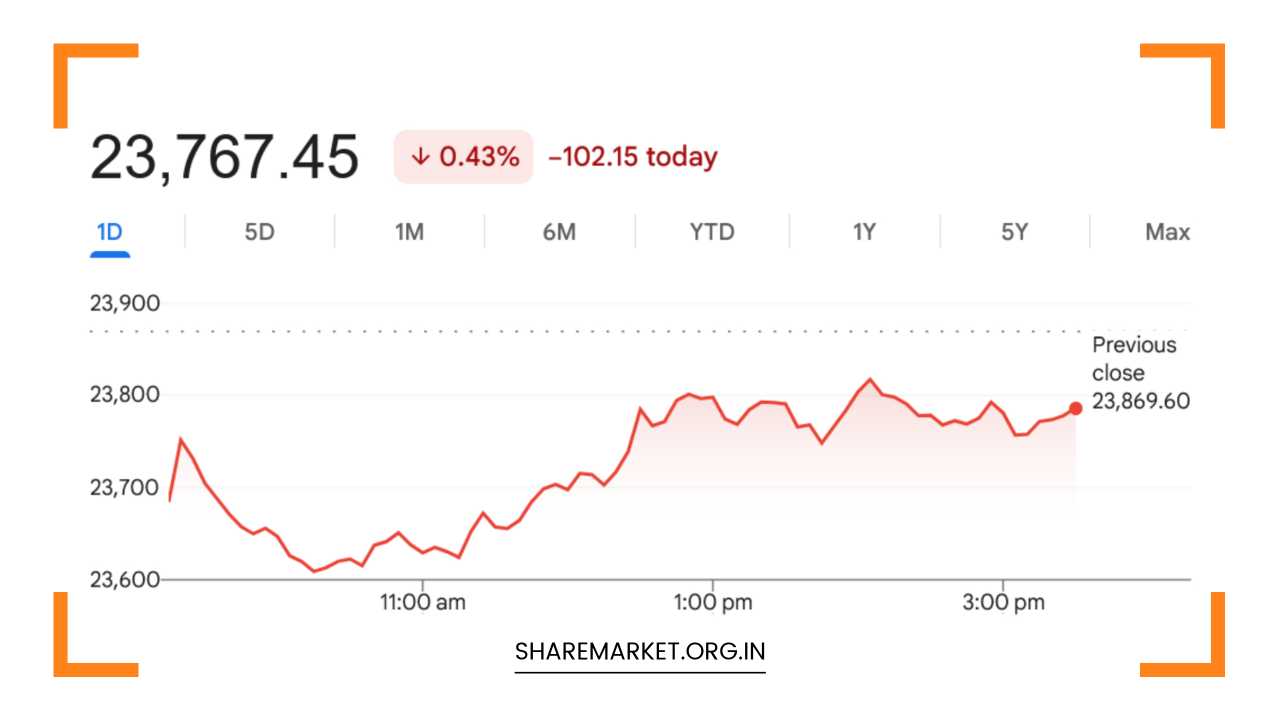
While the headline indices finished deep in the red—with the Nifty 50 slipping below the crucial 23,800 mark—a notable intraday recovery from day-lows cushioned the overall impact. As investors close out the week, attention shifts squarely to how structural macroeconomic headwinds and technical chart markers will dictate market behavior when trading resumes on Monday, July 27.
Detailed Review of July 24 Market Action
Index Movements and Market Breadth
At the closing bell, the 30-share BSE Sensex retreated 331.62 points, or 0.43%, to settle at 76,059.77. Similarly, the broader NSE Nifty 50 contracted by 102.15 points, or 0.43%, to close at 23,767.45.
Market breadth reflected a relatively even split of sentiment despite the headline losses:
-
Total Stocks Traded: Approximately 4,207 stocks were actively traded.
-
Advances: 2,050 stocks managed to close in positive territory.
-
Declines: 1,961 counters faced selling pressure.
-
Unchanged: 196 stocks remained flat.
Despite the negative close, the broader markets showed remarkable resilience by bouncing back from severe intraday troughs. The Nifty Midcap 100 ended flat, while the Nifty Smallcap 100 experienced a mild setback of 0.3%.
Top Gainers and Losers
Stock-specific actions were heavily polarized during the session:
-
Nifty Top Losers: Heavyweights such as Bajaj Finance, Eternal, Mahindra & Mahindra (M&M), Shriram Finance, and Bharti Airtel bore the brunt of institutional profit-booking and risk-off sentiment.
-
Nifty Top Gainers: Countering the downtrend, tech and defensive plays like HCL Technologies, Wipro, Cipla, ITC, and HDFC Life drew firm buying interest. HCL Tech outperformed following strong corporate updates and strategic regional expansions.
Sectoral Performance: Divergent Trends
Sectoral dynamics showcased a stark divergence between cyclical/export-heavy sectors and defensive/technology plays:
| Sector Index | Direction | Performance / Change | Key Drivers |
| Nifty Media | Gainer | +1.80% | Broad-based speculative buying and value picking. |
| Nifty IT | Gainer | +0.80% | Strong earnings visibility and defensive capital rotation. |
| Nifty PSU Bank | Gainer | +0.50% | Public sector lender resilience and attractive valuations. |
| Nifty Bank | Gainer | +0.18% | Late-session short-covering and credit growth expectations. |
| Nifty Auto | Loser | -1.10% | Margin contraction fears due to rising commodity and oil costs. |
| Nifty Metal & Energy | Loser | -0.55% to -0.57% | Global growth slowdown concerns and commodity price pressures. |
| Nifty Realty & Infra | Loser | -0.40% to -0.55% | High-interest-rate environment sensitivity. |
Macroeconomic Catalysts and Global Headwinds
Vinod Nair, Head of Research at Geojit Investments, emphasized that near-term market sentiment remains tethered to external geopolitical and macroeconomic factors:
-
Surging Crude Oil Prices: Renewed disruptions in West Asia—particularly attacks on tankers in the Red Sea—have pushed Brent crude past USD 100 a barrel. Elevated energy costs threaten India’s fiscal deficit, inflation trajectory, and current account balance.
-
Rising US Bond Yields: The US 10-year Treasury yield climbed toward a 52-week high (hovering around 4.71%), driven by persistent labor market strength and mounting expectations of a hawkish Federal Reserve stance heading into the September policy meeting. This dynamic continues to fuel foreign institutional investor (FII) outflows from emerging markets like India.
-
Trade Policy Overhangs: New trade tariffs imposed by Washington have heightened anxieties for export-driven global economies, prompting global investors to reallocate portfolios toward safer asset classes.
Technical Outlook for July 27
Nifty 50 Technical Structure
According to Sudeep Shah, Head of Technical and Derivatives Research at SBI Securities, the Nifty remains in a delicate technical zone after breaching crucial short-term moving averages:
-
Immediate Support: Positioned strictly in the 23,650–23,600 zone. A decisive breakdown below this threshold could accelerate selling momentum, dragging the index toward downside targets at 23,450 and subsequently 23,300.
-
Immediate Resistance: Clustered in the 23,950–24,000 zone, which closely aligns with the pivotal 50-day Exponential Moving Average (EMA). Sustained movement above 24,000 is mandatory to reverse the current medium-term bearish bias.
Bank Nifty Technical Structure
Bank Nifty demonstrated superior relative strength on Friday, staging a sharp intraday recovery from lower levels that carved out a large bullish candle on the daily timeframe and reclaimed its vital 200-day EMA [cite:].
-
Immediate Resistance: Placed in the 57,100–57,200 band. Conquering this hurdle could unlock further upside potential toward 57,600 and 58,000 [cite:].
-
Immediate Support: Anchored in the 56,300–56,200 zone [cite:]. Holding above this floor will be essential for maintaining positive momentum when markets reopen on July 27.
Final Thoughts and Trading Strategy for July 27
As the market prepares for the trading session on July 27, caution remains the prudent watchword. The combination of high crude prices, foreign capital outflows, and global macro friction suggests that a “sell on rise” strategy near major overhead resistance levels remains favored by institutional technical desks until concrete global relief materializes.
Traders should monitor global cues over the weekend closely, tracking international crude movements and early Asian market openings on Monday morning. Strict risk management, adherence to stop-losses around critical support levels, and selective accumulation of fundamentally sound domestic-facing sectors (such as banking and IT leaders) will be vital for navigating the upcoming session.