Sensex Down 1,122. Points, Nifty at 24,480; Tomorrow Nifty Prediction
Navigating the Storm: Market Turbulence and the Outlook for March 5
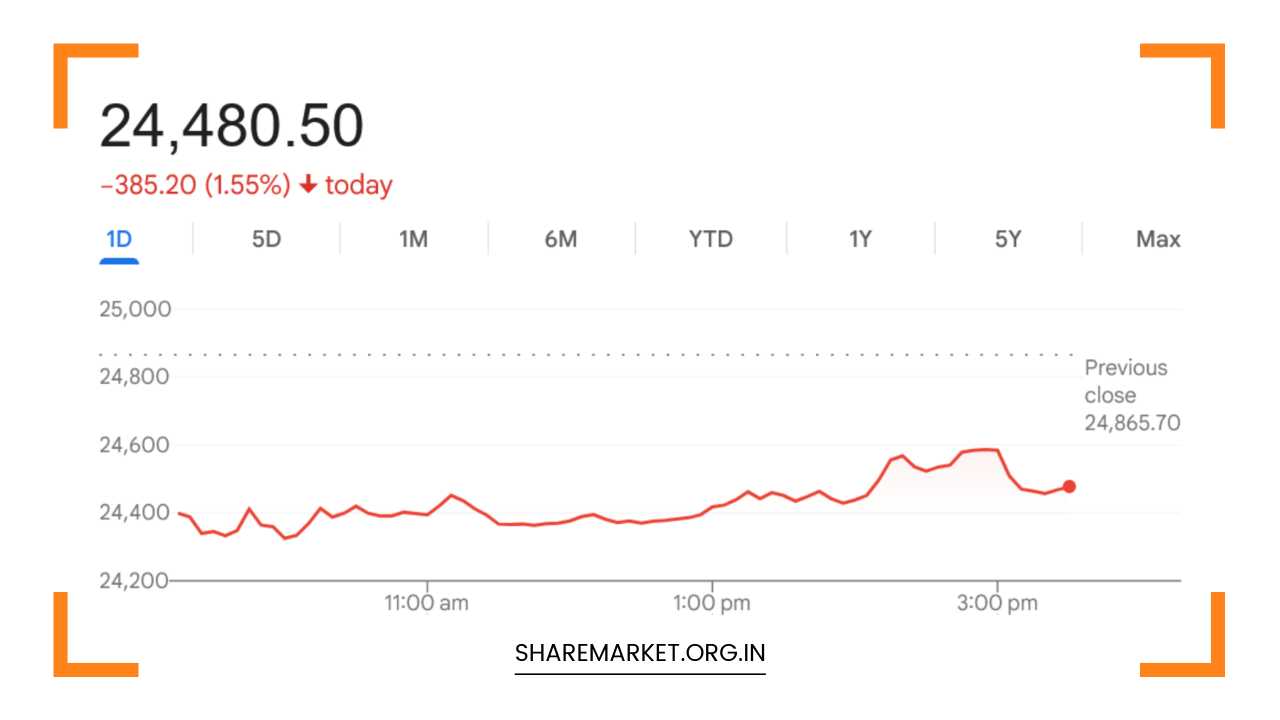
The Indian stock market experienced a jarring reality check on March 4, 2026. As the closing bell signaled a sharp decline, it became clear that geopolitical anxieties are no longer distant rumblings—they are now the primary drivers of domestic market sentiment. With the Nifty decisively breaching the 24,500 support level and the Sensex shedding over 1,100 points, investors are left questioning the stability of the current bull run. As we look toward the session on March 5, the mood is one of calculated caution, as the market balances on the edge of a potential technical breakdown.
A Broad-Based Retreat: The Anatomy of the Sell-Off
The trading session on March 4 was defined by a pervasive “risk-off” sentiment. The data paints a stark picture of the damage: 3,105 stocks declined compared to only 996 that managed to stay in the green. The Nifty’s 1.55% slide to 24,480.50 was not merely a reaction to profit-booking; it was a structural response to fear.
The carnage was uniform across almost every major sector, highlighting the vulnerability of the Indian market to global energy shocks. The following table summarizes the sectoral impact, illustrating where the selling pressure was most acute:
| Sector | Impact | Primary Drivers |
| Infra & Realty | -2% to -4% | High input costs, liquidity concerns |
| PSU Banks | -2% to -4% | Systemic risk apprehension |
| Oil & Gas | -2% to -4% | Crude supply disruption anxiety |
| Auto & Metals | -2% to -4% | Margin pressure, slowing demand |
| IT Services | Neutral/Mild | Potential hedge via currency depreciation |
While the IT sector—often a refuge for capital during periods of uncertainty—showed resilience, the heavyweights in infrastructure and cyclical commodities bore the brunt of the volatility.
The Geopolitical Trigger: The Strait of Hormuz and the Oil Price Spike
At the heart of the market’s distress is the escalating US-Iran conflict. The Strait of Hormuz is not merely a geographic chokepoint; it is the jugular vein of the global energy supply chain. With roughly 20% of the world’s crude oil transiting this passage, any threat to its security translates immediately into a surge in Brent crude prices.
For an economy like India, which imports the vast majority of its oil, this is a multi-dimensional crisis. Higher oil prices inevitably translate to:
-
Inflationary Pressure: Increased logistics and production costs across the economy.
-
Currency Depreciation: Increased demand for dollars to pay for imported oil puts downward pressure on the Indian Rupee (INR).
-
Policy Constraints: The Reserve Bank of India (RBI) may find its hands tied regarding interest rate cuts if inflation projections are forced upward by energy costs.
President Donald Trump’s evolving commentary—shifting from promises of a quick resolution to acknowledging the risk of a prolonged conflict—has deeply unsettled Wall Street, which in turn has signaled a retreat in emerging markets like India. If the “forever war” narrative takes hold, the Nifty’s path to recovery will become significantly steeper.
Technical Outlook: Reading the Charts for March 5
As traders prepare for the next session, the technical landscape offers a mix of warning signs and potential opportunities for a relief rally.
Anand James, Chief Market Strategist at Geojit Investments, emphasizes that the gap-down opening on March 4 created a significant psychological hurdle. For any meaningful recovery to occur, the Nifty must defend the 24,500 level with conviction. A failure to hold this level suggests that the market is likely to drift into the 24,000–23,550 range, effectively wiping out the gains of the previous quarter.
Nagaraj Shetti of HDFC Securities offers a more granular perspective. The formation of a green candle with shadows suggests that bargain hunters are already active near lower levels, attempting to mitigate the damage. However, he warns that the internal trend remains distinctly weak. The immediate support zone sits firmly between 24,100 and 24,300. If the Nifty can consolidate here, a “relief rally” could materialize, aimed at testing the immediate resistance at 24,600.
The Institutional Factor: FIIs vs. DIIs
It is also essential to consider the role of institutional capital. During geopolitical crises, Foreign Institutional Investors (FIIs) are typically the first to initiate a “flight to safety,” liquidating holdings in emerging markets to move capital into US Treasury bonds or the dollar. The extent of the Nifty’s recovery on March 5 will depend heavily on whether Domestic Institutional Investors (DIIs) possess the conviction to absorb this foreign selling. If DIIs remain sidelined, the lack of depth in the market could exacerbate downward volatility.
Strategic Considerations for Investors
In the current climate, reactive trading is the greatest threat to capital preservation. Instead, consider these disciplined approaches:
-
Reduce Leverage: Now is not the time to be trading on margin. High volatility can trigger stop-losses instantly.
-
Prioritize Balance Sheets: Focus on companies with low debt and high cash reserves. These firms are inherently better equipped to weather the storm of rising input costs.
-
Monitor the VIX: Keep a close watch on the India VIX. An elevated VIX indicates that options premiums are expensive, and intraday swings will be erratic.
The market currently sits at a crossroads. While the geopolitical situation remains dangerously fluid, the technical support at 24,100 provides a potential pivot point. If global sentiment finds even a temporary truce, we may see a snap-back rally. Until then, the watchword for March 5 is “patience.” Avoid the urge to catch a falling knife, and wait for a clear, sustained break above key resistance levels before adding new long positions.