Sensex Down 1,236 Points, Nifty at 25,454; Tomorrow Nifty Prediction
Sensex Tanks 1,236 Points Amid Middle East Tensions; What to Expect on Feb 20
The global landscape is shifting beneath the feet of investors as the geopolitical temperature in the Middle East reaches a boiling point. What began as localized friction has escalated into a direct confrontation involving major powers, sending shockwaves through international trade routes and energy markets. For the Indian equity market, which had been enjoying a period of relative exuberance, Thursday, February 19, 2025, served as a sharp reality check.
As we look toward the final trading session of the week on Friday, February 20, the question isn’t just whether the bleeding will stop, but whether we are witnessing a fundamental shift in market sentiment.
The Thursday Bloodbath: A Deep Dive into the Numbers
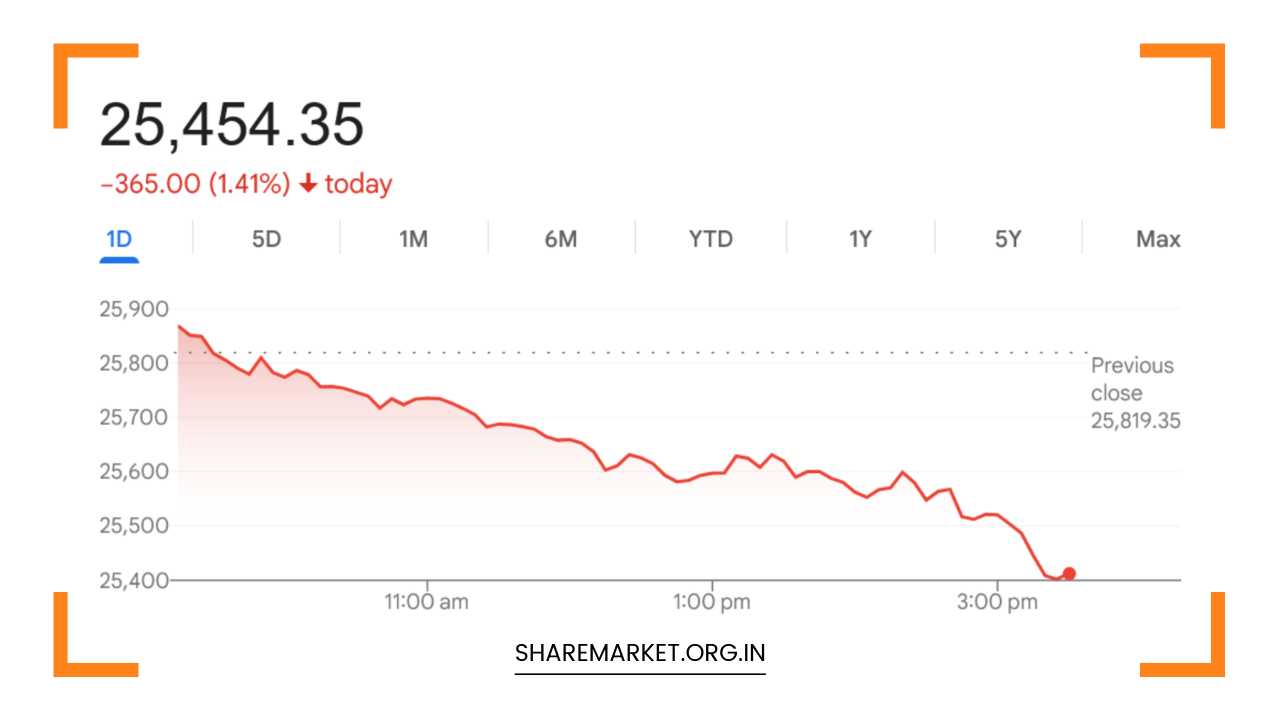
The session on February 19 was characterized by a “sell everything” mentality. The BSE Sensex plummeted 1,470 points during intraday trading before settling at 82,498.14, a decline of 1.48%. Similarly, the NSE Nifty 50 hit an intraday low of 25,388.75, eventually closing at 25,454.35, down 1.41%.
The carnage was not limited to blue-chip stocks. The broader market took a heavier hit, reflecting a lack of confidence among retail and institutional investors alike:
-
BSE 150 Midcap Index: Closed down 1.54%.
-
BSE 250 Smallcap Index: Closed down 1.16%.
-
Wealth Erosion: Investors saw approximately ₹8 lakh crore wiped out in a single session, with the total market capitalization of BSE-listed companies shrinking from ₹472 lakh crore to ₹464 lakh crore.
Sectoral Performance and Individual Drags
While the decline was universal across sectors, some felt the pinch more than others. Auto, Realty, and Capital Goods led the retreat, each falling by over 2%.
| Top Losers (Nifty) | Top Gainers (Nifty) |
| InterGlobe Aviation (Indigo) | Dr. Reddy’s Laboratories |
| Mahindra & Mahindra (M&M) | ONGC (Oil & Gas hedge) |
| Bharat Electronics (BEL) | HDFC Life |
| UltraTech Cement | Hindalco Industries |
| Trent |
The resilience of ONGC is particularly telling; as crude oil prices climb due to Middle Eastern instability, domestic explorers often act as a natural hedge for the index.
Technical Analysis: The “Bearish Engulfing” Threat
Technical analysts are sounding the alarm. Nagaraj Shetti, Senior Technical Research Analyst at HDFC Securities, noted that the Nifty formed a “long-range bear candle” on the daily chart. This candle, boasting a 500-point range, effectively wiped out the gains of the previous four sessions in one fell swoop.
Technically, this suggests a Bearish Engulfing pattern. This occurs when a large red candle completely “engulfs” the body of the previous day’s green candle, signaling that the bears have taken full control of the narrative.
Key Levels to Watch for February 20:
-
Support at 25,400: This is the immediate psychological and technical floor.
-
The 25,200 – 25,100 Zone: If 25,400 breaks early on Friday, the market is likely to slide toward this secondary support zone, where buyers might finally see value.
-
Resistance at 25,800: Any recovery attempt will likely face stiff selling pressure at this level, which has now transitioned from support to resistance.
The Valuation Dilemma: Quality Over Hype
A recurring theme among experts is the “froth” in the mid- and small-cap segments. VK Vijayakumar, Chief Investment Strategist at Geojit Investments, points out a stark divergence in valuations:
-
Nifty 50: Trading at roughly 20x FY27 estimated earnings (considered reasonable).
-
NSE Midcap: Trading at 28x FY27 earnings.
-
NSE Smallcap: Trading at 24x FY27 earnings.
When geopolitical risks rise, high-valuation stocks are the first to be dumped. In a “risk-off” environment, capital flows back toward the safety of large caps with proven balance sheets and predictable cash flows. This is no longer a “rising tide lifts all boats” market; it is a stock-picker’s market.
The Geopolitical Catalyst: Why the Middle East Matters
The primary driver of this volatility is the escalating tension between the US and Iran. The Middle East is home to the Strait of Hormuz, a chokepoint through which nearly 20% of the world’s oil consumption passes.
-
Crude Oil Spikes: Brent crude creeping toward the $90-$95 mark is a direct threat to India’s fiscal deficit and inflation targets, as India imports over 80% of its oil.
-
The FII Exit: Foreign Institutional Investors (FIIs) tend to pull out of emerging markets like India when global uncertainty peaks, seeking the “safe haven” of the US Dollar and Gold.
-
Supply Chain Disruptions: Renewed conflict threatens to disrupt shipping lanes, increasing freight costs and fueling global “cost-push” inflation.
Market Prediction for February 20 and Beyond
Despite the grim headlines, some analysts see a silver lining. Abhinav Tiwari of Bonanza Research suggests that while the short term will remain turbulent, India’s domestic fundamentals—robust tax collections, steady credit growth, and cooling domestic inflation—remain intact.
“A correction is not a trend reversal,” Tiwari notes. “For the long-term investor, these dips offer an entry point into high-quality names that were previously overextended.”
What Should Investors Do?
As we head into the February 20 session, the strategy should be one of cautious observation rather than panic.
-
Avoid Bottom-Fishing: Do not jump into falling small-cap stocks just because they “look cheap.”
-
Watch the Rupee: Keep an eye on the USD/INR pair; a weakening rupee will put further pressure on equities.
-
Focus on Defensives: Pharmaceuticals (like Dr. Reddy’s) and large-cap IT may provide some shelter if the sell-off continues.
The Bottom Line: The market is currently reacting to “known unknowns.” Until there is clarity on the extent of the military escalation in the Middle East, volatility will be the only constant. February 20 will be a test of the 25,400 support level; if it holds, we may see a period of consolidation. If it breaks, the bears may have a long weekend ahead of them.