Sensex Down 148 Points, Nifty at 25,509; Nifty Prediction for Tomorrow
Market Closes in the Red: What Lies Ahead for November 7th?
The Indian stock market ended lower on Wednesday, November 6th, extending its cautious tone after a volatile start to the week. Despite intermittent attempts at recovery during intraday trading, selling pressure in metal, power, and realty stocks dragged the benchmark indices into the red by the closing bell.
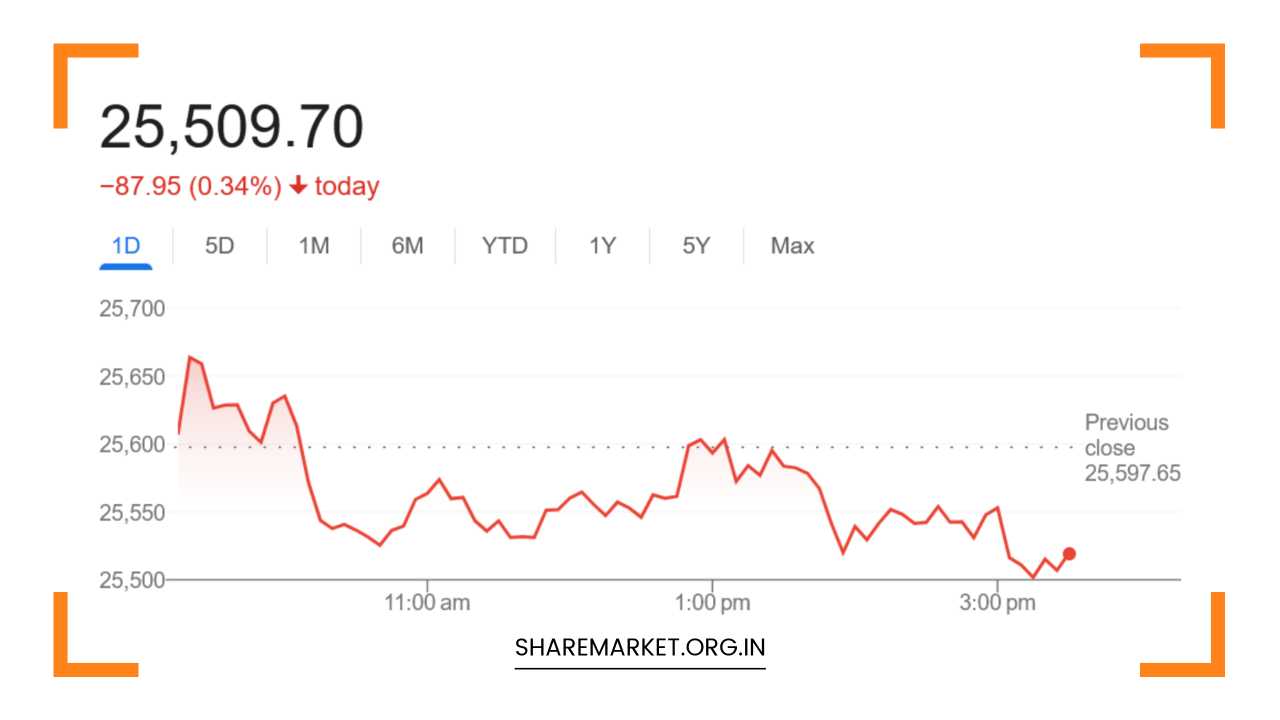
At market close, the BSE Sensex slipped 148.14 points, or 0.18 percent, to end at 83,311.01, while the Nifty 50 declined 87.95 points, or 0.34 percent, to settle at 25,509.70. Market breadth favored the bears, with 1,174 stocks advancing, 2,855 declining, and 130 remaining unchanged on the BSE. The session reflected a mild risk-off sentiment as investors chose to book profits after the recent uptrend and awaited key domestic and global triggers.
Sectoral Performance: Metals and Power Under Pressure
A closer look at the sectoral indices showed a mixed performance. The Nifty Metal, Power, Realty, and Media indices fell sharply, losing between 1.5% and 2.5%. The correction in these sectors came after a strong run-up in the past few weeks, particularly in metals, which had benefitted from expectations of Chinese stimulus and improving global demand. However, renewed concerns about slowing industrial activity in China and moderating commodity prices led investors to pare positions.
On the other hand, FMCG, Auto, and IT sectors provided some cushion to the market, closing with marginal gains. Defensive buying in consumer staples like Hindustan Unilever and ITC helped offset some of the broader market weakness. Auto stocks such as Tata Motors and M&M found support after reporting encouraging monthly sales figures and festive season demand. In the IT pack, Infosys and TCS saw mild buying interest amid a weaker rupee, which tends to boost export earnings for technology firms.
The BSE Midcap index declined by 1.2 percent, while the Smallcap index fell by 1.5 percent, reflecting broad-based selling across the market. The underperformance of the broader indices suggests that investors are turning more selective and cautious, preferring to stay in quality large-cap names until the market direction becomes clearer.
Among the top gainers on the Nifty were Asian Paints, InterGlobe Aviation (IndiGo), Mahindra & Mahindra, Reliance Industries, and UltraTech Cement, which managed to buck the downtrend. Meanwhile, Hindalco, Grasim Industries, Adani Enterprises, Power Grid Corporation, and Eternal featured among the top losers, pulling the index lower.
Technical View: Key Support and Resistance Levels
According to Rupak Dey, Senior Technical Analyst at LKP Securities, the Nifty’s close below its 21-day exponential moving average (EMA) is a sign of short-term weakness. “The index has slipped below the 21EMA, indicating a pause in the recent upward momentum,” he said. “Currently, it is hovering near the immediate support zone of 25,450, which coincides with the previous swing high. If Nifty falls decisively below this level, the short-term trend may turn bearish, potentially inviting further selling pressure. Conversely, as long as the index holds above 25,450, a rebound cannot be ruled out.”
This analysis highlights a critical juncture for the market: traders will be closely watching whether the index manages to sustain above the support region, which could determine the near-term trajectory.
Rajesh Bhosale, Equity Analyst at Angel One, echoed similar caution, noting that “after the strong rally seen in October, the markets appear to have entered a cooling-off phase.” He added that the recent consolidation might continue for a few sessions as investors digest corporate earnings and await fresh triggers.
Anand James, Chief Market Strategist at Geojit Financial Services, pointed out that Nifty could regain bullish momentum if it sustains above the 25,630–25,650 range. “If the index manages to stay above this level, it may aim for resistance levels near 25,770 and 26,035. On the downside, any break below 25,450 could intensify selling pressure,” he explained.
What Could Influence the Market on November 7th?
Market participants expect Thursday’s session (November 7th) to be driven largely by global cues, foreign institutional investor (FII) flows, and stock-specific reactions to ongoing Q2 FY26 earnings.
According to Abhinav Tiwari, Research Analyst at Bonanza Portfolio, “the next directional move will depend heavily on how foreign investors position themselves. FIIs have been net sellers over the past few sessions, reflecting a cautious stance amid global uncertainty and slightly elevated U.S. bond yields.”
He also pointed out that the market is keeping a close eye on Life Insurance Corporation of India (LIC), whose quarterly results are expected soon. “LIC’s numbers could have a significant impact on the sentiment within the financials and insurance space,” he added.
Macroeconomic and Global Factors
On the macroeconomic front, the Indian rupee remained relatively stable around ₹88.6 per U.S. dollar, supported by the Reserve Bank of India’s (RBI) intervention in the currency market. A steady rupee has helped limit foreign outflows, even as global investors await clarity on U.S. monetary policy.
Globally, market sentiment remains cautiously optimistic. Investors are pricing in a 65% probability of another interest rate cut by the U.S. Federal Reserve in December, following a series of dovish comments from Fed officials. If this materializes, it could boost risk appetite and provide support to emerging market equities, including India.
Meanwhile, Asian markets traded mixed as traders assessed weaker-than-expected Chinese manufacturing data and geopolitical developments in the Middle East. European markets were slightly positive, buoyed by improving earnings reports and hopes of rate easing. U.S. futures suggested a flat-to-slightly-positive open, providing a neutral global backdrop for Indian equities.
Outlook: Volatility Ahead, but Long-Term Uptrend Intact
Despite the near-term softness, analysts remain optimistic about India’s medium-to-long-term growth story. Strong domestic macroeconomic indicators—rising GST collections, steady corporate earnings, and robust credit growth—continue to underpin investor confidence.
However, in the short run, traders should brace for bouts of volatility as the market consolidates near record highs. Key levels to watch on the Nifty are 25,450 (support) and 25,770–26,035 (resistance). A decisive move beyond these ranges could set the tone for the next directional trend.
In summary, the Indian market’s dip on November 6th reflects a phase of profit-booking and consolidation rather than a trend reversal. With crucial earnings releases, global policy signals, and currency movements shaping investor sentiment, November 7th is likely to witness a cautious yet opportunity-driven trading day.