Sensex Down 150 Points, Nifty at 25,936; Tomorrow Nifty Prediction
Market Closes Lower Amid Volatility: What to Expect on October 29
The Indian stock market ended lower on October 28, 2025, following a volatile trading session marked by frequent fluctuations across key indices. Despite early optimism in the morning session, profit booking in heavyweight sectors such as IT, FMCG, and pharma erased most of the intraday gains. By the close, benchmark indices had slipped into the red, with traders turning cautious ahead of key domestic and global economic cues expected later in the week.
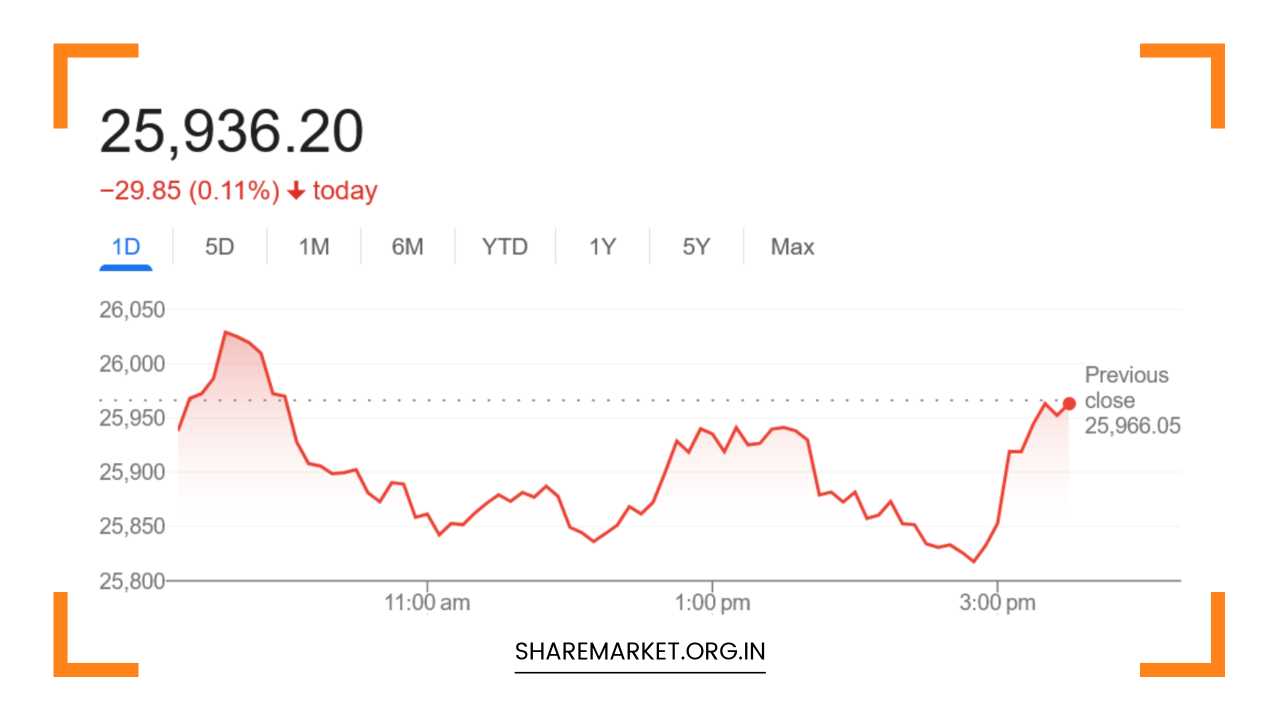
The Sensex closed at 84,628.16, down 150.68 points or 0.18 percent, while the Nifty 50 settled at 25,936.20, down 29.85 points or 0.11 percent. Market breadth remained slightly negative, with 1,809 stocks advancing, 2,171 declining, and 158 remaining unchanged on the BSE. The mixed performance underscored a tug-of-war between bullish sentiment driven by strong domestic fundamentals and persistent concerns over high valuations and global uncertainty.
Key Gainers and Losers
In the Nifty pack, Bajaj Finserv, Power Grid, ONGC, Coal India, and Trent emerged as the top laggards, weighed down by profit-taking and sectoral weakness. Bajaj Finserv and Power Grid saw declines following muted quarterly updates and sector rotation away from defensive and energy counters. Meanwhile, ONGC and Coal India witnessed selling pressure amid fluctuations in crude oil and coal prices globally.
On the other hand, Tata Steel, SBI Life Insurance, JSW Steel, HDFC Life, and Larsen & Toubro (L&T) were among the top gainers. The metals sector, in particular, saw renewed buying interest after global commodity prices rebounded and expectations rose for increased infrastructure spending in the upcoming Union Budget. Tata Steel and JSW Steel benefited from strong global demand signals, while L&T attracted investors following a series of large infrastructure project wins in the Middle East and domestic markets.
Sectoral and Broader Market Performance
Sectorally, the market showed a mixed pattern. The metal and PSU bank indices gained around 1.2 percent each, driven by renewed optimism in global commodities and improved credit growth data. In contrast, IT, pharma, FMCG, and realty sectors fell between 0.5 and 1 percent, as investors preferred to book profits after recent gains and ahead of U.S. Federal Reserve commentary on interest rates.
The BSE Midcap and Smallcap indices ended flat, indicating indecisiveness among investors in the broader market. While some midcap stocks continued to attract retail buying, selective profit booking limited broader market participation. Analysts noted that while the broader market remains structurally strong, valuations in certain pockets are beginning to appear stretched, prompting caution among institutional investors.
Technical View: Nifty Holding Crucial Support
From a technical perspective, Anand James, Chief Market Strategist at Geojit Financial Services, highlighted that Monday’s Nifty rally failed to decisively cross the critical 25,940–26,000 zone. According to him, a sustained move above 26,000 could pave the way for a further uptrend, extending gains toward 26,200 and beyond. Conversely, a breakdown below 25,900 could signal weakness and potentially drag the index toward 25,700 or even 25,400, though he believes such a sharp correction is unlikely in the near term.
James added that market volatility is likely to persist in the short term as traders reposition themselves after the monthly F&O expiry. However, he emphasized that as long as the index stays above its key support at 25,700–25,750, the broader structure remains sideways-to-bullish.
Valuations and Foreign Investor Sentiment
V.K. Vijayakumar, Chief Investment Strategist at Geojit Investments, pointed out that improving GDP growth data and robust corporate earnings continue to support India’s long-term market outlook. However, he cautioned that the Indian market’s relatively expensive valuations could deter foreign institutional investors (FIIs), especially if global yields rise or if the market rallies too quickly.
According to Vijayakumar, “The underlying fundamentals remain strong, but valuations are at the upper end of the historical range. FIIs have turned cautious recently, booking profits after consistent inflows over the past few months. Any sharp rally could invite another round of selling by foreign investors.”
This dynamic between strong domestic fundamentals and external valuation pressure is likely to define near-term market behavior. The movement of FIIs and domestic institutional investors (DIIs) will play a crucial role in determining whether Nifty can sustain its position above 26,000.
Analyst Expectations for October 29
Amruta Shinde, Technical and Derivatives Analyst at Choice Broking, noted that the immediate resistance for Nifty lies at 26,000–26,100, with support at 25,750. She expects a decisive move above 26,000 to trigger momentum buying that could carry the index toward 26,200 in the short term. “As long as Nifty holds above 25,750, the trend remains positive, and traders may continue to adopt a buy-on-dips strategy,” Shinde said.
Similarly, Rupak Dey, Senior Technical Analyst at LKP Securities, observed that the market displayed heightened volatility on the NSE’s monthly F&O expiry day. Despite the choppiness, he pointed out that the overall chart structure remains intact. “Nifty is comfortably trading above its 21-day exponential moving average (EMA), which indicates that the underlying bullish trend remains valid,” he said.
He added that the Relative Strength Index (RSI) continues to show a bullish crossover and remains in the high momentum zone, signaling potential for further upside if the index breaches the 26,000 mark decisively. According to Dey, resistance levels are seen near 26,300, while immediate support lies at 25,850.
Market Prediction : What to Watch on October 29
Going into October 29, traders will be closely monitoring both global cues and domestic developments. Key factors to watch include movements in U.S. Treasury yields, crude oil prices, and the rupee’s performance against the dollar. Additionally, corporate earnings from key companies in the banking and technology sectors may influence investor sentiment.
Market participants are also eyeing commentary from the Reserve Bank of India (RBI) regarding inflation trends and liquidity management. A dovish tone could boost rate-sensitive sectors such as realty, auto, and banking, while any hint of tightening could dampen short-term enthusiasm.
In the broader context, India continues to stand out as one of the most resilient emerging markets, buoyed by robust domestic consumption, a strong investment pipeline, and improving fiscal metrics. However, given the elevated valuations and intermittent volatility, analysts advise traders to exercise caution and avoid over-leveraged positions.
Bottom Line
The Nifty’s failure to close above the 26,000 mark indicates continued indecision in the market, though the broader undertone remains positive. A breakout above 26,000 could trigger a fresh leg of rally toward 26,200–26,300, while a slip below 25,850 may invite mild profit booking. For now, maintaining a balanced approach—buying selectively on dips while keeping a close eye on global cues—appears to be the prudent strategy as the market heads into the final trading sessions of October.