Sensex Down 217 Points, Nifty at 22,460; Tomorrow Nifty Prediction
Tomorrow Nifty Prediction
Market Closes with a Decline: What to Expect on March 11
Market Overview: The Indian stock market faced significant volatility on March 10, 2025, as major benchmark indices ended the day in the red.
While the market showed some promise earlier in the day, it struggled to maintain its gains, particularly in the second half of the trading session.
The broader market, especially mid and small-cap stocks, bore the brunt of the sell-off, leading to a sharp decline across major indices.
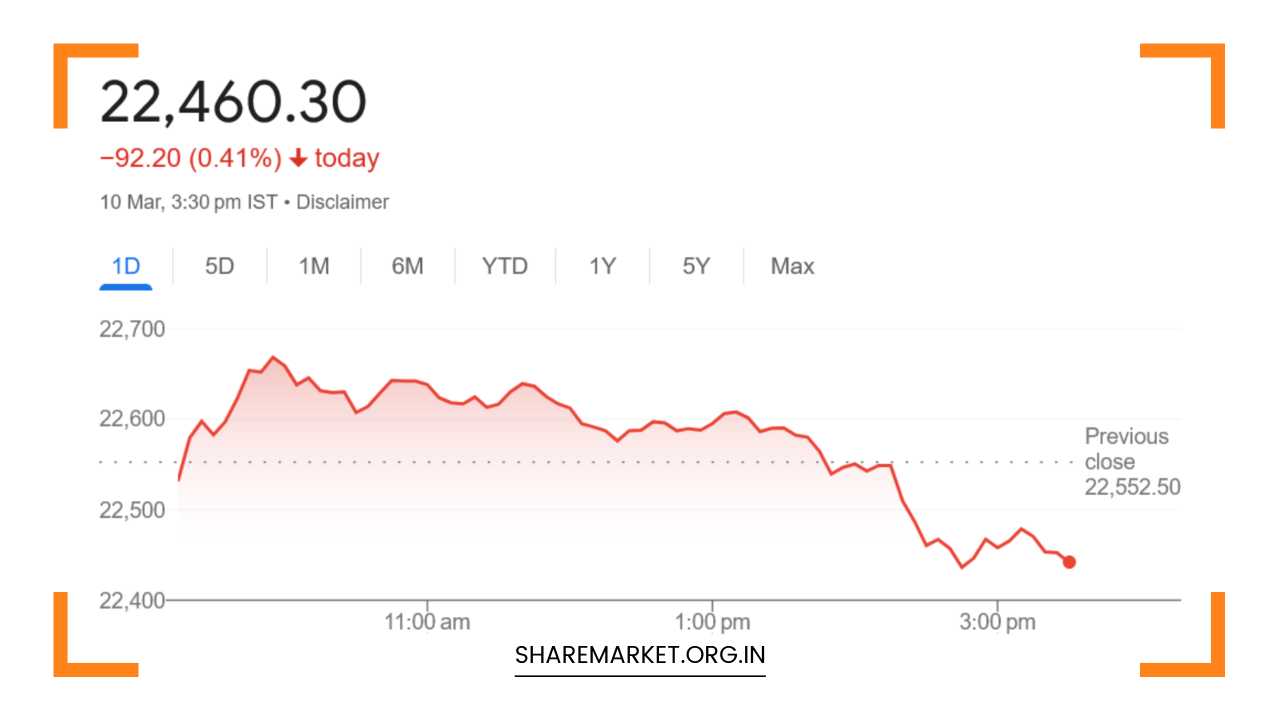
The Nifty index, which is widely regarded as a barometer of the market’s performance, fell below the 22,500 mark during the session, signaling a weak sentiment in the market.
The Sensex, which tracks the performance of the 30 largest companies listed on the Bombay Stock Exchange (BSE), also ended the day lower, adding to the overall pessimism surrounding market performance.
Given the overall trends and sentiment, the outlook for March 11 remains uncertain, with the market likely to remain volatile in the near term.
Stock Market Performance:
The Indian stock market closed with notable losses on March 10. The Sensex ended the trading day at 74,115.17, down by 217.41 points or 0.29%.
Similarly, the Nifty closed at 22,460.30, down by 92.20 points or 0.41%. The broader market also showed signs of weakness, with 1,147 stocks advancing, while 2,776 stocks declined, and 140 stocks remained unchanged.
This sharp divergence between advancing and declining stocks highlights the challenges faced by investors in navigating this volatile environment.
The Nifty Bank index, which tracks the performance of the banking sector, was hit particularly hard, closing 281 points lower at 48,217.
Meanwhile, the Midcap index closed 751 points down at 48,440. These declines in the banking and midcap stocks reflect the broader market’s struggle to find a direction in a period of heightened volatility.
Among the Nifty 50 stocks, 39 out of 50 ended in the red, underscoring the broad-based nature of the decline.
Likewise, 23 out of 30 Sensex stocks and 11 out of 12 Nifty Bank stocks closed lower. These widespread declines across multiple sectors indicate a broad loss of investor confidence, with most segments of the market facing downward pressure.
Sectoral Performance:
One of the key highlights of March 10 was the underperformance of almost all sectors, with the exception of the FMCG (Fast-Moving Consumer Goods) sector.
The FMCG sector, known for its stability and defensive nature, was one of the few areas that managed to hold its ground amidst the broader sell-off.
In contrast, the real estate and PSU (Public Sector Undertaking) banking stocks were the worst hit, contributing significantly to the market’s overall decline.
The weakness in the realty sector can be attributed to concerns over interest rate hikes and rising inflation, while PSU bank stocks continue to face challenges related to asset quality and regulatory pressures.
The broader market, represented by mid and small-cap stocks, performed much worse than the benchmark indices.
The mid and small-cap stocks saw declines of over 1.5%, reflecting heightened risk aversion among investors.
These stocks, typically considered riskier than large-cap stocks, are more vulnerable to market volatility, and their underperformance is a testament to the broader market’s fragile sentiment.
Expert Insights: Aditya Gaggar,
Director at Progressive Shares, provided insights into the day’s market activity. According to Gaggar, the market initially experienced a rally, driven primarily by large-cap stocks.
However, the rally faltered as the market faced resistance around the 22,620 mark. Despite attempts to push higher, the market struggled to sustain its gains, and the rally ultimately lost momentum.
Gaggar highlighted that the real damage came in the second half of the trading session when mid and small-cap stocks experienced a sharp sell-off.
This selling pressure was significant enough to drag the Nifty down by 92.20 points, closing at 22,460.30.
For the market to make a meaningful recovery, Gaggar suggests that the bulls will need to break through the strong resistance zone between 22,620 and 22,730.
If the Nifty manages to surpass this resistance, it could pave the way for a reversal and a potential rally.
However, if the market fails to breach these levels, it may continue to struggle, and further declines could be on the horizon.
Vinod Nair, Head of Research at Geojit Financial Services, pointed to the deteriorating global cues as a significant factor influencing market sentiment.
The ongoing uncertainty in the U.S. economy, particularly concerns related to rising unemployment rates and potential tariff hikes, has led to increased volatility.
This global uncertainty is having a ripple effect on markets worldwide, including India. Nair believes that the market is likely to remain volatile in the near future, as investors react to the evolving global economic conditions.
Prashant Tapase, Senior Technical Analyst at Mehta Equities, emphasized the broad-based nature of the market’s weakness, particularly in mid and small-cap stocks.
Tapase also noted the sharp depreciation of the Indian rupee, which has added to the market’s concerns.
The depreciation of the rupee makes imports more expensive, potentially leading to higher inflation.
Additionally, the continued outflow of foreign funds from the Indian market is putting additional pressure on the market. Tapase suggests that the combination of these factors is likely to result in continued volatility in the short term.
Market Prediction for March 11:
Looking ahead to March 11, the outlook remains uncertain. The market is likely to remain volatile, with global and domestic factors continuing to exert influence.
From a technical perspective, the Nifty faces strong resistance in the 22,620-22,730 zone. A break above these levels could signal a potential reversal and a shift toward a more positive sentiment.
However, if the Nifty closes below 22,330, it could lead to further declines, potentially taking the index back to its previous swing low of 21,960.
Investors should also keep a close eye on global cues, particularly developments in the U.S. economy. The ongoing uncertainty around the unemployment rate, inflation, and potential tariff hikes could continue to fuel volatility.
On the domestic front, concerns about the rupee’s depreciation and the outflow of foreign funds are likely to remain key drivers of market sentiment.
Final Remarks:
In summary, the Indian stock market experienced a significant decline on March 10, driven by broad-based losses across multiple sectors, particularly in mid and small-cap stocks.
With volatility expected to persist in the near term, investors should remain cautious and closely monitor key support and resistance levels, along with global and domestic economic developments.
The market’s direction over the next few days will likely depend on its ability to break key resistance levels and the resolution of external factors such as global economic conditions and currency fluctuations.
For now, volatility seems to be the dominant theme, and investors will need to navigate these turbulent waters with care and attention to detail.