Sensex Down 277 Points, Nifty at 25,910; Tomorrow Nifty Prediction
Market Closes with a Decline: What to Expect on November 19th
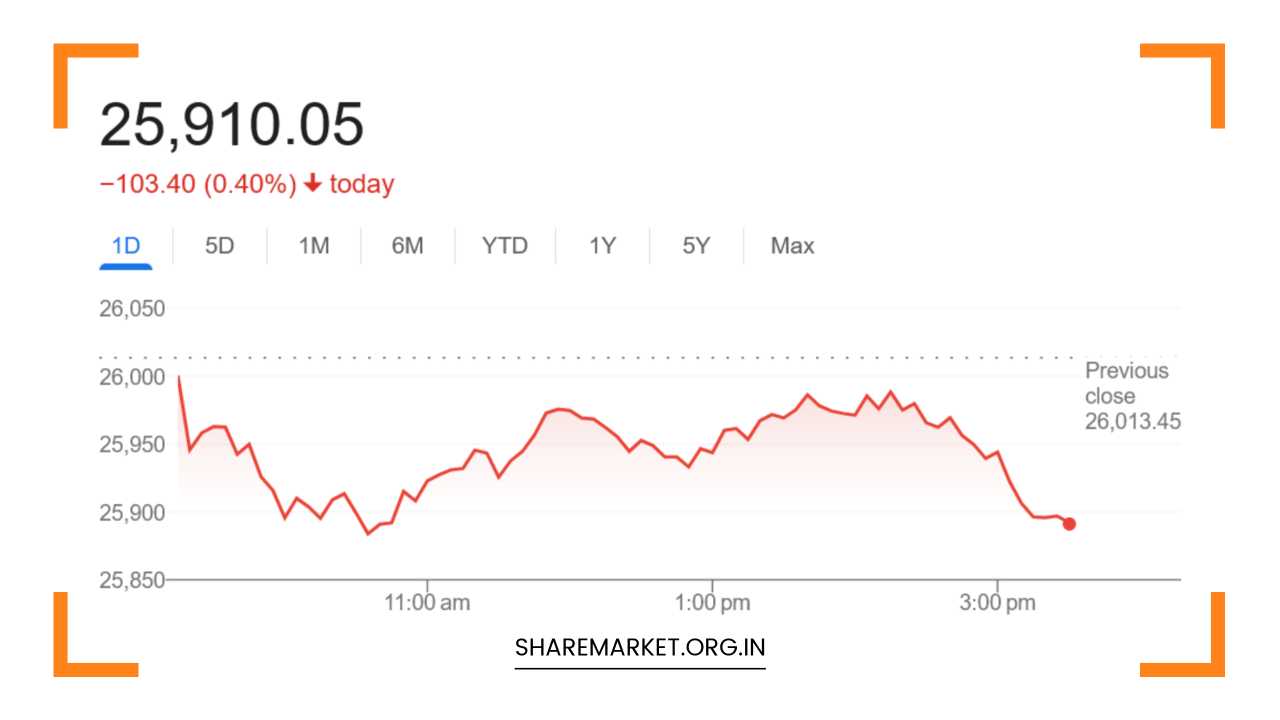
The Indian stock market ended on a subdued note on November 18th, reflecting cautious sentiment among investors as global cues remained mixed and domestic indices struggled to sustain intraday recoveries. Throughout the session, the Nifty remained under pressure and spent most of its time trading below the crucial 25,900 mark. By the closing bell, the benchmark indices had extended their losses, signaling that traders preferred to trim positions ahead of key economic events and global developments expected later in the week.
At the end of the trading session, the Sensex dropped 277.93 points, or 0.33 percent, settling at 84,673.02. Meanwhile, the Nifty50 fell 103.40 points, or 0.40 percent, to close at 25,910.05. Market breadth also leaned heavily toward negative territory, with 1,393 stocks advancing against 2,632 declining, while 131 remained unchanged. The skewed ratio indicates that profit-booking was broad-based and not limited to large-cap counters alone.
Sector and Stock Performance on November 18th
Among the Nifty components, Bharti Airtel, Axis Bank, Power Grid Corporation, Bajaj Auto, and Asian Paints emerged as the top gainers, showing resilience despite a weak broader market. On the flip side, Tech Mahindra, Tata Consumer, Jio Financial Services, InterGlobe Aviation, and Bajaj Finserv were the major laggards, exerting downward pressure on the index. The IT sector continued its recent correction as concerns over global technology spending persisted.
The broader markets also mirrored the weakness in frontline indices. The BSE Midcap index slipped 0.7 percent, while the Smallcap index fell 0.8 percent, reflecting heightened selling pressure in more volatile market segments. All key sectoral indices closed in the red, highlighting widespread caution across industries. Notably, IT, metals, and realty sectors declined by roughly 1 percent, weighed down by global uncertainties and softer demand expectations.
How the Market Might Move on November 19th
Market participants are now shifting focus to November 19th as they look for cues on whether the Nifty can stabilize or if the market’s corrective phase will deepen. Analysts remain divided on short-term direction, with expectations ranging from sideways consolidation to a possible rebound from support levels.
Analyst View: Anand James on Nifty’s Range-Bound Setup
Anand James, Chief Market Strategist at Geojit Financial Services, observed that the Nifty’s near-term direction remains uncertain since the index is currently locked within a tight trading range. According to him, the band between 26,130 and 25,840 is crucial, with sideways movement likely unless a strong breakout occurs. James expects an initial drift toward 25,980 or even 25,900 before the index attempts a recovery. If the Nifty manages to climb directly above 26,022, it could trigger an upward move targeting 26,130, a level where fresh buying may emerge.
Broader Market Perspective: VK Vijayakumar on Positive Macro Factors
Providing a macro-focused viewpoint, VK Vijayakumar, Chief Investment Strategist at Geojit Investments, highlighted three positive factors that could support the Indian market despite recent volatility.
First, he pointed to encouraging statements from the White House, indicating that the United States is “close to a trade deal with India.” Such developments can boost market sentiment, especially in sectors positioned to benefit from increased trade cooperation.
Second, Vijayakumar noted the diminishing global AI frenzy. While this cooling trend may dampen valuations in global tech-heavy markets, he believes India may benefit indirectly. With global investors reassessing high-growth tech bets, India—bolstered by strong structural fundamentals, a growing digital ecosystem, and resilient domestic demand—may attract renewed interest.
Third, he highlighted improving domestic fundamentals. Strong GDP growth, healthy corporate earnings, and an ongoing investment cycle continue to reinforce confidence among long-term investors. These drivers, he said, are supporting the market’s ongoing mild rally.
However, he cautioned against assuming foreign investor inflows will continue uninterrupted. Although FPIs have recently turned into net buyers, it is too early to declare this a sustained trend given their intermittent selling throughout the year. Vijayakumar also emphasized the critical role of consumption in driving the next phase of the rally. While the recent GST rate cut has sparked hopes of quicker demand recovery, he stressed that sustained improvements in consumption-related data—such as retail sales and household spending—are essential.
Technical Levels to Watch: Insights from Dhupesh Dhameja
Dhupesh Dhameja, Derivatives Research Analyst at SAMCO Securities, offered a technical breakdown of the Nifty’s immediate support and resistance levels. On the downside, he identified the 25,850–25,780 range as a crucial support zone. As long as the index remains above this level, he believes the broader trend will stay positive.
On the upside, Dhameja marked the 26,050–26,100 zone as a key resistance band. A decisive close above this level could open the path for the Nifty to retest its all-time high of 26,277.35. Such a breakout would likely encourage momentum traders to add long positions.
Dhameja also advised traders to pay close attention to derivatives activity, especially indications of short covering at the 26,000 call option or fresh put writing at 25,900 or 25,950. These signals typically precede stronger directional movements. Based on current momentum indicators, derivatives positioning, and relatively stable volatility levels, he believes market sentiment remains tilted in favor of the bulls.
Outlook for Investors
Overall, while the market ended in the red on November 18th, analysts remain cautiously optimistic about the near term. The interplay between global signals, domestic macro conditions, and technical indicators will likely determine the Nifty’s movement on November 19th. For investors, the key will be monitoring support zones, observing derivatives cues, and staying alert to macro announcements that might shift sentiment.