Sensex Down 31 Points, Nifty at 25,986; Nifty Prediction for Tomorrow
Indian Market Analysis: Deciphering the Flat Close and Outlook for December 4th
The Indian benchmark indices, the Sensex and Nifty 50, concluded the trading session on December 3rd with a near-flat closing, masking a day of significant intra-day volatility and underlying sector-specific churn. This muted finish, which marks the fourth consecutive day of decline or consolidation, reflects a growing cautiousness among investors, primarily ahead of the crucial Reserve Bank of India’s (RBI) Monetary Policy Committee (MPC) meeting outcome scheduled later in the week.
Market Performance Review: December 3rd
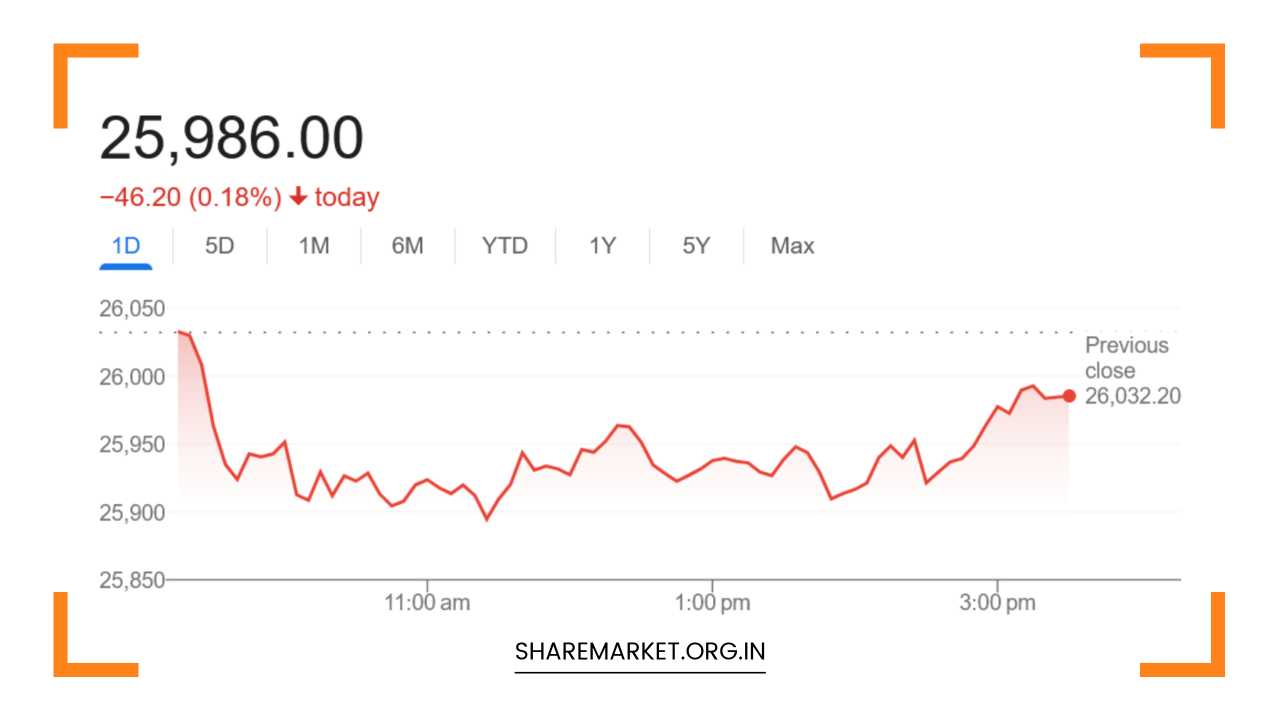
Despite closing marginally in the red, both major indices showcased remarkable recovery in the final hour of trading, pulling back from earlier lows.
-
Sensex Performance: The BSE Sensex settled down by 31.46 points, a negligible decline of 0.04 percent, to close at 85,106.81.
-
Nifty 50 Performance: The NSE Nifty 50 saw a slightly sharper drop of 46.20 points, or 0.18 percent, ending the session at 25,986.00.
This late recovery was primarily attributed to selective buying interest concentrated in specific heavyweight sectors, notably IT and private banks.
Broader Market Weakness and Sectoral Dynamics
The narrow nature of the market rally was clearly evident in the broader market indices and the advance-decline ratio, signaling that only a small portion of the market was participating in the gains.
-
Broader Market Indices: The weakness was more pronounced in the broader market, with the BSE Midcap Index falling 1 percent and the Smallcap Index declining 0.4 percent. This indicates significant profit-booking and pressure outside the top-tier stocks.
-
Market Breadth: The overall market breadth was decidedly weak, with approximately 1,436 shares advancing against 2,553 shares declining, and 144 remaining unchanged. This negative advance-decline ratio of nearly 1:2 clearly favored sellers and points to widespread consolidation.
-
Sectoral Performance:
-
Gainers: The IT sector led the pack, supported by the weakening Indian Rupee which generally boosts export-oriented companies’ dollar-denominated earnings. Media, private banks, and telecom also registered modest gains of 0.2-0.6 percent.
-
Laggards: Sectors linked to domestic investment and government policy faced selling pressure. The PSU bank index fell sharply by 3 percent, possibly reacting to news concerning the Foreign Direct Investment (FDI) limit in the sector. Other heavy losers included Oil and Gas, Metal, Power, PSU, Capital Goods, and Consumer Durables, which closed down between 0.5 percent and 1.5 percent.
-
Top Movers on the Nifty 50
-
Major Losers: The list of significant losers included Max Healthcare, Shriram Finance, Bharat Electronics, InterGlobe Aviation, and Tata Consumer, underscoring the profit-booking and cautious sentiment in diversified sectors.
-
Major Gainers: The benchmark indices were supported by key stocks such as Wipro, Hindalco Industries, TCS, Axis Bank, and ICICI Bank, highlighting the defensive strength of IT and the selective strength in Private Banking.
Market Prediction for December 4th: Key Factors in Focus
The trajectory of the Indian market on December 4th is poised to be dominated by critical domestic and global cues, with the upcoming RBI MPC decision acting as the most significant event overhang.
1. The RBI MPC Meeting: The Central Pivot
The market’s immediate focus is heavily tilted towards the RBI MPC meeting, the outcome of which is due later in the week. Abhinav Tiwari, a research analyst at Bonanza, notes that the general expectation was for a 25 basis point repo rate cut. However, this expectation has been moderated or even questioned following the recent release of strong Q2 GDP data, which suggests robust economic growth.
-
Conflicting Signals: The RBI is currently navigating a complicated environment characterized by high GDP growth and historically low inflation. While low inflation traditionally supports a rate cut, strong growth gives the central bank headroom to maintain the status quo to ensure long-term stability.
-
Revised Expectations: Many economists and market participants are now leaning towards the RBI maintaining the status quo on the repo rate at 5.50% in this policy, leading to underlying uncertainty and volatility in the banking and rate-sensitive sectors.
2. Technical Levels: Nifty 50 and Bank Nifty
Technical analysis suggests that the flat closing is merely a pause in a consolidating trend, and the market’s direction will be determined by whether key support or resistance levels are breached.
-
Nifty 50 Technical View (as per Sudip Shah of SBI Securities):
-
Key Support: The crucial support zone lies between 25,830–25,800. A decisive break below the 25,800 mark could signal deeper downside, potentially leading the index towards 25,650 and then 25,500.
-
Key Resistance: On the upside, immediate resistance is established in the 26,050–26,100 zone. A sustained move above 26,100 would be necessary to negate the recent corrective trend and aim for fresh highs.
-
-
Bank Nifty Technical View (as per Sudip Shah of SBI Securities): Bank Nifty, which has shown relative strength, also faces key levels.
-
Key Resistance: The major hurdle for the index is the 59,400–59,500 zone. A powerful rally and close above 59,500 could propel the index towards targets of 59,800 and subsequently 60,100.
-
Key Support: Downside support for the banking index is placed in the 59,000–58,900 zone.
-
3. Macroeconomic and Global Factors
Beyond the RBI, several other factors will influence investor sentiment:
-
Rupee Volatility and FII Flows: The Indian Rupee has been under pressure, weakening to near-record lows. This, coupled with persistent Foreign Institutional Investor (FII) outflows, is a major source of market weakness. Continued depreciation of the rupee and sustained FII selling could intensify the selling pressure.
-
Global Cues: Investors will monitor global markets, particularly US economic data, as they assess expectations for the US Federal Reserve’s monetary policy. Mixed global cues and currency volatility (such as the jump in Japanese bond yields) contribute to the cautious mood.
-
Trade Deal and Geopolitics: Clarity on the ongoing India-US trade deal and overall geopolitical stability remain important for risk appetite, particularly for sectors reliant on global trade.
Final Thoughts
The market’s flat close on December 3rd is best interpreted as a period of consolidation and caution preceding a major event. While selective buying in IT and private banks prevented a significant decline, the weakness in the broader market and the negative advance-decline ratio suggest that underlying sentiment remains fragile. For December 4th, traders and investors should closely monitor the 25,800 support level on the Nifty and the RBI MPC-related news flow. A break on either side of the critical technical ranges, especially following any new development related to the RBI’s policy outlook, will likely determine the market’s direction for the rest of the week.