Sensex Down 386 Points, Nifty at 25,056; Tomorrow Nifty Prediction
Markets Extend Losing Streak for Fourth Session: What to Expect on September 25
Indian equity markets remained under pressure for the fourth consecutive session on Wednesday, September 24, as a combination of weak global cues, sectoral drag, and cautious investor sentiment weighed on indices.
Despite attempts to stage an intraday recovery, the market closed lower across all major benchmarks, signaling persistent bearish undertones.
As investors turn their attention to September 25, all eyes are on key technical levels and macroeconomic triggers that could shape short-term market direction.
Market Summary – September 24
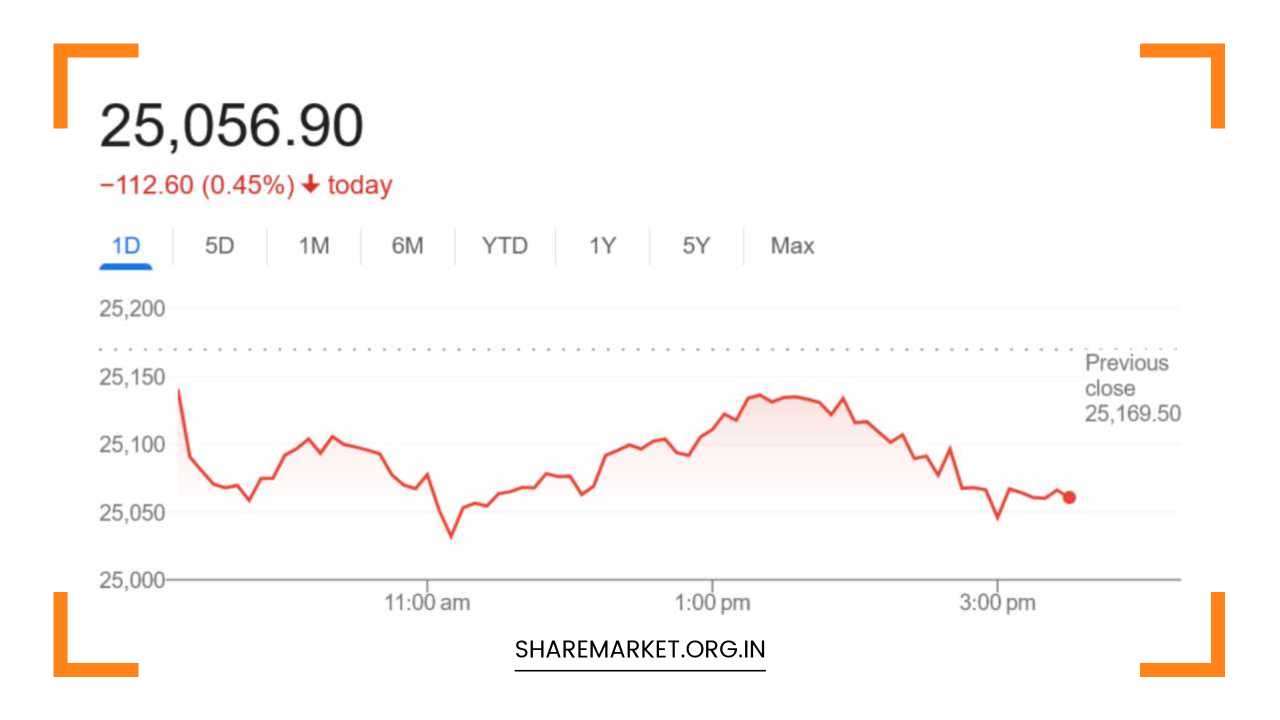
The BSE Sensex declined by 387 points, closing at 81,716, while the Nifty 50 fell by 113 points, settling at 25,057.
This marks the fourth straight session of declines for the benchmark indices, reflecting mounting concerns around global interest rates, rising oil prices, and sectoral underperformance.
The Bank Nifty index saw a sharp correction of 388 points, closing at 55,122, dragged down by weakness in private and PSU banking stocks.
Meanwhile, broader markets continued to underperform, with the Nifty Midcap 100 index shedding 572 points to end at 57,924, indicating sustained selling pressure in mid- and small-cap counters.
Sectoral Performance – Widespread Weakness
The bearish sentiment was evident across most sectors, with realty, auto, energy, IT, metal, and banking stocks leading the decline.
These sectors faced headwinds due to a mix of weak demand outlook, rising input costs, and concerns around global growth.
- Realty and Auto: Both sectors came under pressure as rising interest rates and muted consumer sentiment raised concerns about discretionary spending and credit growth.
- IT and Metals: Weak global cues and sluggish international demand, particularly from developed markets, impacted these export-oriented sectors.
- Banking and Financials: Elevated bond yields and hawkish commentary from the US Federal Reserve weighed on investor confidence in rate-sensitive sectors.
The only bright spot was the FMCG index, which managed to post a marginal gain, supported by select buying in defensive stocks amid broader market weakness.
Market Breadth – Decline Across the Board
The market breadth remained firmly negative:
- Sensex: 22 out of 30 stocks ended in the red.
- Nifty 50: 35 of the 50 stocks saw selling pressure.
- Bank Nifty: 9 of the 12 constituents closed in negative territory.
This widespread decline underscores the broad-based nature of the correction and reflects reduced risk appetite among investors.
Expert Views – Near-Term Uncertainty with Long-Term Positives
Vaibhav Vidwani, Research Analyst at Bonanza Portfolio, noted that the market is expected to remain volatile and range-bound in the near term.
He highlighted that the ongoing India-US treasury discussions, combined with the US Federal Reserve’s stance on interest rates, are contributing to global uncertainty.
“We expect some consolidation in the coming sessions, especially as investors digest macroeconomic developments and await further clarity from central banks,” Vidwani said. “However, over the medium to long term, there are several positives that could support the market — including government-driven reforms, continued capital expenditure by the public sector, and signs of revival in domestic consumption.”
Vidwani also expressed optimism about corporate earnings, which are likely to improve over the next one to two quarters, potentially providing fundamental support to valuations.
Nagaraj Shetty, Technical Research Analyst at HDFC Securities, echoed the cautious sentiment from a technical standpoint.
He pointed out that the Nifty formed a bearish candlestick on the daily chart, marked by minor upper and lower shadows — a sign of indecision and volatility at lower levels.
“Despite an attempt at intraday recovery, the Nifty failed to hold gains and closed near the day’s low. This pattern suggests continued weakness, with no clear indication of a reversal yet,” Shetty explained.
He added that on the weekly chart, the Nifty is approaching a crucial support zone near 24,900, which aligns with both the ascending trendline and the 10-week exponential moving average (EMA).
Key Technical Levels to Watch – Nifty 50
- Immediate Resistance: 25,150
- Crucial Support: 24,900 (Trendline + 10-week EMA)
- Break Below 24,900: Could trigger further downside toward 24,700–24,600
- Break Above 25,150: May lead to a short-covering rally toward 25,300–25,400
Traders and technical analysts are closely monitoring these levels, as a breakdown below support could intensify the selling, while a bounce could indicate the start of a consolidation phase.
What to Expect on September 25 – Volatility Ahead
Heading into the trading session on Thursday, September 25, the outlook remains cautiously bearish to neutral.
With key technical levels being tested, the market may experience high intraday volatility, especially in rate-sensitive and global-facing sectors.
Key Factors to Watch:
- US Bond Yields & Dollar Strength – Rising yields continue to exert pressure on global equity markets and could impact FII flows into Indian markets.
- Oil Prices – Any sustained rise in crude oil prices poses a risk to India’s inflation trajectory and import bill.
- Updates from India-US Talks – Any positive developments on the economic cooperation front may offer some relief to markets.
- FII/DII Activity – Tracking foreign and domestic institutional investor flows will provide cues on broader sentiment.
- Global Markets – Asian and US markets will set the tone for early trades, especially amid uncertainty around rate hikes and inflation expectations.
Final Thoughts – Caution Near Term, Optimism Long Term
While the near-term market trend remains weak and volatile, driven by macroeconomic uncertainties and technical pressure, the long-term outlook continues to be supported by strong fundamentals.
Analysts advise investors to remain cautious in the short run, focus on quality stocks with strong earnings visibility, and avoid over-leveraging during volatile phases.
Any sustained correction could present buy-on-dips opportunities, especially in sectors poised to benefit from India’s structural growth story — such as infrastructure, manufacturing, and select consumption plays.