Sensex Down 400 Points, Nifty at 26,068; Nifty Prediction for Monday
Market closes in the red; here’s how it might play out on November 24
Indian equity markets ended on a subdued note on November 21, extending the cautious sentiment seen throughout the week as traders weighed global cues, sector-specific pressures, and profit-booking near record highs. The benchmark indices slipped moderately, marking a pause in the market’s recent upward momentum, which had pushed indices to new peaks earlier in the month.
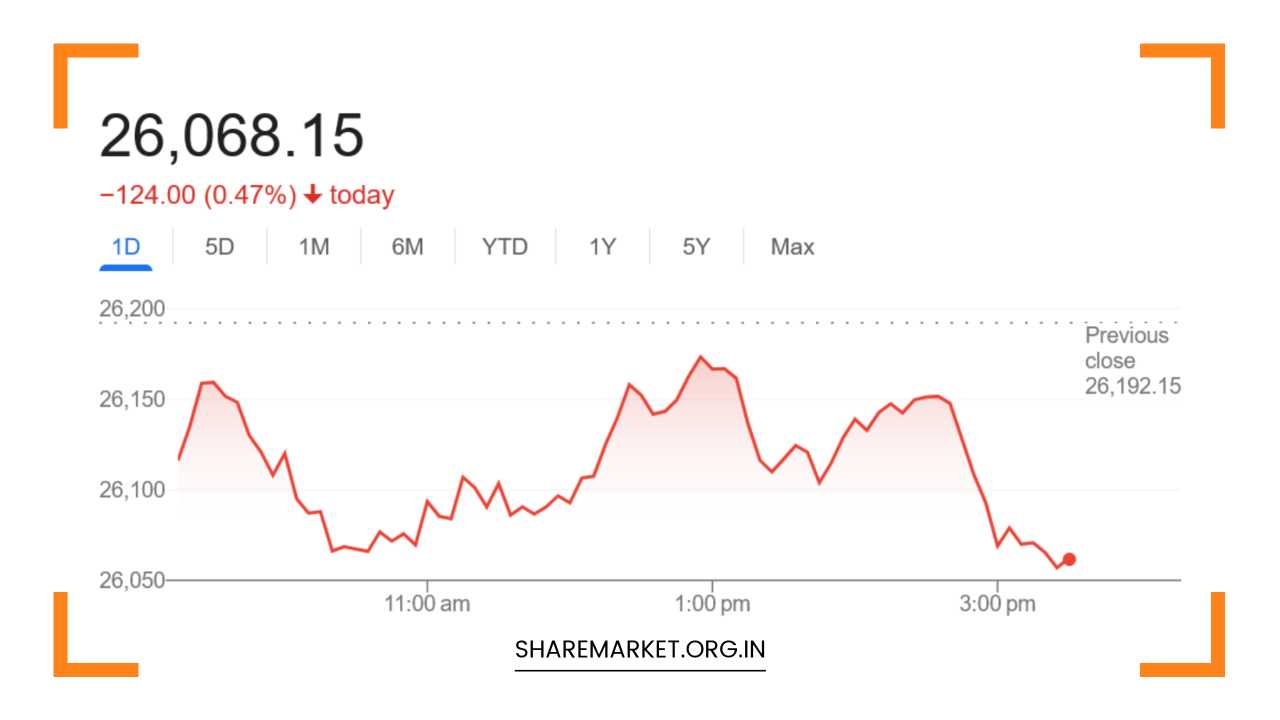
At the closing bell, the Sensex declined 400.76 points, or 0.47 percent, to settle at 85,231.92. The Nifty 50 also fell 124 points, or 0.47 percent, closing at 26,068.15, slipping below the psychologically important 26,100 mark. Market breadth remained weak: out of the total traded stocks, 1,113 advanced, 2,711 declined, while 131 remained unchanged, signaling broad-based selling pressure.
Sectoral and Broader Market Performance
The weakness was more pronounced in the broader markets, with the BSE Midcap and BSE Smallcap indices each losing 1.3 percent. These segments, which had significantly outperformed the benchmark indices over the past few months, witnessed accelerated profit-booking as investors trimmed positions in high-valuation pockets.
On the sectoral front, FMCG was the only index to end in positive territory, reflecting defensive buying amid broader market weakness. All other major sectors closed in the red. Capital goods, realty, PSU banks, and metals saw a decline of around 1 percent each, indicating pressure across cyclical and rate-sensitive spaces.
Stock-specific action also influenced the day’s market tone. Among the major laggards on the Nifty were Maruti Suzuki, M&M, InterGlobe Aviation, Tata Motors PV, and Max Healthcare, all of which faced selling due to a combination of earnings-related concerns, rising input costs, or sector-specific uncertainties. On the other hand, JSW Steel, Hindalco, Tata Steel, Bajaj Finance, and HCL Technologies emerged as the top gainers. The gains in metals were somewhat surprising given the broader sectoral weakness, but analysts attributed this to expectations of improved global commodity demand and favorable Chinese economic signals.
What Triggered the Weakness?
Several underlying factors contributed to the subdued sentiment:
- Global Uncertainty: Traders remained cautious due to ongoing volatility in global markets. Concerns around U.S. interest rate trajectories, geopolitical developments, and mixed signals from Asian markets weighed on risk appetite.
- Stretched Valuations: With markets trading near all-time highs, even minor negative cues prompted investors to book profits, especially in sectors that had seen sharp run-ups.
- Rising Volatility: A spike in the India VIX — the volatility index — indicated uncertainty and nervousness among traders, especially ahead of key global data releases later in the week.
Expert View: How the Market Could Move on November 24
According to Abhinav Tiwari, Research Analyst at Bonanza, the India VIX surged 13%, a significant rise that typically reflects heightened trader anxiety and expectations of near-term fluctuations. Tiwari notes that although the headline indices ended lower, the broader structure of the market remains intact as the indices continue to hover near their lifetime highs.
“Despite the negative close, markets remain near all-time highs, indicating cautious profit-booking rather than widespread selling,” he explained. This suggests that investors are not exiting the markets entirely but are instead taking money off the table in overbought areas.
Tiwari further added that the market’s current consolidation phase reflects a wait-and-watch stance among participants. External uncertainties — such as global monetary policy actions, geopolitical tensions, and fluctuations in commodity prices — continue to influence domestic sentiment. Meanwhile, sector-specific challenges, particularly in autos and healthcare, have also contributed to instability.
He emphasized the importance of keeping a close watch on upcoming global developments, domestic corporate earnings, and macroeconomic announcements, all of which could act as catalysts for directional moves.
Technical Outlook: Key Levels to Watch
Technical indicators also offer insight into possible market direction for November 24.
Anand James, Chief Market Strategist at Geojit Financial Services, highlighted that the Nifty’s recent breakout above its one-month consolidation range had strengthened expectations for a near-term move toward 26,550. However, he cautioned that Thursday’s price action sent mixed signals. The intraday move above the upper Bollinger Band, followed by a close below it, suggests that the upside may now be limited in the short term.
According to James, the 26,237 level is critical. Failure to sustain above this zone could invite selling pressure. Additionally, a fall below 26,160 could increase the likelihood of bearish momentum returning to the market.
“If the price fails to hold above 26,237 or falls below 26,160, the bears could return. In such a scenario, the Nifty could fall to 26,028–25,984,” he said.
These levels will be crucial for traders, especially in the backdrop of rising volatility and sectoral weaknesses. Momentum indicators are also showing signs of fatigue, reinforcing the need for caution in the near term.
What to Expect on November 24
Given the current landscape, the market’s movement on November 24 will likely depend on:
- Overnight global market cues
- U.S. economic data and rate-related commentary
- FIIs’ trading behavior
- The sustainability of support levels highlighted in technical charts
A positive global setup or strong domestic triggers could help the Nifty reclaim lost ground. However, if volatility persists and key support levels are breached, short-term correction cannot be ruled out.
Overall, the bias remains cautiously optimistic, but with heightened sensitivity to external triggers. Traders are advised to stay selective, avoid aggressive bets, and maintain appropriate stop-loss levels.