Sensex Down 411 Points, Nifty at 24,273; Tomorrow Nifty Prediction
Market Closes in the Red: What to Expect on May 9th
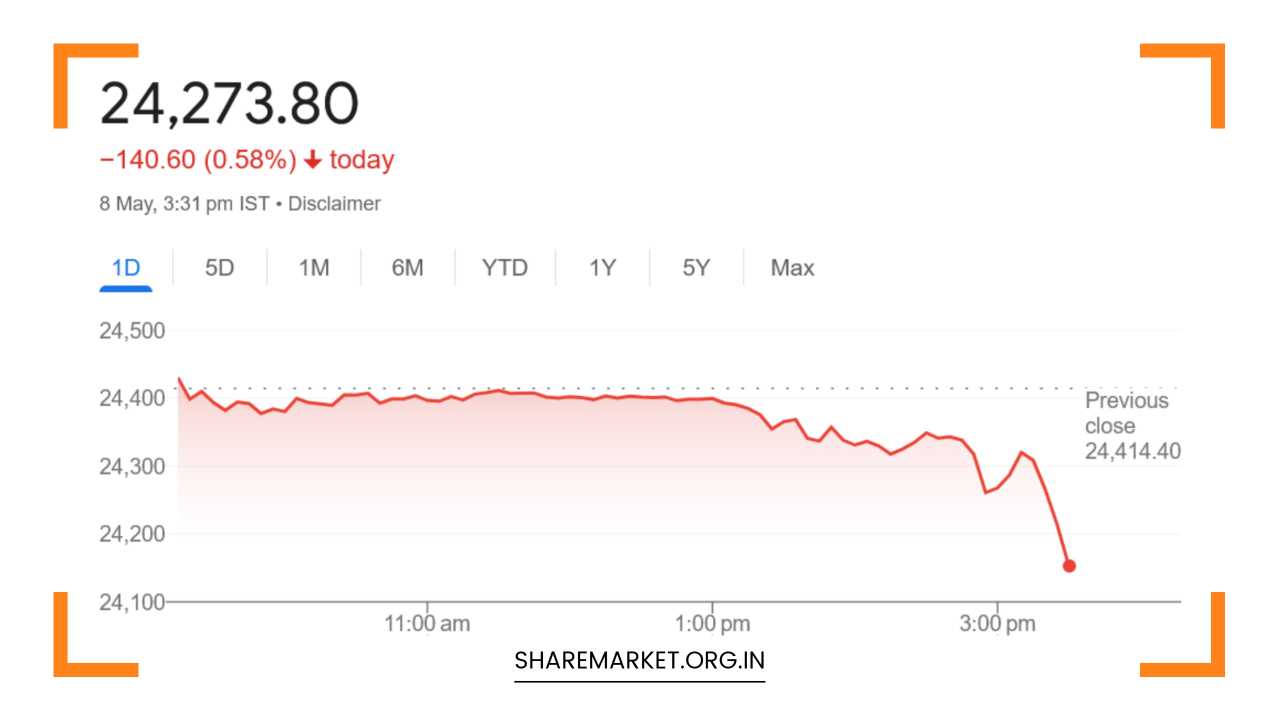
Indian equity markets faced a turbulent session on May 8th, ending the day in the red amidst significant volatility.
The Sensex dropped by 411.97 points, or 0.51%, closing at 80,334.81, while the Nifty saw a larger decline of 140.60 points, or 0.58%, settling at 24,273.80.
The broader market sentiment was equally subdued, with 2,497 stocks declining compared to just 1,256 advancers, highlighting the pervasive risk-off sentiment.
Only 126 stocks managed to close unchanged. This broad-based decline was compounded by sector-specific losses, with most major indices closing in negative territory, reflecting the overall market weakness.
In this context, investors are left wondering whether this bearish trend will continue into the next trading session on May 9th.
Experts are closely monitoring key support and resistance levels for Nifty, as well as the broader macroeconomic and geopolitical developments that are influencing market sentiment.
Key Technical Levels: Support at 24,300 and Resistance at 24,500
Devarsh Vakil, Head of Prime Research at HDFC Securities, suggests that the 24,300 level on the Nifty index is crucial for the market in the near term.
There has been significant put option writing around this level, indicating that there is strong support for Nifty at 24,300.
The increased open interest in put options suggests that institutional investors are positioning for potential support near this level, which could provide a floor for any further downside.
Historically, when such put writing takes place, it indicates that traders are confident in the support at that price level, and any significant drop below it could trigger a fresh round of buying.
On the flip side, Nifty faces resistance at the 24,500 mark. This level is seen as a key hurdle, and if Nifty manages to break above it, there could be a sharp short-covering rally, which would likely trigger a quick move higher.
A sustained move above 24,500 would likely boost investor confidence and shift the market sentiment from cautious to positive, potentially reversing the current downtrend.
Broader Market Sentiment and Geopolitical Concerns
While the technical levels provide a clear framework for short-term market movements, the broader macroeconomic and geopolitical environment remains a critical factor influencing the market’s direction. One of the most significant concerns for investors currently is the escalating tension between India and Pakistan.
Geopolitical risks have been a persistent theme in global markets, and the South Asian subcontinent is no exception.
Recent developments have sparked fears of a potential military escalation between the two countries, which could have far-reaching economic implications.
According to analysts at Jefferies, this increased tension could have a particularly adverse impact on certain sectors, including tourism, high-beta stocks, and industrials.
Tourism and hospitality sectors are particularly vulnerable to such geopolitical tensions, as any escalation could deter international visitors, leading to lower revenues for companies in these sectors.
Similarly, high-beta stocks, which are more sensitive to broader market movements, could experience heightened volatility in the face of increased uncertainty.
Jefferies has adjusted its India strategy, downgrading the weightage of tourism and real estate stocks in its model portfolio.
However, the brokerage has also emphasized that any short-term market correction driven by these geopolitical concerns is likely to be temporary.
Over the longer term, India’s strong economic fundamentals and the resilience of its equity markets could help the market recover, provided there is no sustained escalation in tensions.
Sectoral Performance: IT, Media Hold Steady While Others Decline
In terms of sectoral performance, the market witnessed broad-based losses, with most sectors closing in the red.
The biggest losers were in the Metal, Oil & Gas, Pharma, PSU Banks, Auto, Consumer Durables, and Realty sectors, which all saw declines of 1-2%.
These sectors were already under pressure due to various headwinds, including rising input costs, regulatory challenges, and global supply chain disruptions.
The Pharma sector, for instance, continues to grapple with price controls and regulatory scrutiny, while the Oil & Gas sector is facing headwinds from fluctuating global crude prices.
The auto sector, which had shown signs of recovery in recent months, also faced selling pressure, partly due to concerns over rising commodity prices and potential margin compression.
The PSU banking space, which had seen strong gains in the earlier part of the year, also came under pressure, reflecting investor caution amid broader market weakness.
However, there were pockets of resilience in the market, notably in the IT and Media sectors. Both of these sectors closed in the positive zone, which was a notable deviation from the broader market trend.
HCL Technologies, Kotak Mahindra Bank, Titan Company, Axis Bank, and Coal India were some of the top gainers on the Nifty index, driven largely by defensive sectors such as IT and Banking.
These stocks were able to weather the market storm and end the day in the green, as investors sought safer havens amidst the broader market sell-off.
Midcap and Smallcap Indices Struggle
The Midcap and Smallcap indices also underperformed the broader market. The BSE Midcap index fell by 1.9%, while the Smallcap index saw a 1% decline.
This underperformance is a reflection of the risk-off sentiment prevailing in the market, as smaller stocks are generally more volatile and sensitive to broader market swings.
These stocks tend to outperform during bullish market phases but are often hit hardest during market corrections, as seen today.
The underperformance of mid and small-cap stocks also suggests that investors are becoming more cautious about taking risks, particularly in stocks that are perceived to be more volatile or speculative.
As the market continues to grapple with geopolitical and economic uncertainty, large-cap stocks with strong fundamentals are likely to be more attractive to investors seeking stability.
Outlook for May 9th: Watch for Range-Bound Trading
Aditya Gaggar, Director at Progressive Shares, highlighted that despite the sharp intraday declines on May 8th, Nifty remains within a defined range of 24,250 to 24,500.
He noted that this range-bound movement indicates that the market is in a wait-and-watch mode, with investors cautiously awaiting further developments.
The direction of the market over the next few sessions will likely depend on whether Nifty breaks decisively above 24,500 or below 24,250.
If Nifty manages to break above 24,500, it could trigger a short-covering rally, which might lead to a quick upside move.
Conversely, if the index slips below 24,250, there could be further selling pressure, which would increase the risk of a deeper correction. In the near term, traders should watch these levels closely to gauge the next potential move for the market.
Final Thoughts: Caution and Patience Required
Overall, the market outlook remains uncertain as it navigates through geopolitical risks and sector-specific challenges.
The support at 24,300 and resistance at 24,500 are key technical levels to watch, and any breach of these levels could set the tone for the next phase of market movement.
Given the volatility and potential risks, investors should approach the market with caution, focusing on well-established stocks with strong fundamentals while also keeping an eye on developments in the geopolitical landscape.
The market may remain volatile in the short term, but a long-term recovery is possible if the broader risks abate and economic fundamentals continue to support growth.