Sensex Down 572 Points, Nifty at 24,680; Nifty Prediction for Tomorrow
Markets End Deep in the Red; Key Levels to Watch on July 29
Indian equity markets closed sharply lower on Friday, July 28, as investor sentiment turned cautious amid persistent selling by foreign institutional investors (FIIs), weakness in global cues, and a broad-based decline across sectors.
The losses come after weeks of strong momentum, signaling a possible short-term reversal or consolidation phase.
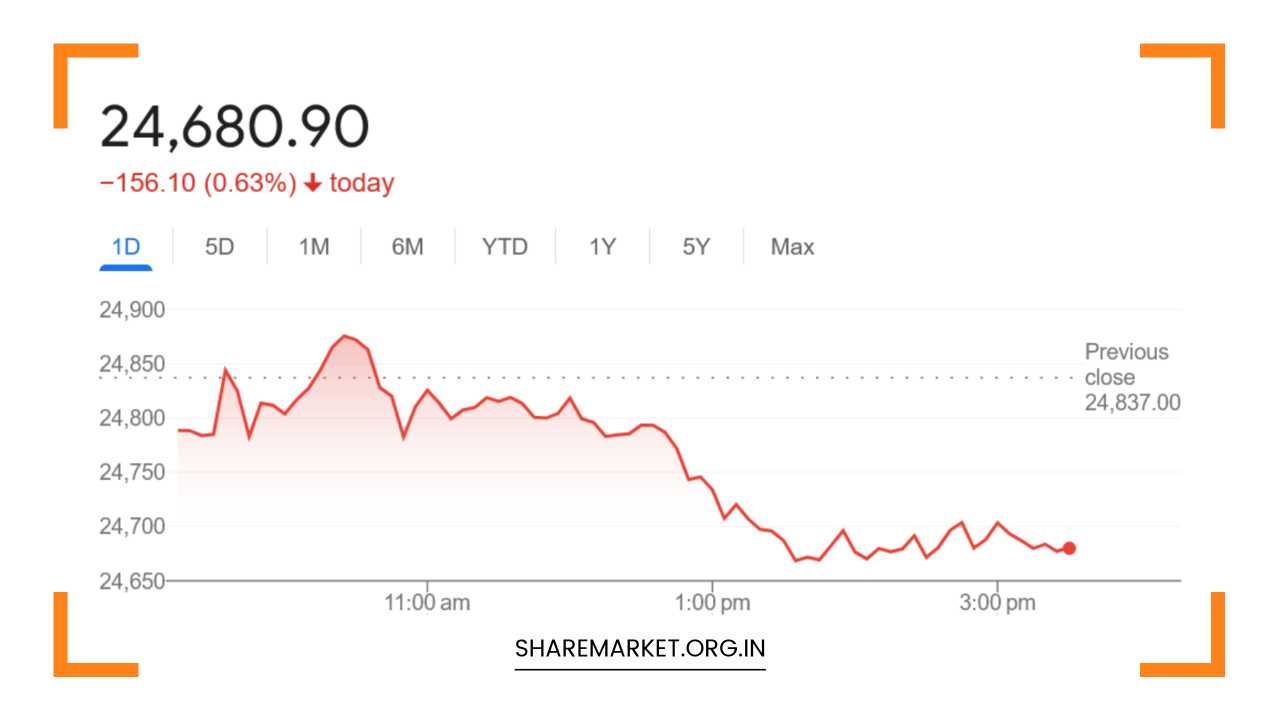
The benchmark indices saw a notable correction, with the BSE Sensex falling 572.07 points or 0.70% to end the day at 80,891.02, while the Nifty 50 shed 156.10 points, or 0.63%, closing at 24,680.90.
The weakness was broad-based, with only a handful of stocks ending in the green.
Market Breadth: Weakness Across the Board
The broader market also witnessed heavy selling pressure:
- Advancing stocks: 1,206
- Declining stocks: 2,767
- Unchanged stocks: 152
Both BSE Midcap and Smallcap indices underperformed the benchmarks, with the Midcap index down 0.7% and the Smallcap index losing 1.3%.
This underperformance in the broader market indicates heightened risk aversion among investors, particularly in high-beta and less liquid stocks.
Sectoral Performance: Pharma the Lone Bright Spot
Sector-wise, the damage was widespread. With the exception of the Nifty Pharma index, which managed to close in the green due to buying in select defensive names, all other major sectoral indices ended in the red.
- Realty index: Down 4%, reflecting concerns about valuations and profit booking in real estate stocks after a sharp rally.
- Media index: Declined by 2.9% on weak earnings and sentiment.
- Capital Goods, Metals, Telecom, PSU Banks, and Private Banks: Lost between 1% and 1.5%.
The selling across sectors highlights a broad risk-off sentiment, driven by global macro uncertainties and sustained outflows from institutional investors.
Top Nifty Performers and Laggards
Gainers:
A few defensives and select names bucked the trend:
- Shriram Finance
- Cipla
- Hero MotoCorp
- Hindustan Unilever (HUL)
- SBI Life Insurance
These stocks gained primarily due to positive earnings expectations, defensive appeal, or company-specific triggers.
Losers:
Heavyweights dragged the index lower:
- Kotak Mahindra Bank
- Wipro
- Bajaj Finance
- Bharti Airtel
- IndusInd Bank
The decline in banking and IT majors suggests investor unease about sector outlooks, particularly in light of rising global bond yields, mixed earnings, and cautious management commentary.
FIIs Intensify Selling Pressure
Foreign institutional investors remained net sellers, offloading ₹1,979.96 crore worth of Indian equities on Friday.
This follows an already heavy week of selling, where FIIs sold over ₹13,552 crore in the cash market, according to data from stock exchanges.
This sustained FII outflow continues to be a major headwind for Indian equities. Global risk aversion, firm U.S. dollar, rising U.S. bond yields, and a reallocation of funds towards other emerging markets may be contributing to this trend.
According to VK Vijayakumar, Chief Investment Strategist at Geojit Financial Services, this sharp bout of selling by FIIs has exacerbated the market weakness and may continue to weigh on sentiment until there’s a shift in global positioning or macro indicators.
Volatility Spikes: India VIX Rises 7%
Adding to investor jitters, the India VIX, a key gauge of near-term market volatility, jumped nearly 7% to 12.07. A spike in the VIX typically signals increasing anxiety among traders, and may lead to more unpredictable price movements in the days ahead.
A rising VIX also indicates that traders are expecting higher intraday swings and possibly deeper corrections in the short term. This kind of environment tends to favor cautious trading, defensive positioning, and short-term hedging strategies.
Technical View: Key Levels for Nifty on July 29
According to Anand James, Chief Market Strategist at Geojit Financial Services, the Nifty 50 is approaching critical support levels.
He points out that the index may find immediate support near 24,450, with stronger support at the 24,000 mark. A breach of these levels could trigger further downside and a potential shift in medium-term trend.
On the upside, a sustained move above 24,922 could trigger short-covering and pave the way for a bounce towards 25,000 and 25,324, though that region remains a strong resistance zone.
Traders are advised to monitor these technical levels closely, especially given the rise in volatility and continued FII selling.
The coming week will be crucial in determining whether the markets consolidate, bounce, or extend the correction.
What to Watch on July 29
Looking ahead to Monday’s session, several factors could influence market direction:
1. Global Cues:
Global equity trends, particularly in the U.S. and Asian markets, will remain a key driver. If U.S. indices continue to show weakness amid rate hike fears or geopolitical concerns, Indian markets may remain under pressure.
2. FII and DII Activity:
Traders will keep a close watch on institutional flows. Any sign of reduced FII selling or aggressive domestic institutional investor (DII) buying may support the market at lower levels.
3. Corporate Earnings:
Ongoing Q1FY26 earnings announcements will play a crucial role. Positive surprises could support specific sectors and help the broader market stabilize.
4. Technical Breakouts or Breaches:
A move below 24,450 on the Nifty could trigger stop-losses and lead to further declines. Conversely, a close above 24,922 could invite fresh buying.
Final Thoughts
The Indian stock market ended the week on a sour note, with signs of caution emerging among investors.
Broad-based declines, persistent FII outflows, and a rise in volatility all point to a market under pressure.
While domestic fundamentals remain largely supportive, global headwinds and technical cues suggest that the coming sessions could be volatile.
Investors and traders should maintain a balanced approach, closely track support/resistance levels, and remain nimble in this uncertain environment.
Defensive sectors, earnings beats, and quality stocks may continue to offer resilience amid broader market weakness.