Sensex Down 733 Points, Nifty at 24,654; Nifty Prediction for Monday
Markets in the Red Again: What to Expect on September 29
The Indian stock market continued its downward trajectory on September 26, with key benchmark indices ending in the red for the seventh consecutive trading session.
Investor sentiment remained subdued amid persistent global and domestic headwinds, leading to widespread sell-offs across sectors.
Market Recap: September 26
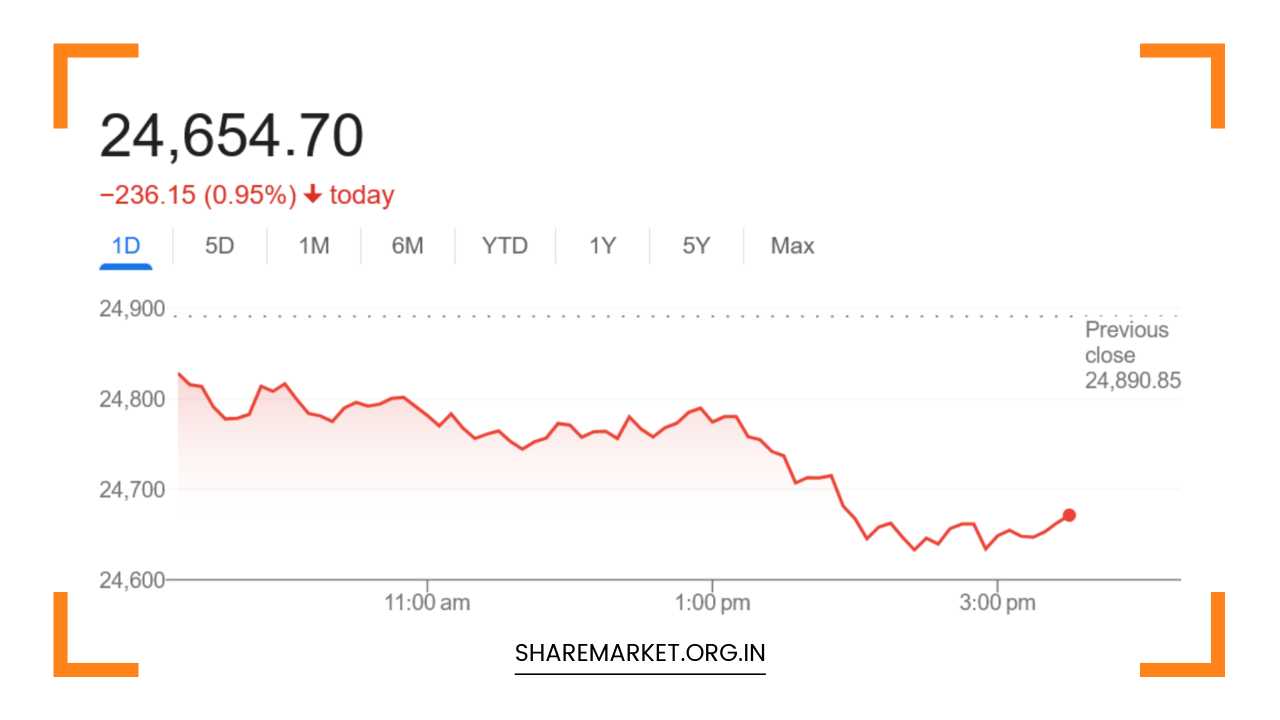
The BSE Sensex shed 733.22 points, or 0.90%, closing at 80,426.46, while the NSE Nifty declined by 236.15 points, or 0.95%, to finish at 24,654.70. Both indices have now corrected significantly from their recent all-time highs.
Market breadth was extremely negative. Of the total stocks traded on the NSE, 2,828 declined, only 912 advanced, and 106 remained unchanged, reflecting the extent of the bearish sentiment. The broader market was under even more pressure, with both BSE Midcap and Smallcap indices declining by 2% each—highlighting the sharper correction outside the frontline indices.
Top Gainers and Losers
Among the Nifty constituents, IndusInd Bank, Sun Pharma, Mahindra & Mahindra, Eternal, and Tata Steel were among the worst performers, suffering the brunt of the sell-off. These stocks saw sharp declines amid weak sectoral outlooks and profit booking.
In contrast, a few names managed to stay resilient. Larsen & Toubro (L&T), Tata Motors, Eicher Motors, Reliance Industries, and ITC ended the day in positive territory, bucking the broader market trend.
However, gains in these select heavyweight stocks were not enough to offset the widespread losses, especially with all sectoral indices closing in the red, including Nifty Bank, IT, Metals, Pharma, PSU Banks, and Consumer Durables.
Sectoral Overview
Every major sector ended lower on September 26. Notably:
- Nifty IT was under heavy pressure due to weak global cues and bearish commentary from global tech majors.
- Banking and financial services continued to decline, affected by persistent FII selling and concerns over interest rate trends.
- Metal stocks, which had shown strength in recent weeks, reversed course as global commodity prices softened.
- Pharma stocks were hit after reports of new tariffs on branded medicines, dampening investor confidence in the sector.
Weekly Market Performance
From a broader perspective, this week marked the market’s worst weekly performance in nearly six months. Over the past five trading sessions:
- Sensex and Nifty declined by around 3%.
- Nifty Bank lost over 2%.
- All sectoral indices posted weekly losses, with Nifty IT plunging 8%, its worst weekly fall in 2025 so far.
The correction was sharpest in mid and small-cap segments, raising concerns about stretched valuations and overheating in broader markets.
Market Prediction: What Could Happen on September 29?
As we move toward the end of the month, market participants remain cautious. A confluence of factors—domestic and global—is weighing on sentiment. Analysts and market strategists believe that this phase may continue for some time.
Earnings Uncertainty and Valuation Concerns
According to N. Arunagiri, Founder and CEO of Trustline Holdings, the markets are currently undergoing what he terms a “time correction” phase.
“There’s no significant improvement expected in earnings until FY2027,” he says. In such an environment, markets often trade sideways or correct modestly, awaiting stronger earnings growth to justify current valuations.
This explains the sharp reactions to any negative news and the market’s reluctance to sustain rallies. Investors are choosing to remain on the sidelines, especially ahead of the Q2 FY2025 earnings season, which starts in early October.
Macro and Global Factors
Ajit Mishra, SVP – Technical Research at Religare Broking, highlighted several catalysts for the recent slide. “The announcement of new tariffs on branded medicines hurt pharma stocks, while ongoing concerns around visa policies affected the IT sector. Globally, weak commentary from tech majors added to the pressure.”
He also pointed out continued Foreign Institutional Investor (FII) outflows, which have been a recurring drag on the Indian markets. As global yields remain elevated and the rupee weakens, foreign investors are pulling back from emerging markets, including India.
Technical Analysis: Key Support Levels
From a technical standpoint, the Nifty is now hovering near a critical support zone at 24,400, which coincides with the 200-Day Exponential Moving Average (200-DEMA). This level is being closely watched by traders and analysts alike. A breakdown below this could trigger further selling and a potential trend reversal.
Meanwhile, the Sensex too is testing its intermediate support levels, and any breach could invite more downside pressure. The weakness in heavyweight stocks has been particularly notable in the past two sessions, accelerating the indices’ decline.
Broader Market Weakness
The steep fall in mid-cap and small-cap stocks is also concerning. These segments, which have been market darlings for much of 2025, are now witnessing sharp corrections, largely due to valuation concerns and profit booking.
The current correction could be seen as a healthy pause, but if selling intensifies, it might turn into a deeper retracement phase.
Strategy for Investors
Given the current scenario, a cautious and disciplined approach is advisable. Here are some key takeaways:
- Avoid aggressive buying in high-beta or richly valued stocks, especially in the mid and small-cap space.
- Focus on fundamentally strong companies with stable earnings and low debt.
- Monitor key support levels on indices like Nifty and Sensex—breaches could signal deeper corrections.
- Keep an eye on global market trends, FII flows, and macroeconomic indicators such as inflation, interest rates, and currency movement.
- Prepare for volatility ahead of earnings season, especially in sectors like IT, pharma, and banking.
Final Thoughts
The Indian markets are currently navigating a rough patch, shaped by weak global cues, earnings uncertainty, and technical resistance. With seven straight sessions of decline and the worst weekly performance in half a year, sentiment is clearly fragile.
Whether the indices find support near current levels or extend their decline will depend on a mix of domestic earnings cues and international developments. Investors should remain cautious but not panic.
This could be a period of consolidation before the next leg of the rally, provided earnings growth revives and macro headwinds ease.