Sensex Down 765 Points; Nifty at 24,363; Nifty Prediction for Monday
Markets Close in Red: What to Expect on August 11 and Beyond
The Indian stock market ended Friday, August 8, on a sour note, continuing its downward trajectory. Both the benchmark Sensex and Nifty 50 indices closed in negative territory, signaling heightened investor caution.
This marks the sixth consecutive week of decline, adding to the growing sense of uncertainty in the markets.
With key technical levels being breached and broader market conditions continuing to deteriorate, investors are wondering what lies ahead in the coming days, particularly on August 11.
Friday’s Market Performance – A Closer Look
On Friday, the Sensex dropped by 847 points or 1.05% intraday, hitting a low of 79,775.84. It later made a slight recovery but closed 788 points, or 0.98%, lower at 79,835.61.
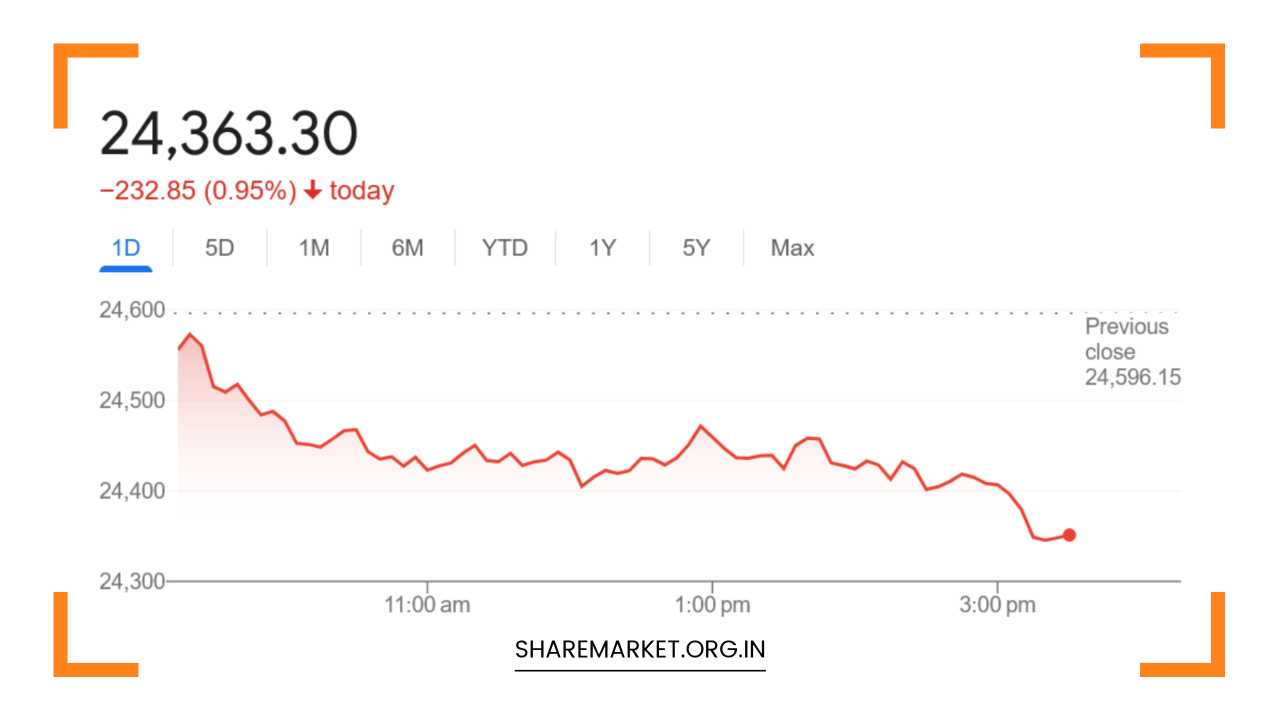
Similarly, the Nifty 50, which tracks the performance of the top 50 companies listed on the NSE, saw a decline of 1.05% on Friday, slipping to an intraday low of 24,337.50. The Nifty eventually closed at 24,363.30, down 233 points or 0.95%.
This decline follows a broader pattern that has persisted for over a month. In fact, the Sensex and Nifty have now marked a sixth consecutive week of losses, reflecting an overall bearish sentiment in the Indian stock markets.
Investors have been grappling with a combination of factors, including weak earnings, high valuations, and external uncertainties, which have compounded selling pressures.
Broader Market Weakness
While the large-cap stocks (those comprising the Sensex and Nifty) garnered most of the attention, the broader market has also struggled.
The BSE Midcap index fell 1.56%, while the Smallcap index declined 1.03%. This indicates that the pain is not just confined to large stocks, but rather is spreading across the entire market spectrum, with smaller companies also facing pressure.
The broader market decline is significant for investors looking at a diversified portfolio. In this phase of market weakness, sectors that had previously been favored for their growth potential, such as IT, healthcare, and even consumer discretionary stocks, have all seen corrections.
This highlights the challenges for those relying on mid-cap and small-cap stocks for growth, as they are more vulnerable during periods of market stress.
Factors Behind the Continued Downtrend
The ongoing market decline since the end of June can be attributed to a range of factors:
- Global Economic Headwinds: Worries about global growth, particularly related to geopolitical tensions, trade wars, and the ongoing challenges in the supply chain, have put pressure on investor sentiment. The risk-off environment has led to significant capital outflows from emerging markets, including India.
- Weak Corporate Earnings: The first-quarter earnings for many sectors have been disappointing. Companies are facing rising input costs, slower-than-expected demand, and increasing competition. In particular, the banking, automotive, and IT sectors have reported weaker-than-expected earnings, adding to the pessimism.
- High Valuations: Indian equities had been trading at historically high valuations for an extended period, and while the market has corrected in recent weeks, some stocks are still considered expensive. The rich valuation multiples, especially in blue-chip stocks, have made investors cautious, contributing to the selling pressure.
- Foreign Institutional Investors (FIIs) Outflows: FIIs have been net sellers in the Indian markets, pulling out capital amid global uncertainties. With reduced liquidity and foreign interest, the market has struggled to maintain upward momentum.
- Tariff and Taxation Concerns: The ongoing concerns over tariff wars and potential changes to tax structures, both domestically and internationally, have dampened investor optimism. These factors create an additional layer of uncertainty that is difficult for investors to ignore.
Nifty’s Technical Breakdown and Future Outlook
One of the most significant developments this week has been the breach of the critical support level at 24,500 for the Nifty 50 index.
This support zone had previously acted as a strong foundation for the market, and its breakdown raises concerns of further downside. As of now, Nifty is trading below this crucial level, which could signal additional weakness in the near term.
However, there is a glimmer of hope for investors, as some technical indicators suggest the possibility of a short-term rebound.
According to Dhupesh Dhameja, a senior analyst at Samco Securities, the immediate support for the Nifty lies at 24,450, which is close to the previous demand zone. As long as Nifty holds above this level, there could be opportunities for a rebound.
Key Technical Indicators to Watch
- Relative Strength Index (RSI): The RSI, which is a momentum oscillator used to assess the strength of a price move, is currently hovering around 40. While this level is typically seen as an indicator of an oversold market, the RSI has shown positive divergence in recent days. This means that while the Nifty has been making lower lows, the RSI has been making higher lows, suggesting that the downward momentum may be slowing.
- Oversold Conditions: Despite the bearish trend, the broader market is in oversold territory. Many stocks, especially in the mid and small-cap segments, have seen sharp declines and are now priced at more attractive valuations. This creates an opportunity for long-term investors to initiate new positions, assuming they believe in the fundamental strength of the companies.
- Intraday Indicators: On shorter timeframes, there are signs of a potential recovery, with intraday technicals indicating that the market may be in the process of bottoming out. These signs suggest that while the overall trend remains bearish, traders could see short-term opportunities to buy on dips.
What Investors Should Do Next
For traders and investors, the key question is: how to navigate this volatile market? Several strategies can be employed:
- Look for Key Support Levels: Nifty’s immediate support lies around 24,450–24,500. If the index fails to hold above this level, we could see a deeper pullback toward the 24,000 mark. Conversely, if Nifty manages to reclaim the 24,525 level, the index could look to retest the 24,706–24,815 range.
- Risk Management: Given the volatile conditions, risk management will be crucial. Investors should consider using stop-loss orders to protect their capital and reduce exposure to sharp market swings.
- Focus on Quality: In periods of market weakness, it’s essential to focus on quality stocks with strong fundamentals and growth potential. Sectors such as pharmaceuticals, FMCG, and certain parts of the infrastructure space may still hold potential for long-term investors.
- Opportunities in Oversold Stocks: For those with a longer-term horizon, the current downturn presents opportunities to accumulate stocks at attractive valuations. Stocks that have corrected sharply could present buying opportunities, especially if their underlying businesses remain strong.
Final Thoughts– Cautious Optimism
While the markets are under pressure due to a combination of domestic and global factors, there are signs that the bearish momentum could be slowing down.
Technical indicators suggest that the downside may be limited in the short term, especially if the Nifty holds above key support levels.
Investors should stay vigilant and manage their risk while looking for opportunities to initiate new positions.
While the market’s near-term direction remains uncertain, the long-term growth story for India remains intact, offering potential for those who can navigate these choppy waters.