Sensex Down 77 Points, Nifty at 24,716; Tomorrow Nifty Prediction
Markets End Flat in Red: What to Expect from Sensex, Nifty on June 3
The Indian stock market closed in the red on June 2, as investors opted for a wait-and-watch approach amid ongoing global uncertainty and key domestic factors at play.
Despite underlying strength in select sectors and a resilient broader market, benchmark indices slipped slightly as profit-booking and caution ahead of upcoming events capped gains.
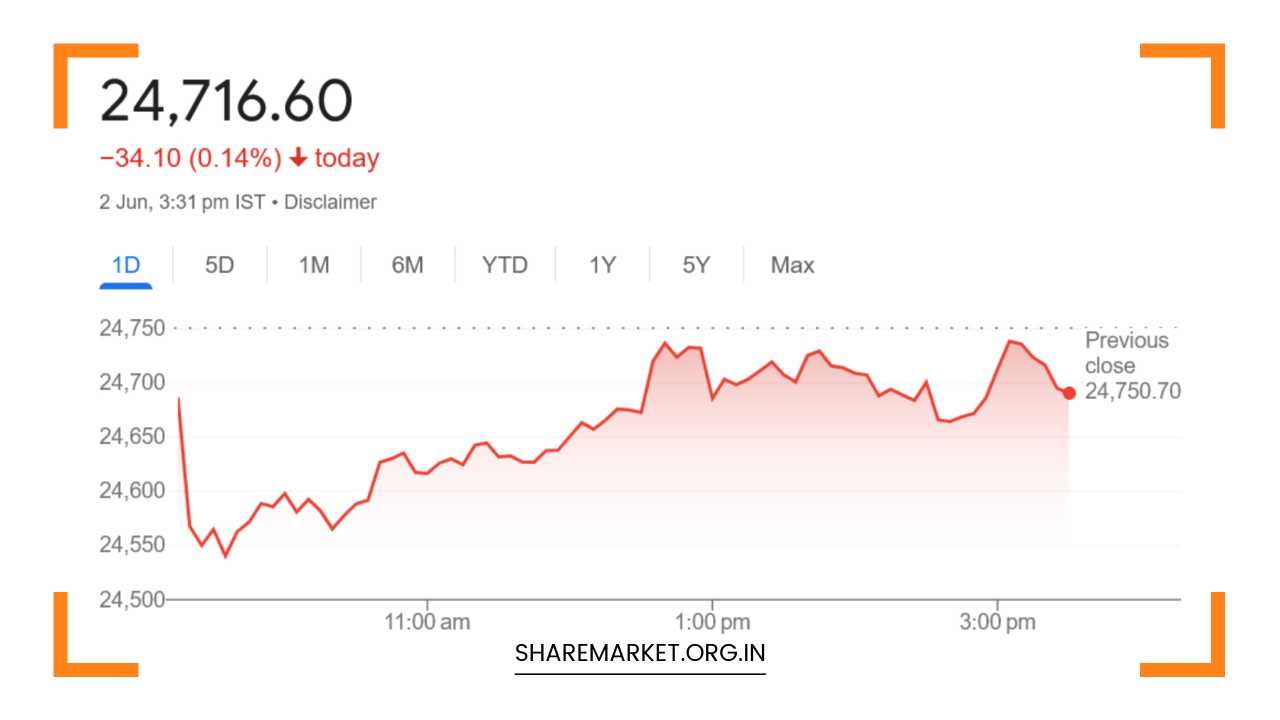
The BSE Sensex declined by 77.26 points, or 0.09%, to settle at 81,373.75, while the NSE Nifty 50 shed 34.10 points, or 0.14%, closing at 24,716.60.
During the session, both indices hovered in a narrow range, reflecting indecision and a lack of strong triggers for a breakout. However, market breadth was broadly positive, indicating strength beneath the surface.
On the BSE, 2,065 stocks advanced, 1,903 declined, and 159 remained unchanged, highlighting active participation in mid- and small-cap counters.
Sectoral Performance: A Mixed Bag
On the sectoral front, the market displayed a divergent trend.
Public Sector Banks (PSU Banks) and the Realty sector led the gains, each rising by around 2%, driven by favorable economic indicators and continued buying interest from institutional investors.
Realty stocks, in particular, have been buoyed by expectations of strong demand in the housing segment and easing interest rate concerns.
Conversely, sectors such as Consumer Durables, Information Technology (IT), and Metals underperformed, each declining by about 0.5%.
The IT sector has been under pressure due to weak global cues and concerns around discretionary tech spending in key export markets like the US and Europe.
Metal stocks, too, came under pressure amid weak global commodity prices and concerns around Chinese demand.
The BSE Midcap index ended the day with a gain of 0.6%, while the Smallcap index added 0.4%, reflecting sustained investor interest in broader markets despite volatility at the index level.
Top Gainers and Losers
Among the Nifty 50 constituents, notable gainers included:
- Adani Ports
- Mahindra & Mahindra (M&M)
- Tata Consumer Products
- NTPC
- Power Grid Corporation
These stocks rose on strong volume and positive sentiment driven by company-specific developments and stable sectoral outlooks.
On the losing side, stocks such as Hero MotoCorp, Tech Mahindra, JSW Steel, HDFC Life, and Tata Steel dragged the index lower due to weak earnings outlook, sector rotation, and global headwinds.
What’s Supporting the Market?
Despite the marginal dip in headline indices, analysts remain optimistic about the market’s medium-term trajectory, citing several domestic tailwinds:
- Expectation of an RBI Rate Cut
Market participants are increasingly hopeful of a repo rate cut by the Reserve Bank of India in the coming months, supported by a stable inflation outlook. A rate cut would boost interest-sensitive sectors like real estate, banking, and automobiles, and inject further liquidity into the market. - Favorable Monsoon Forecast
The Indian Meteorological Department has predicted a normal to above-normal monsoon this year. A good monsoon is critical for rural demand, agricultural output, and overall economic growth. This is expected to positively impact sectors such as FMCG, auto, and rural-focused financials. - Robust Q4 GDP Growth
India’s fourth-quarter GDP data came in stronger than expected, reaffirming the resilience of the domestic economy. The growth was driven by higher government spending, strong consumption, and healthy performance in manufacturing and construction sectors. - Improved GST Collections
The government’s Goods and Services Tax (GST) revenue continues to remain buoyant, indicating strong economic activity and improved compliance. This supports the fiscal position and provides the government with greater room to invest in infrastructure and welfare schemes.
Global Cues and Investor Sentiment
While domestic fundamentals remain solid, global concerns continue to weigh on sentiment. According to Vinod Nair, Head of Research at Geojit Financial Services, the Indian market has entered a consolidation phase for the third consecutive week.
“The escalating tariff war, rising geopolitical tensions, particularly the ongoing Russia-Ukraine conflict, and concerns over the US Fed’s next move have made global investors cautious,” he said.
“This has prompted a risk-off sentiment, even as the Indian market is being supported by strong institutional buying in sectors like FMCG, financials, and real estate.”
Technical Outlook: Cautious Optimism Ahead
From a technical standpoint, the Nifty showed resilience after briefly dipping below its 20-day exponential moving average (20 DEMA), a key short-term indicator.
Ajit Mishra, SVP – Technical Research at Religare Broking, observed that the index’s intraday recovery from lower levels signals that bulls are still in control and not willing to give up ground easily.
“This setup suggests a lack of clear direction but also hints at latent buying interest, especially in stock-specific plays,” Mishra noted.
He recommends that traders maintain a balanced approach—capitalizing on short-term opportunities in midcaps and smallcaps, while remaining cautious of headline risks.
What to Watch on June 3
As we head into the June 3 trading session, markets may continue to trade in a range, with a focus on stock-specific action and sector rotation. Investors should keep an eye on the following:
- RBI commentary or updates ahead of its upcoming policy meeting
- Developments in global markets, particularly US bond yields and dollar movement
- Monsoon progress and any significant weather-related developments
- Institutional flow patterns, especially from foreign institutional investors (FIIs)
Investment Strategy: Balanced and Selective
Market experts advise a cautiously optimistic approach going forward. With macroeconomic fundamentals strong and earnings season largely behind, this is an opportune time to focus on quality stocks in sectors tied to domestic demand.
Investment strategies may include:
- Allocating funds to interest rate-sensitive sectors like real estate, banking, and auto
- Selective exposure to FMCG and rural-focused companies benefiting from monsoon and consumption uptick
- Avoiding over-leveraged or globally exposed sectors in the short term, such as IT and metals
- Exploring midcap and smallcap opportunities, especially in sectors like capital goods, infra, and renewable energy
Final Thoughts
While global uncertainties continue to pose risks, India’s structural growth story remains intact. With favorable domestic cues like robust GDP growth, a healthy monsoon outlook, and possible rate cuts on the horizon, the Indian equity market is well-positioned for medium-term gains.
However, in the near term, investors are advised to stay nimble, focus on domestic themes, and avoid chasing momentum blindly.
Stay tuned as June 3 may bring more clarity on whether bulls can regain firm control or if the market will extend its consolidation phase.