Sensex Down 94 Points, Nifty at 25,492; Nifty Prediction for Monday
The Market Closed Flat: How It Might Play Out on November 10
The Indian stock market ended a choppy trading session on November 7 with little change, as investors remained cautious amid mixed global cues and ongoing profit-booking in select sectors. After opening weak and witnessing several rounds of buying and selling, both benchmark indices closed the day almost flat, reflecting the market’s indecisiveness ahead of key economic data releases and corporate earnings announcements later in the week.
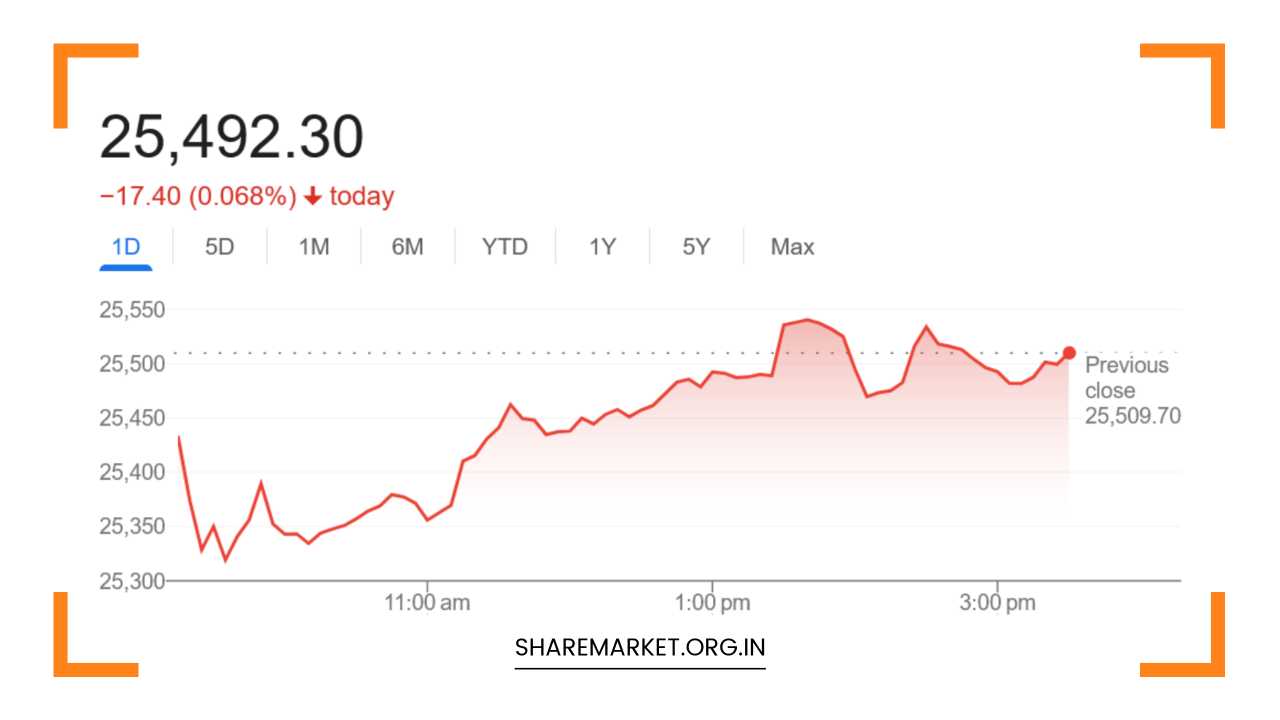
The Sensex slipped 94.73 points, or 0.11 percent, to settle at 83,216.28, while the Nifty 50 closed 17.40 points lower, or 0.07 percent, at 25,492.30. Market breadth was slightly negative, with 1,962 stocks advancing, 2,036 declining, and 126 remaining unchanged on the Bombay Stock Exchange.
Despite the subdued close, intraday movements were volatile. Early losses were trimmed by late-session buying in select financial and metal names, helping the indices recover part of their losses. However, selling pressure in FMCG, IT, and telecom stocks prevented a broader recovery.
Sectoral Trends: Metals Shine, Defensives Lag
Among the sectoral indices, the BSE Metals index stood out with a strong 1.4 percent gain, driven by optimism about rising commodity prices and positive global demand outlooks. Shares of Tata Steel, JSW Steel, and Hindalco Industries gained traction as investors bet on higher steel prices amid steady infrastructure spending.
Conversely, sectors such as information technology, consumer durables, fast-moving consumer goods (FMCG), and telecom ended the session with losses of around 0.5 percent each. The weakness in IT stocks mirrored a global correction in tech shares, as investors reassessed growth expectations following mixed earnings results from U.S. technology majors. FMCG and telecom stocks came under pressure amid concerns about subdued rural demand and regulatory challenges.
The BSE Midcap index managed to rise 0.2 percent, indicating selective buying interest in quality midcap names, while the Smallcap index closed flat, showing that risk appetite among retail investors remained muted after several weeks of high volatility.
Among individual Nifty constituents, Shriram Finance, Adani Enterprises, Tata Steel, Bajaj Finance, and Mahindra & Mahindra were the top gainers, benefiting from value buying and sector-specific optimism. On the other hand, Bharti Airtel, Tata Consumer Products, Apollo Hospitals, Tech Mahindra, and InterGlobe Aviation featured among the top laggards, reflecting selling pressure in defensive and growth-oriented counters.
Weekly Overview: A Pause in the Rally
On a weekly basis, Indian equities recorded their second consecutive week of decline, marking the steepest weekly fall in more than a month. Both the Sensex and the Nifty slipped around 1 percent, as investors booked profits after a multi-week rally. Midcap and Bank Nifty indices, however, remained largely unchanged, signaling resilience in certain parts of the market.
Out of the 50 Nifty components, 38 stocks delivered negative returns for the week, showing broad-based weakness. Hindalco, Grasim Industries, and Power Grid Corporation were among the biggest losers, while select financial and auto names managed to hold their ground.
Analysts noted that the recent correction was healthy and necessary after the markets rallied to record highs in October. The consolidation phase, they said, could pave the way for a more sustainable uptrend once investors gain clarity on global monetary policy and domestic earnings trends.
What Lies Ahead: Market Outlook for November 10 and Beyond
Market participants are now keenly watching how the indices perform on November 10, as the next session could determine whether the Nifty resumes its upward trajectory or extends its consolidation phase.
Experts suggest that this period presents an opportunity for long-term investors to reassess their portfolios and focus on large-cap stocks with attractive valuations. According to analysts, foreign institutional investors (FIIs) have been net sellers in recent sessions, which has led to a correction in several blue-chip counters. This has made valuations more reasonable in sectors with strong growth potential.
The banking and pharmaceutical sectors, in particular, are emerging as key areas of opportunity. Banking stocks are expected to benefit from improving credit demand, stable margins, and asset quality improvements, while the pharmaceutical sector stands to gain from strong export demand and new product launches in regulated markets.
Technical View: Key Levels to Watch
From a technical perspective, analysts believe that the Nifty must close decisively above the 25,700 level to signal a reversal of the current short-term downtrend. A sustained move beyond this resistance zone could trigger further gains and restore investor confidence. On the downside, immediate support is seen near 25,400, where buying interest is likely to emerge.
Vaishali Parekh, Vice President of Technical Research at PL Capital, noted that the midcap and small-cap segments have also experienced corrections from their recent highs due to profit-booking. “These indices are approaching their crucial 50-day exponential moving average (50EMA) zones,” she said. “Some short-term correction and trend reversal can be expected around these levels, followed by a renewed rally if support holds.”
Parekh added that the current market structure suggests a consolidation phase, where indices are likely to move sideways before resuming an upward trend, provided global cues remain supportive and domestic liquidity continues to be strong.
Expert Commentary: Volatility with Opportunity
Vikram Kasat, another analyst at PL Capital, remarked that on November 7, the market displayed resilience despite early weakness. “The indices recovered from the initial decline and ended the volatile session on a sluggish note,” he observed. “The recovery was driven primarily by buying in financial and metal stocks, while FMCG, consumer durables, and telecom names dragged the market down.”
Kasat highlighted that the near-term direction will depend on corporate earnings announcements, global market trends, and foreign investment flows. “Investors will be closely watching quarterly results and management commentaries to gauge future growth prospects. Additionally, movements in global bond yields, crude oil prices, and the U.S. dollar will continue to influence sentiment,” he added.
Bottom Line: A Phase of Consolidation Before the Next Move
Overall, the Indian stock market appears to be in a phase of consolidation after a strong rally earlier in the quarter. Short-term volatility may persist as investors weigh domestic fundamentals against global uncertainties. However, analysts remain optimistic that India’s structural growth story, backed by robust corporate earnings and macroeconomic stability, will keep long-term sentiment positive.
If the Nifty manages to break above 25,700 decisively in the coming sessions, it could trigger a renewed rally toward 26,000 and beyond. Conversely, a fall below 25,400 may extend the correction. For now, selective stock picking—particularly in banking, pharma, and metals—is likely to offer the best opportunities for investors looking to ride the next wave of market momentum.