Sensex Gain 270 Points, Nifty at 25,522; Nifty Prediction for Tomorrow
Markets Close Higher Ahead of July 9: Range-Bound Moves Likely Amid Global Uncertainty
Indian equity markets closed on a positive note on the weekly expiry session, recovering sharply in the final hour of trade after a largely sideways and cautious session.
Despite lingering global uncertainties—especially concerns arising from U.S. President Donald Trump’s announcement of 25–40% tariffs on imports from 14 countries—domestic sentiment remained resilient.
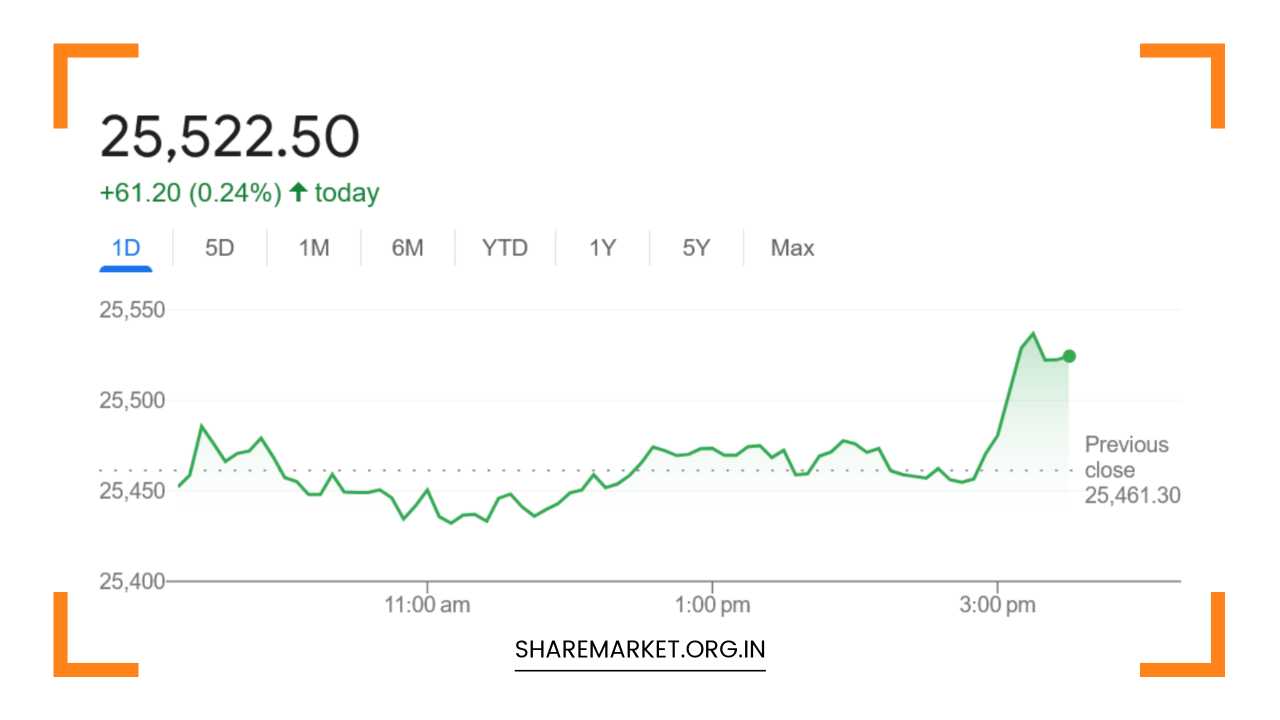
The benchmark Sensex rose 270 points to settle at 83,713, while the Nifty 50 gained 61 points, closing at 25,523.
Buying was concentrated in select sectors including realty, banking, public sector enterprises (PSEs), and oil & gas, while defensive sectors like pharma, FMCG, and automobiles witnessed selling pressure.
Midcap and smallcap indices also participated in the recovery, with the Nifty Midcap index ending 100 points higher at 59,415, indicating broad-based buying in the latter half.
Late-Session Recovery Signals Underlying Strength
After opening on a flat note, the market traded in a narrow band for most of the day, reflecting cautiousness among traders ahead of the weekly F&O expiry and global news flow. However, the last-hour buying helped lift key indices into positive territory.
- Nifty 50 opened at 25,427, registered an intraday low of 25,424, and touched a high of 25,495—showcasing a very narrow intraday range.
- On the BSE, 26 of 50 Nifty stocks closed in the green, while 18 of the 30 Sensex constituents registered gains.
- The Nifty Bank, a key sectoral barometer, gained 307 points to close at 57,256, led by private and PSU banking names.
The Indian rupee also strengthened by 15 paise, closing at 85.70 against the U.S. dollar, offering some relief amid foreign outflows and global risk aversion.
Sectoral Performance: Realty and Banking Lead the Charge
Among the sectors, real estate, public sector enterprises, and banking stocks were the standout performers.
Buying was evident in frontline banking names like HDFC Bank, ICICI Bank, and State Bank of India, while real estate majors like DLF and Godrej Properties surged on improved demand outlook and favorable regulatory updates.
On the other hand, pharmaceutical, FMCG, and automobile stocks lagged, under pressure from weak earnings expectations, high valuations, and cautious consumer sentiment.
The IT and oil & gas sectors also ended with modest gains, helped by stability in global crude prices and positive commentary from U.S. tech companies on demand recovery.
Derivatives Data Hints at Consolidation Phase
In the derivatives segment, a sharp increase in open interest (OI) was observed in stocks such as Titan, BSE, 360One, Angel One, and Divi’s Laboratories—indicating speculative interest and potential for short-term moves.
Looking at index-level data:
- The highest open interest on the call side was observed at the 25,500 strike, suggesting stiff resistance near that level.
- On the put side, significant positions are built around the 25,500 and 25,400 strikes, implying immediate support.
- The Put-Call Ratio (PCR) currently stands at 0.78, a level often associated with a slightly bearish undertone in the near term, as puts are being favored over calls.
This options setup points to a likely range-bound movement for the Nifty in the near future, with 25,400–25,600 acting as a tight band unless a major global trigger shifts sentiment decisively.
Expert Insights: “Buy on Dips” with Caution
According to Sundar Kewat, Technical and Derivative Analyst at Ashika Institutional Equity, markets showed resilience in the face of global headwinds. He noted that the Indian market has been outperforming many peers despite geopolitical tensions and trade headwinds led by Trump’s tariff proposals.
“While the market opened flat, the sideways move was largely due to low conviction among traders, awaiting clarity on global cues. However, the late recovery is a healthy sign and suggests that buyers are willing to step in on dips,” he said.
Mandar Bhojane, Technical Analyst at Choice Broking, offered a note of caution. He advised traders to be conservative in the current environment, marked by high volatility and conflicting signals from global and domestic indicators.
“Adopting a ‘buy on dips’ strategy is ideal for now, especially for traders using leverage. It’s important to book partial profits during rallies and maintain a strict trailing stop-loss to manage downside risk,” Bhojane said.
He emphasized that fresh long positions in the index should only be considered if Nifty decisively breaks above 25,600, a level that could trigger a new round of buying.
Global Uncertainty Looms Over Sentiment
Global markets remain edgy amid trade war fears and U.S. policy uncertainty. President Trump’s tariff announcement against 14 countries has raised concerns about retaliatory measures and potential disruptions to global supply chains.
This development, combined with ongoing geopolitical tensions in Europe and a mixed outlook for interest rates in the U.S., has led to risk-averse sentiment among foreign investors.
Indian equities have remained relatively insulated, thanks to strong domestic macro fundamentals, robust GST collections, and continued retail inflows into mutual funds, but global risk aversion could limit further upside in the near term.
Key Technical Levels to Watch on July 9
With the market likely to remain in a consolidation phase, traders should watch the following technical levels closely:
- Resistance Levels: 25,500 and 25,600 on the Nifty
- Support Levels: 25,400 and 25,300
- Nifty Bank Resistance: 57,500
- Nifty Bank Support: 56,800
A sustained move above 25,600 could open the door for a rally toward 25,750–25,800. Conversely, a fall below 25,300 may signal weakness and could trigger profit booking across sectors.
Outlook: Cautious Optimism Prevails
Despite the headline gains, market participants remain cautiously optimistic. The recovery in the final hour on expiry day suggests that underlying demand remains intact.
However, the low PCR, resistance at key technical levels, and external uncertainties call for a prudent approach.
Traders and investors are advised to track global cues, crude oil prices, currency movements, and any updates related to U.S. tariffs or geopolitical developments. Until clarity emerges, the range-bound trade between 25,300 and 25,600 is likely to continue.