Sensex Gain 447 Points, Nifty at 26,186; Monday Nifty Prediction
Markets Surge After RBI Policy: Decoding the Momentum and Outlook for December 8th
The Indian equity markets experienced a significant uptick following the latest policy announcement from the Reserve Bank of India (RBI). This robust market activity, which saw key benchmarks close with impressive gains, sets a positive tone for the trading week ahead, with particular interest focused on the potential movements on Monday, December 8th.
The central bank’s decisions on interest rates and liquidity have injected a palpable sense of optimism, fundamentally altering the short-term market dynamics and leading to a substantial boost in investor wealth.
Market Performance Post-RBI Announcement
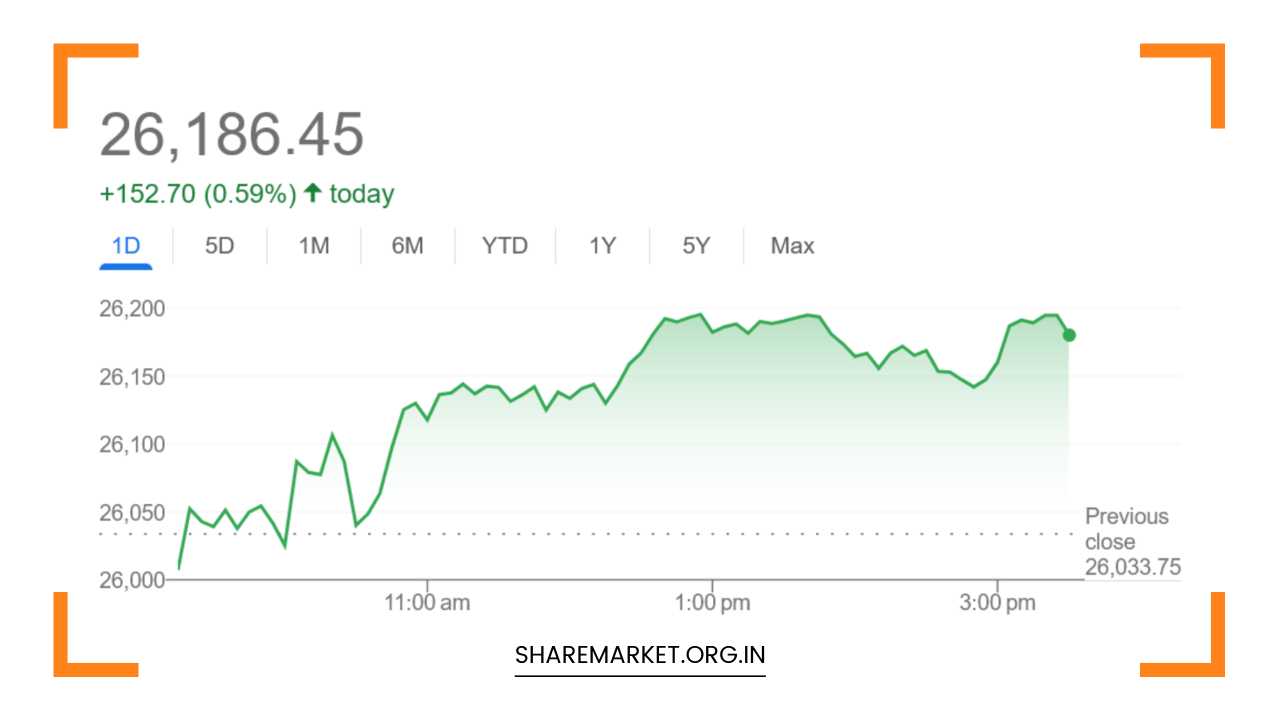
The immediate aftermath of the RBI’s policy review saw buoyant activity across the board, with major indices finishing the day sharply higher. The Sensex advanced by 447 points, closing at 85,712, while the Nifty 50 climbed 153 points to settle at 26,186. Notably, the Nifty managed to breach the 26,200 level intraday, signaling strong buying interest. The banking sector was a clear leader, with the Bank Nifty surging 489 points to end at 59,777. Broader market indices also participated in the rally, as the Midcap Nifty rose by 295 points to close at 60,595.
An analysis of sectoral performance reveals concentrated buying:
-
Key Gainers: Banking, Information Technology (IT), Auto, Metal, and Public Sector Undertaking (PSU) Banks saw significant accumulation. A clear indication of the positive sentiment in the financial space was that all 12 Bank Nifty stocks finished the session in the green.
-
Key Laggards: Conversely, the Energy, Smallcap, and Pharma indices closed with losses, suggesting a selective rotation of capital into rate-sensitive and large-cap segments.
This wave of buying translated into a substantial increase in investor wealth. The total market capitalization of all BSE-listed companies escalated to nearly ₹471 lakh crore from ₹470 lakh crore in the prior session, a single-day gain exceeding ₹1 lakh crore. While the BSE Midcap Index managed a marginal gain of 0.21 percent, the broader Smallcap Index experienced a decline of 0.67 percent, reinforcing the trend of money flowing into the larger, more stable stocks following the policy announcement.
The Catalyst: RBI’s Dual Boost
The key driver behind the market’s bullish response was the RBI’s multi-pronged approach to monetary policy and liquidity management:
-
Rate Cut: The central bank delivered a 25 basis point (bps) reduction in the repo rate. This rate cut is a direct positive for the economy, as it lowers the cost of borrowing for banks, which can, in turn, reduce lending rates for consumers and corporations.
-
Liquidity Injection: Complementing the rate cut was the proposal to inject a massive ₹1.45 lakh crore of liquidity. This injection is planned through a combination of Open Market Operations (OMO) purchases of government bonds, specifically earmarking ₹1 lakh crore for December, and dollar-rupee swaps.
According to Aniruddha Garg, Partner and Fund Manager at INVasset PMS, the lower policy rates and improved banking liquidity are crucial for supporting credit growth. He anticipates this will trigger a shift in investor interest toward cyclical and credit-sensitive sectors, with Banks and Non-Bank Financial Companies (NBFCs) poised for a renewed surge.
Vijay Gaur, Research Analyst at Mirae Asset Sharekhan, reiterated the positive sentiment, noting that the RBI not only reduced the repo rate but also maintained a neutral stance. He highlighted the revised economic forecasts, which further fueled optimism:
-
Real GDP Growth: Raised for FY26 from 6.8% to 7.3%.
-
CPI Inflation: Lowered for FY26 from 2.6% to 2.0%.
The OMO purchases, totaling ₹1 lakh crore in December, are specifically expected to benefit credit-sensitive sectors such as NBFCs, Small Finance Banks (SFBs), Microfinance Institutions (MFIs), Auto, Real Estate, and Gold Financiers. However, Gaur cautioned that this massive liquidity push might put some short-term pressure on banks’ Net Interest Margins (NIMs).
Technical Outlook and Key Levels for December 8th
The market’s technical structure has turned decidedly positive, suggesting the momentum could carry forward into the next trading session on December 8th.
Rupak Dey, Senior Technical Analyst at LKP Securities, observed that the overall trend is positive. He highlighted two key technical indicators:
-
Moving Average: The index is successfully holding above the 21-day Exponential Moving Average (EMA), which is typically considered a strong bullish sign.
-
Consolidation Breakout: The Nifty has broken out of its recent consolidation range, indicating a strengthening positive sentiment.
-
Momentum Indicator: The Relative Strength Index (RSI) has achieved a bullish crossover, confirming strong underlying momentum.
Based on this analysis, Dey believes the “buy on dips” strategy will remain effective as long as the Nifty maintains a level above 26,000. Key resistance levels he identified for the short term are 26,300 and 26,440, with immediate support located between 26,060 and 26,000.
Sudeep Shah, Head of Technical and Derivatives Research at SBI Securities, provided a more granular view on resistance and support zones:
-
Key Resistance: The 26,300–26,350 zone, which encompasses the previous swing high, is identified as a critical resistance area for the Nifty 50.
-
Uptrend Targets: A decisive close above 26,350 could trigger a fresh, aggressive rally, propelling the index toward 26,500 and subsequently 26,700.
-
Key Support: On the downside, the 20-day EMA zone of 26,000-25,950 is flagged as the crucial support level that traders should monitor to confirm the continuation of the current trend.
Global Influencers and Forward-Looking Strategy
While domestic policy has provided the immediate impetus, global factors will play an increasingly significant role in shaping the market’s trajectory after December 8th.
Avnish Jain, Chief Investment Officer at Canara Robeco Asset Management Company Limited, emphasized that the market’s attention will now shift to the upcoming US Federal Reserve policy meeting, where a potential rate cut is widely anticipated. He suggests that this overall positive global sentiment, combined with the RBI’s accommodative stance, could lead to a fall in yields in the coming months.
Beyond domestic and US rate actions, Jain identified several other critical factors that will govern market movements:
-
USD/INR Movement: The strength or weakness of the rupee against the dollar is a key factor for foreign institutional investor (FII) flows and the performance of IT and export-oriented sectors.
-
US-India Trade Deal: The completion of any major bilateral trade agreements could provide a fresh, substantial boost to market sentiment.
-
Currency Fluctuations: Global currency movements will continue to influence capital flows and commodity prices.
Final Thoughts
The RBI’s policy on December 5th has established a strong, bullish foundation. The market is positioned for further gains, especially if the technical support levels hold and global cues, particularly from the US Federal Reserve, align with the current sentiment of rate easing. The focus for investors on December 8th will be on the Nifty’s ability to challenge and breach the overhead resistance zones while credit-sensitive sectors remain the primary beneficiaries of the central bank’s supportive policy.