Sensex Gain 513 Points, Nifty at 26,052; Tomorrow Nifty Prediction
The market closed with strong gains; find out how it might play out on November 20th
The Indian equity market ended the day on a robust note, extending its recent momentum and reinforcing investor confidence across several key sectors. Market sentiment remained broadly constructive, with heavyweight indices closing firmly in the green. Despite mixed global cues and selective sectoral weakness, domestic equities demonstrated resilience, largely supported by strong buying in banking, IT, and pharmaceutical counters.
Market Today: A Strong, Broad-Based Close
The highlight of the session was the Nifty Bank, which surged to a fresh record high and continued to outperform broader market indices. Banking stocks—both private and public sector—saw healthy participation from institutional and retail investors, contributing significantly to the bullish tone. The Nifty Bank closed at 59,216, gaining 317 points, marking yet another session where the financial sector demonstrated its market leadership.
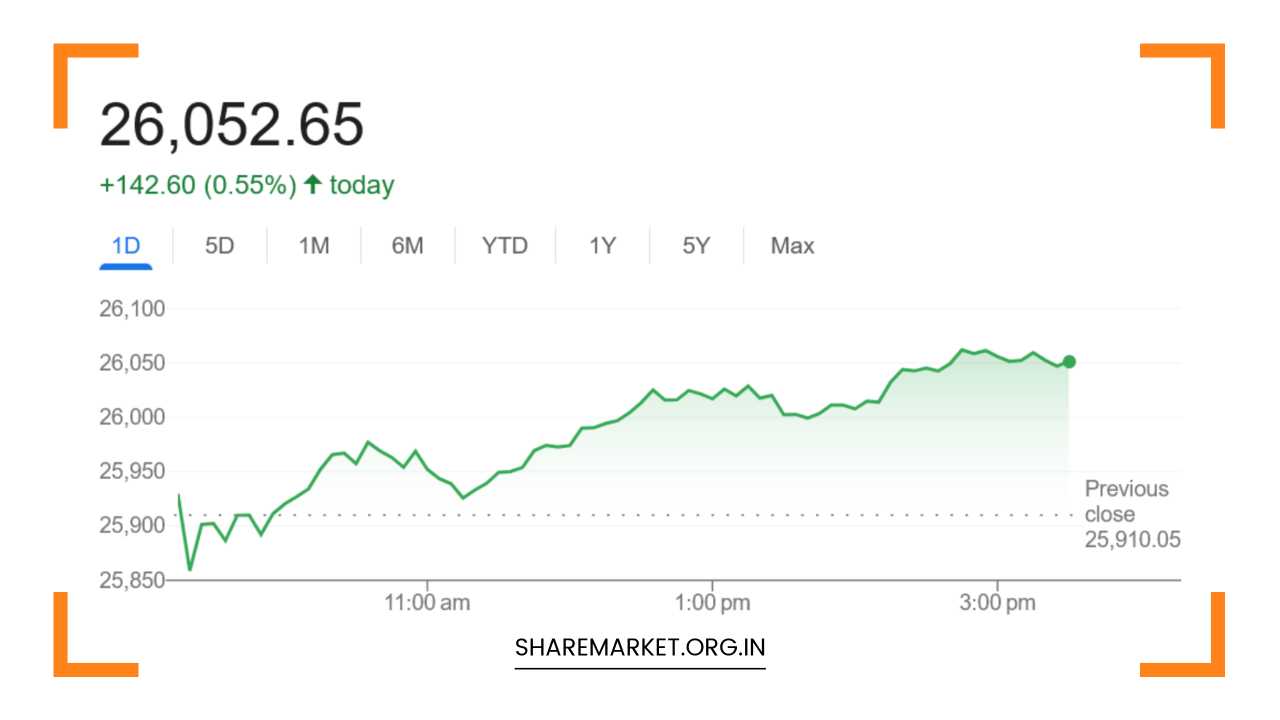
The Sensex, too, posted solid gains, ending the day at 85,186, up 513 points, while the Nifty 50 settled at 26,053, climbing 143 points. These advances reflect sustained optimism in the domestic economy, expectations of steady corporate earnings, and improved global risk appetite despite ongoing concerns about tech valuations worldwide.
One of the standout performers of the day was the IT sector. The Nifty IT index jumped more than 3%, driven by strong buying interest in major software exporters. This surge came amid a phase of global rotation, with investors selectively entering Indian IT companies on expectations of stable demand, improved deal pipelines, and potential tailwinds from currency movements. The rebound in tech counters offered significant support to the broader market.
Other sectoral performers included PSU Banks and Pharma, both of which closed with gains. Public-sector lenders extended their ongoing positive trajectory as investors continued to value their improving balance sheets and credit growth outlook. Pharma stocks benefited from renewed interest as investors sought defensive plays in a market that, despite its strength, has pockets of volatility.
However, not all sectors participated in the rally. The Realty, PSE, and Energy indices closed with losses, indicating that market enthusiasm was selective and largely focused on specific themes rather than broad-based buying across all industries. Realty saw some profit-booking after recent sharp gains, while energy stocks witnessed pressure amid global crude price fluctuations.
The Midcap index, which has been a favorite among retail investors in recent months, maintained its upward trajectory. It closed at 60,949, up 127 points, reflecting continued investor interest in growth-oriented mid-sized companies. Market breadth also remained positive: 31 out of 50 Nifty stocks and 20 out of 30 Sensex stocks ended the day in the green. In the banking space, 10 out of 12 Nifty Bank components advanced, underscoring strong sentiment in financials.
The Indian currency also showed mild strength, with the rupee appreciating by 2 paise to close at ₹88.59 per dollar. While the movement was modest, it hinted at steady foreign inflows and some cooling of dollar strength globally, both of which may support sentiment going forward.
How the Market Might Play Out on November 20th
As investors look toward the next trading session, analysts remain cautiously optimistic. Several experts weighed in on potential market direction, offering insights into both the technical and macroeconomic factors likely to influence short-term trends.
Global Trends and the “Anti-AI Trade”
Dr. V.K. Vijayakumar, Chief Investment Strategist at Geojit Financial Services, noted the emergence of what he described as an “anti-AI trade” globally. This trend, he said, is driven by concerns over inflated valuations in AI-focused tech companies, particularly in the U.S. markets. The Nasdaq’s decline below recent highs is reflective of this sentiment. According to Dr. Vijayakumar, India’s relative outperformance compared to markets like South Korea and Taiwan suggests that investors see Indian equities as a more stable and attractive alternative during this phase of global tech rotation.
If this global sentiment persists, it could continue to bolster interest in Indian markets—especially sectors like banking, manufacturing, autos, and select IT names that are less directly exposed to high-valuation AI-driven volatility.
Key Levels and Technical Outlook for Nifty
From a technical standpoint, the market remains in a delicate yet promising zone. Anand James, Chief Market Strategist at Geojit Financial Services, commented that the recent decline toward the 25,900 level, followed by a strong rebound, aligned with expectations. However, he refrained from providing aggressive near-term guidance, instead emphasizing the importance of key price zones.
He highlighted the 26,130–25,840 range as a crucial band for traders to watch. A sustained move above 26,022, he said, could signal further strength and potentially open the path to higher resistance levels. On the downside, the 25,840–25,822 zone appears to be forming a reliable support base. If Nifty holds this zone, it would indicate that bulls are still firmly in control and dips may attract fresh buying.
Trading Strategy: Buy on Dips, But With Caution
Market participants must still navigate volatility and global uncertainty. According to Hitesh Taylor, Research Analyst at Choice Broking, a “buy-on-dips” strategy remains appropriate, but only for select quality stocks. He advised traders to maintain tight trailing stop-losses to protect profits and minimize risk during pullbacks.
Taylor also suggested partial profit-booking on rallies, as markets are nearing psychologically significant levels where volatility may resurface. Importantly, he noted that new long positions should be initiated only if the Nifty convincingly crosses 26,100, signaling renewed strength and stability. Investors should also keep a close eye on global cues—especially U.S. tech trends, bond yields, and geopolitical developments—as these may influence domestic sentiment.
Overall, the market enters November 20th with a strong foundation, supported by broad participation, solid sectoral performance, and improving technical indicators. While global uncertainties remain, domestic resilience and strong institutional flows suggest that dips may continue to attract buyers. Traders, however, are advised to remain disciplined, selective, and alert to rapidly shifting global signals as the market navigates this dynamic phase.