Sensex Gain 79 Points, Nifty at 24,596; Nifty Prediction for Tomorrow
Stock Market Update: Indian Indices Close with Modest Gains – What to Expect on August 8?
Indian equity markets ended the trading session on a positive note on August 7, with both the Sensex and Nifty registering slight gains amid mixed sectoral performances.
While the day’s overall market sentiment was somewhat subdued, there were signs of recovery in certain sectors, with mid and small-cap stocks showing resilience.
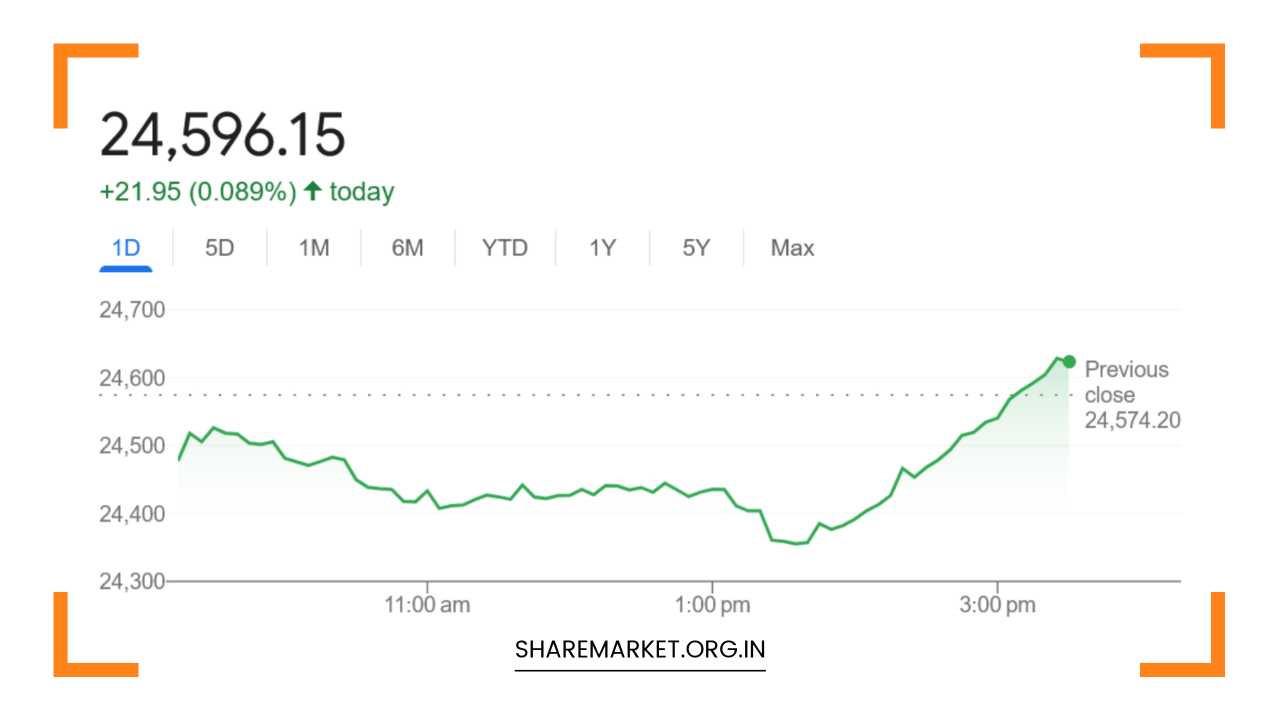
As the session closed, the Sensex rose by 79.27 points, or 0.10%, finishing at 80,623.26, while the Nifty gained 21.95 points, or 0.09%, closing at 24,596.15.
In terms of market breadth, there was a slight tilt towards negative sentiment, with 1,716 stocks advancing, 1,996 stocks declining, and 129 stocks unchanged.
Despite the overall negative advance-decline ratio, investors seemed to remain optimistic about select sectors, particularly those driven by domestic consumption.
Sectoral Performance: IT, Media, and Pharma Lead the Charge
Among the sectoral indices, Information Technology (IT), media, and pharma were the standout performers, showing gains between 0.5% to 1%.
This was in contrast to the more mixed performance seen in other sectors. The BSE Midcap Index rose by 0.3%, reflecting the potential strength in mid-sized companies, while the Smallcap Index ended the session flat, indicating a more cautious outlook in the smaller-cap segment.
Several factors contributed to the performance of the IT sector, which has benefitted from global demand for technology services.
Likewise, media stocks have seen steady demand due to the growth in digital media consumption, and pharmaceutical companies have been buoyed by steady export growth and domestic demand for healthcare products.
On the flip side, Nifty’s top losers included stocks like Adani Enterprises, Adani Ports, Trent, Tata Motors, and Grasim Industries.
These companies, which are sensitive to broader economic conditions and market sentiment, faced selling pressure during the session.
Much of the weakness in these stocks could be attributed to profit-taking, global economic concerns, and sector-specific challenges.
Global Economic Concerns: Trump’s Tariffs and Their Impact on Indian Exports
Looking beyond domestic factors, there is growing concern over the potential impact of U.S. tariffs under the leadership of former President Donald Trump.
According to market experts at MK Global, the immediate impact on the earnings of listed Indian companies from such tariffs appears to be relatively limited.
However, a significant tariff hike—such as the proposed 50% levy—could have far-reaching consequences, especially in sectors reliant on exports to the U.S.
Impact on Export-Driven Sectors
In particular, sectors such as textiles, jewelry, and pharmaceuticals could face severe headwinds if exports to the U.S. slow down dramatically.
These sectors contribute significantly to India’s export earnings and employment, especially in labor-intensive industries.
A steep tariff could potentially lead to job losses and hurt the growth prospects of these companies.
The textile and jewelry industries, for example, are highly dependent on the U.S. market, which is one of India’s largest trading partners.
According to analysts, such tariffs could lead to a considerable reduction in orders, putting pressure on production units and affecting employment.
Government Support and the Domestic Consumption Story
On a more optimistic note, MK Global highlighted that India’s economy remains primarily driven by domestic consumption, which is expected to shield the country from the worst effects of any external tariff disruptions.
As a result, sectors that are largely insulated from international trade, such as banking, telecom, automobiles, cement, hotels, and capital goods, are expected to remain relatively strong.
Analysts suggest that India’s high domestic consumption—fuelled by a young and growing population—would likely continue to support growth even in the face of external shocks.
This gives investors a more favorable outlook for domestic consumption-driven sectors, which could outperform in the short-to-medium term.
Moreover, the Indian government is expected to provide financial assistance to sectors hit hard by these tariff changes.
Measures could include providing liquidity support to the affected industries and cushioning the impact on workers in sectors like textiles and jewelry.
There is also the possibility of interventions to mitigate rising Non-Performing Assets (NPAs) among banks that lend to export-focused companies, ensuring that the financial system remains stable.
The Risk of a Short-Term Cycle: Rupee Weakness and Investor Sentiment
In the short term, MK Global warns that the Indian rupee may face additional pressure from global uncertainties, particularly in light of the potential tariff escalation.
As the current account deficit could widen due to lower export earnings, the rupee might weaken, making imports more expensive and contributing to inflationary pressures.
This could lead to foreign investor outflows, especially from export-driven sectors, triggering a cycle of lower stock prices, weaker sentiment, and broader market volatility.
However, analysts believe this would be a short-term phenomenon, and that India’s fundamental growth drivers should eventually overpower such disruptions.
Investor Sentiment: Caution Is the Watchword
According to Dr. VK Vijayakumar of Geojit Investments Ltd, while panic in the market is unlikely in the immediate term, weakness could persist for a while, especially in sectors linked to exports.
Given the prevailing uncertainty, Dr. Vijayakumar suggests that investors exercise caution, particularly in the short term.
He emphasized that export-based stocks are likely to remain under pressure, particularly those in industries sensitive to global trade dynamics.
On the other hand, domestic consumption stocks—including companies in the banking, financial, telecom, automobile, and cement sectors—are expected to hold up better in the near term, given that they are less dependent on external factors.
Looking Ahead: What to Expect on August 8 and Beyond
As we head into August 8, investors will be closely watching global cues, particularly any developments related to the U.S.-China trade situation and any new measures from the Indian government aimed at supporting export sectors.
In addition, market participants will be keen to gauge the effectiveness of India’s domestic consumption-based growth story, which continues to be the pillar of support in uncertain times.
Despite the challenges posed by potential tariff hikes, India’s diversified economy, strong domestic demand, and government support mechanisms should provide a cushion.
While caution is warranted in the near term, investors can look for opportunities in domestic growth stocks that are less exposed to international risks.
Final Thoughts: Navigating Volatility in the Short Term
To summarize, August 7 marked a modest day for the Indian equity markets, with a slight gain in both the Sensex and Nifty indices.
Sector-specific movements, global concerns, and the ongoing effects of external factors like U.S. tariffs are likely to continue influencing investor sentiment in the near term.
However, India’s focus on domestic consumption and government interventions should provide some stability, even as challenges persist.
Investors should remain cautious but also be on the lookout for potential opportunities in sectors less affected by global trade tensions.
As the market continues to navigate these uncertain waters, a selective approach will likely be the best strategy.