Sensex, Nifty Close Flat – Nifty Prediction for Tomorrow
Stock Market Wrap: Indices End Flat Amid Volatility – Key Levels to Watch on July 8
The Indian stock market ended Monday’s session on a quiet note, with the benchmark indices closing almost unchanged.
After recent bullish momentum, market participants showed signs of caution, as investors preferred to stay on the sidelines ahead of crucial domestic and global triggers.
Despite the flat close, underlying sentiment remains broadly positive, with analysts pointing to a healthy consolidation phase.
However, the day also highlighted growing intraday volatility and a mixed trend across sectors and market caps, signaling that the road ahead could be choppy in the short term.
Closing Snapshot – July 7
On the first trading day of the week, Indian equities remained largely range-bound. Here’s how the major indices performed:
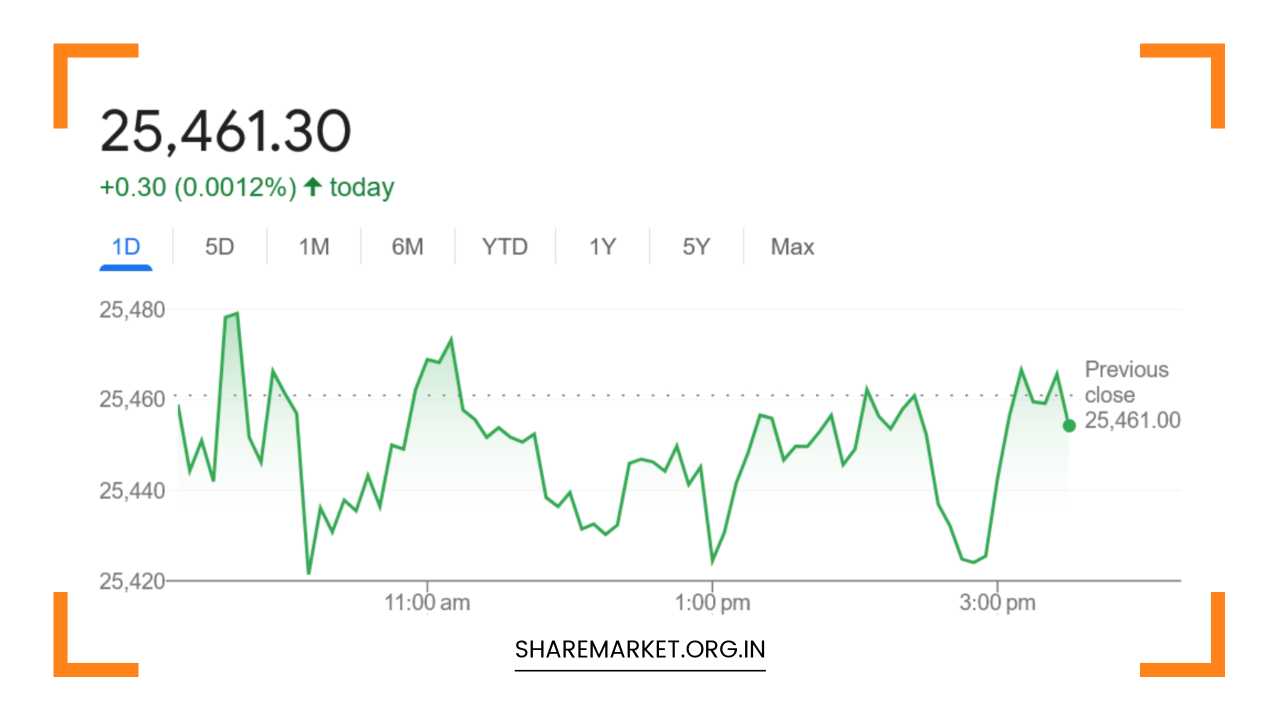
- Nifty 50 ended unchanged at 25,461, reflecting indecision after hitting a record high last week.
- Sensex rose marginally by 10 points, settling at 83,443.
- Nifty Bank underperformed, slipping 83 points to end at 56,949, largely due to weakness in private sector banks.
- Nifty Midcap 100 fell 162 points, closing at 59,516, indicating pressure in the broader markets.
- Smallcap indices also witnessed profit-booking.
The market breadth leaned negative:
- 28 of the 50 Nifty stocks ended in the red.
- 18 of 30 Sensex stocks declined.
- 9 of 12 Nifty Bank constituents closed lower.
Sectoral Performance: Mixed Signals
The session saw divergent trends across sectors, underscoring investor selectivity and rotational interest:
- Gainers:
- FMCG stocks saw sustained buying interest, supported by hopes of steady rural demand and input cost stability.
- Oil & Gas and Realty sectors also posted gains, backed by positive sentiment in crude oil pricing and improving housing data.
- Losers:
- IT, Metals, and Defence stocks dragged, as concerns around global demand and margin pressures resurfaced.
- Select auto and capital goods names also saw some profit-booking after recent rallies.
This kind of sectoral divergence is typical of a market in consolidation, where investors selectively rotate funds into perceived safe or undervalued areas while trimming exposure to stretched valuations.
Macro & Fundamental Outlook: Bullish Undertone Holds
Despite the flat movement, experts remain optimistic about the medium-to-long term prospects of the Indian equity market.
According to Motilal Oswal Financial Services, the Indian markets have regained momentum after a necessary price and time correction from the September 2024 highs.
“India remains one of the most compelling equity stories globally — not just because of its size, but also due to its consistent growth trajectory and diversified economic structure,” the firm noted.
Factors contributing to the positive outlook include:
- Stable macroeconomic indicators (inflation, fiscal deficit, forex reserves)
- Sustained domestic consumption and capex-led revival
- Strong FPI inflows and robust retail participation
- Earning resilience across key sectors
The ongoing correction is being seen more as a consolidation than a sign of weakness, as investors digest the gains made over the past few weeks.
Technical Outlook: Nifty at Key Crossroads
From a technical standpoint, the Nifty is currently oscillating within a tight range, signaling a pause before a potential breakout or breakdown.
Hardik Matalia, Derivative Analyst at Choice Broking, highlighted that:
- Immediate support lies at 25,400, followed by stronger support at 25,300.
- Resistance is capped at 25,500, with a key breakout level at 25,600.
He added: “A sustained move above 25,600 could trigger renewed bullish momentum and lead the market toward fresh all-time highs. Until then, the Nifty may consolidate in a narrow band.”
The broader view remains bullish as long as Nifty holds above the 25,000 mark — a level that has now become a psychological and technical floor for traders.
Intraday Strategy: Level-Based Trading Recommended
Srikant Chauhan, Head of Research at Kotak Securities, emphasized that Monday’s action formed a small candle on the daily chart, suggesting indecision between bulls and bears.
The intraday chart also indicated non-directional activity, which typically precedes a sharp move in either direction.
Key intraday levels to monitor:
- Breakout Zone: 25,500–25,650 (Nifty) / 83,500–84,000 (Sensex)
- Breakdown Zone: Below 25,400 (Nifty) / 83,250 (Sensex)
- Support Zones: 25,300–25,225 / 83,000–82,800
“Traders should adopt a level-based trading strategy and maintain tight stop-losses, especially considering the rise in intraday volatility,” Chauhan said. “Until a directional move emerges, scalping strategies around these ranges will offer better risk-reward setups.”
What to Expect on July 8
Looking ahead to Tuesday’s session, the market may remain range-bound unless a fresh trigger emerges. Investors will be closely watching:
- Global market cues, especially from the U.S. and China
- Crude oil price movements
- Early Q1 FY25 earnings announcements
- Institutional flows (FII/DII activity)
- Currency and bond market trends
If Nifty can decisively move past the 25,500–25,600 resistance band, we could see the index charting new highs. Conversely, a dip below 25,400 may invite short-term weakness.
Final Thoughts: Positive Bias with Near-Term Caution
While the market ended flat, it continues to display strength in structure. The broader trend remains intact, but short-term consolidation is likely to continue unless we see strong breakout volumes.
Investors: Stay invested with a focus on quality stocks, especially in sectors showing strong fundamentals like banking, FMCG, real estate, and capital goods. Use dips as buying opportunities, particularly if Nifty remains above 25,000.
Traders: Stick to a disciplined approach. Adopt level-based intraday strategies, remain nimble, and avoid over-leveraging amid rising volatility.
The market is in a wait-and-watch mode — and often, that’s when patience pays the best dividends.