Share Market Today: Sensex Falls Again; Rs 2.79 Lakh Crore Investor Wealth Wiped Out
Market Turmoil Continues: Sensex Drops for Fourth Day, Investors Lose Billions
The downward trend in the Indian stock markets persisted on Wednesday, December 3rd, marking the fourth consecutive session of declines. Despite the headline indices showing only a slight dip, the underlying market sentiment was decidedly weak, evidenced by a significant erosion in investor wealth.
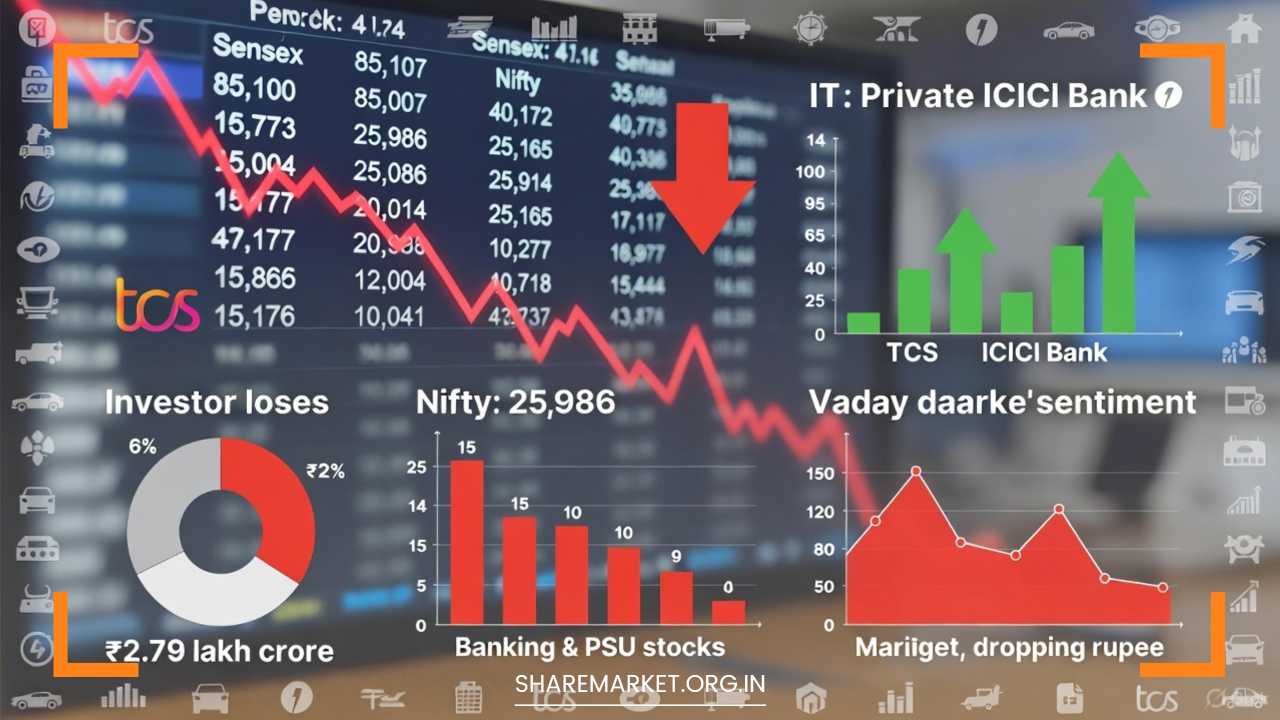
The benchmark BSE Sensex slipped 31 points, or 0.04%, to close at 85,107. Concurrently, the Nifty 50 faced a slightly larger reduction, falling 46 points, or 0.18%, to settle below the crucial 26,000 mark at 25,986. This continuous downward pressure has raised concerns among market participants about the immediate future trajectory of the indices.
Broader Market Weakness and Sectoral Performance
While the frontline indices managed to restrict their losses to marginal figures, the broader market witnessed a much more pronounced downturn. This disparity suggests that selling pressure was concentrated heavily on mid and small-cap stocks, indicating a shift towards risk aversion among domestic and foreign investors alike.
-
The BSE Midcap Index experienced a noticeable fall of 0.95%.
-
The BSE Smallcap Index also closed in the red, down 0.22%.
This weakness was exacerbated by a few key macro-economic factors, notably the rupee’s exchange rate. The rupee’s record low against the dollar, coupled with persistent selling by foreign institutional investors (FIIs), served to significantly weaken the overall market sentiment, particularly for companies with high import costs or foreign debt.
Sectorally, the selling was intense and widespread across several key segments:
-
Banking and Financial Stocks: These were among the hardest hit, with the Nifty PSU Bank index plunging nearly 3 percent. This significant decline underscores concerns regarding asset quality or potential liquidity issues within the public sector banking space.
-
Consumer Durables and Auto Stocks: These cyclical sectors also faced considerable pressure, with both segments recording losses of more than 1 percent. This often reflects worries about future consumer spending and economic growth outlook.
However, the market decline was partially offset by pockets of resilience. Gains in IT and select private banking stocks provided the much-needed support that prevented the frontline indices from a steeper fall. The IT sector, in particular, often benefits from a weakening rupee, as a significant portion of its revenue is dollar-denominated.
Investor Wealth Erosion: ₹2.79 Lakh Crore Loss
The persistent selling pressure translated directly into a substantial loss of investor wealth. The total market capitalization (m-cap) of all BSE-listed companies declined to ₹469.66 lakh crore by the close of trade on Wednesday, down from ₹472.46 lakh crore recorded on the preceding trading day.
Consequently, the net decline in the market capitalization of BSE-listed companies amounted to approximately ₹2.79 lakh crore in a single day. This figure represents the wealth lost by investors across the spectrum of the Indian equity market, highlighting the severity of the bearish sentiment that prevailed. The continuous decline over four trading sessions has cumulatively wiped out an even greater amount, causing considerable distress among retail and institutional investors.
Performance of Sensex Constituents
Focusing on the 30-share BSE Sensex, the mixed closing was a result of concentrated buying in a few heavyweight stocks that countered the broader selling wave.
Top Gainers Among Sensex Stocks
Out of the 30 Sensex stocks, only 10 managed to close the day with gains, indicating a clear majority of stocks were under selling pressure. The gains were predominantly driven by IT and financial majors:
| Stock | Closing Gain (%) |
| TCS (Tata Consultancy Services) | +1.41% (The biggest gainer, boosted by sector-specific positive sentiment) |
| ICICI Bank | +1.37% |
| Infosys | +1.20% |
| HDFC Bank | +1.15% |
| Axis Bank | +0.91% |
The strong performance of these heavyweights, particularly the private banking and IT giants, was instrumental in keeping the overall Sensex index from a steeper correction.
Top Losers Among Sensex Stocks
Conversely, the remaining 20 Sensex stocks closed in the red, with certain industrial and financial stocks bearing the brunt of the selling:
| Stock | Closing Decline (%) |
| Bharat Electronics | -2.13% (The top loser for the day) |
| Titan | -1.86% |
| Mahindra & Mahindra (M&M) | -1.75% |
| NTPC | -1.70% |
| State Bank of India (SBI) | -1.69% |
The significant losses in these stocks, ranging from defense and manufacturing (Bharat Electronics), consumer goods (Titan), auto (M&M), and utilities/PSU banking (NTPC, SBI), demonstrate the varied nature of the stocks targeted by sellers.
Market Breadth and Technical Indicators
The market breadth, a strong indicator of the overall health of the exchange, decisively leaned in favor of the bears.
-
A total of 4,316 shares were actively traded on the Bombay Stock Exchange (BSE).
-
The number of stocks that declined stood at 2,554.
-
In contrast, only 1,481 stocks managed to close with gains.
-
Another 153 stocks closed flat with no significant movement.
This negative advance-decline ratio of nearly 1:1.7 (Gainer:Decliner) confirms that the majority of stocks experienced price erosion despite the muted fall in the headline indices.
Furthermore, the session saw considerable volatility in individual stocks:
-
85 stocks hit a new 52-week high during the trading day, suggesting strong fundamental momentum in select counters, often uncorrelated to the broader market trend.
-
Worryingly, 289 stocks hit a new 52-week low, a sharp indicator of long-term weakness or recent severe correction in a large number of companies.
The continuation of the four-day losing streak, coupled with the adverse market breadth and the substantial loss of investor wealth, paints a cautious picture for the Indian equity market. Investors are advised to monitor the FII flow, the movement of the Indian rupee, and the global macroeconomic cues in the coming days, as these factors will likely dictate the near-term market direction.