Sensex Down 46 Points, Nifty at 24,334; Monday Nifty Prediction
Stock Market Ends Flat on April 30: Will Volatility Continue on May 2?
Indian stock markets closed marginally in the red on April 30, ending a choppy session influenced by mixed global cues, geopolitical uncertainty, and profit-booking in key sectors.
While frontline indices like the Nifty 50 and Sensex remained broadly flat, broader market indices faced noticeable selling pressure.
Investors are now turning their focus toward global economic developments, corporate earnings, and regional tensions, which could shape market movements in the coming days.
Market Recap: Key Indices Remain Flat
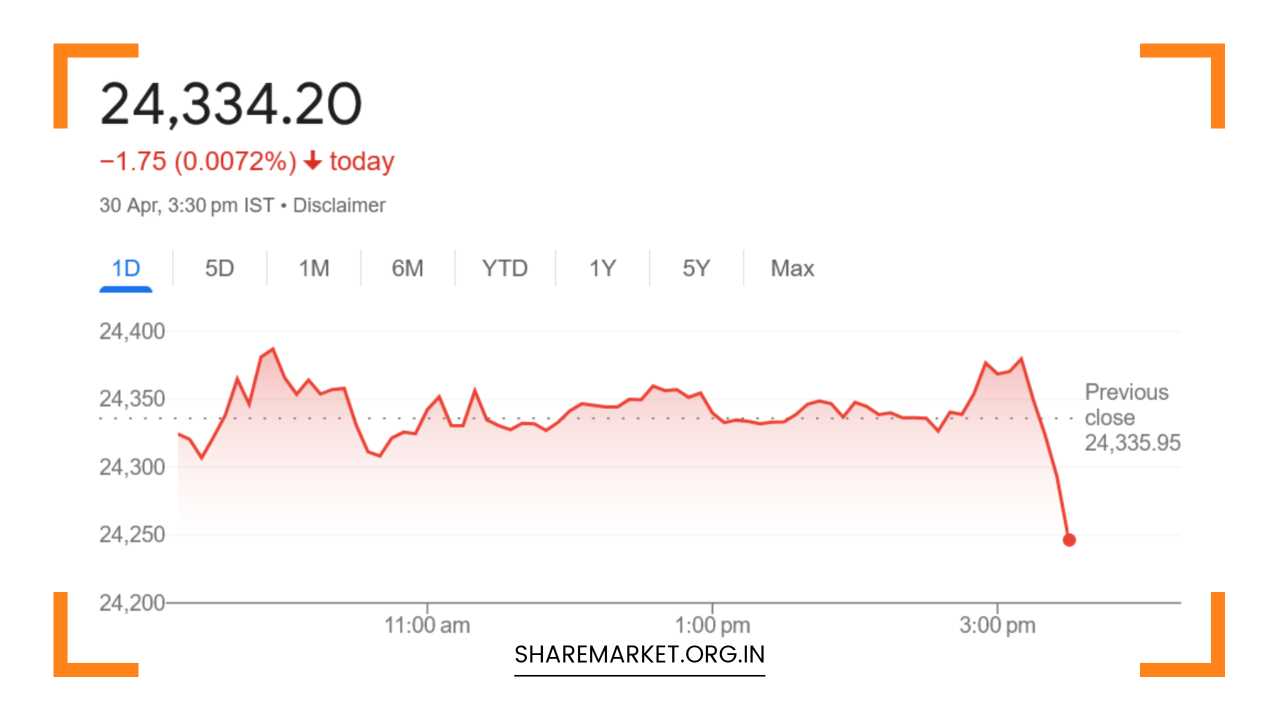
On Tuesday, the Indian equity market witnessed range-bound trading before closing on a flat-to-negative note:
- BSE Sensex closed at 80,242.24, down 46.14 points or 0.06%
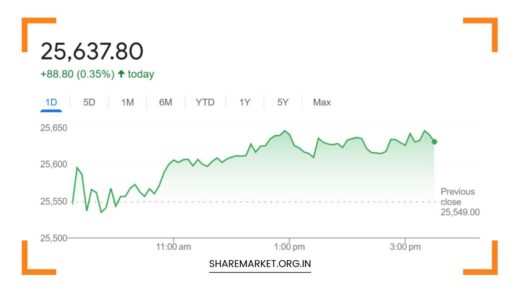
- Nifty 50 ended at 24,334.20, slipping 1.75 points or 0.01%
Market breadth remained weak, indicating a bearish undertone. Out of all the stocks traded on the BSE:
- 938 stocks advanced
- 2,828 declined
- 141 remained unchanged
This lopsided ratio highlights broader selling, especially in smallcap and midcap segments, even as benchmark indices remained largely flat.
Top Gainers and Losers
Despite a dull session overall, several stocks managed to post healthy gains. Among the top gainers on the Nifty were:
- Maruti Suzuki – supported by robust April auto sales expectations
- HDFC Life and SBI Life Insurance – aided by strong investor interest in insurance sector stocks
- Bharti Airtel – boosted by hopes of ARPU (average revenue per user) improvement
- Power Grid Corporation – gained on defensive buying amid market uncertainty
On the downside, top losers included:
- Bajaj Finserv and Bajaj Finance – both witnessing profit booking after recent rallies
- Trent – saw selling pressure despite recent outperformance in the retail segment
- Tata Motors – likely impacted by concerns over JLR sales
- SBI – saw mild correction amid a broader sell-off in PSU banking names
Sectoral Overview: Realty Shines, PSU Banks Drag
Sectoral indices presented a mixed picture:
- Realty Index emerged as the best-performing sector, gaining 2%, as investors continued to bet on a structural upturn in the real estate cycle driven by high demand and government push.
- On the contrary, PSU Bank Index and Media Index were the biggest drags, both declining around 2%. Weak earnings visibility and investor aversion to high-beta sectors in times of uncertainty contributed to this decline.
- Midcap and Smallcap indices underperformed:
- BSE Midcap was down 0.5%
- BSE Smallcap declined sharply by 1.4%
This shows that investor confidence in broader markets is waning in the short term, likely due to valuation concerns and external risks.
Technical View: Key Levels to Watch on Nifty and Bank Nifty
Hardik Matalia, Technical Analyst at Choice Broking, shared the following insights for short-term traders:
Nifty 50:
- Support Levels:
- First key support at 24,200
- Deeper supports at 24,100 and 24,000
- Resistance Levels:
- Immediate resistance at 24,400
- Higher resistance at 24,500 and 24,700
Bank Nifty:
- Support Zones:
- Strong base at 55,000, with next support around 54,700–54,400
- Resistance Points:
- Initial resistance at 55,600, followed by 55,900 and 56,200
According to Matalia, a breach below the key supports could trigger short-term correction, while a break above the resistance zones might reignite bullish momentum.
Geopolitical Tensions and Global Uncertainty Weigh on Sentiment
Geopolitical factors also added to investor nervousness on April 30. Vaibhav Vidwani, Research Analyst at Bonanza Portfolio, highlighted that increasing tensions along the India-Pakistan border played a role in dampening market sentiment.
“The Indian stock market closed slightly lower today, with investors wary of rising geopolitical tensions and awaiting more clarity from US-India trade talks.
Combined with upcoming corporate earnings, these factors will keep market sentiment cautious,” Vidwani explained.
He added that global trade-related news, especially concerning tariffs and diplomatic negotiations, may cause heightened volatility in the coming sessions.
Global Trade Developments: Tariff Hopes Fuel Optimism
Despite near-term headwinds, global macro developments are offering some positive cues. Devarshi Vakil, Head of Prime Research at HDFC Securities, believes the market has been buoyed in recent weeks by a reduction in US-China trade tensions and renewed optimism around US-India tariff negotiations.
“There’s renewed hope of a breakthrough on global trade issues. The expectation of tariff reductions and potential trade deals, especially between the US and India, is providing a supportive backdrop for Indian equities,” said Vakil.
Notably, US Treasury Secretary Scott Bessant recently commented that progress on the US-India tariff deal is “encouraging,” giving rise to optimism in export-linked sectors.
FII Flows: Foreign Investors Back India’s Resilience
One of the most supportive factors for Indian markets has been the steady inflow of foreign institutional capital.
Over the last 10 sessions, Foreign Institutional Investors (FIIs) have poured in ₹37,325 crore, reflecting sustained confidence in India’s economic trajectory.
VK Vijaykumar, Chief Investment Strategist at Geojit Financial Services, remarked:
“The combination of a weakening US dollar and India’s strong economic fundamentals is attracting global capital. India has emerged as a bright spot in the global investment landscape. However, valuations have become stretched in several pockets, and investors would be wise to take some profits off the table and maintain cash positions for future opportunities.”
Market Prediction for May 2: Volatility Ahead
Looking ahead to May 2, the market is likely to remain volatile. Several factors will drive market sentiment:
- India-Pakistan border developments
- Quarterly earnings season
- Progress in US-India trade talks
- Global macroeconomic indicators and crude oil prices
- Currency market movements, particularly the US dollar index
While the broader trend for Indian equities remains positive, experts suggest exercising caution in the short term.
With significant event-driven risks and high valuations in select sectors, selective stock-picking, portfolio rebalancing, and tactical profit booking may be prudent.
Bottom Line:
Despite a flat close, underlying market sentiment remains cautious. With geopolitical tensions, earnings expectations, and global trade dynamics in focus, investors should prepare for increased volatility and adopt a disciplined, risk-managed approach in the sessions ahead.