Sensex Down 1,247 Points. Nifty at 23,063; Tomorrow Nifty Prediction
Comprehensive Market Outlook: Analyzing the September 24 Bloodbath and Navigating September 25
The Indian equity markets experienced one of their sharpest, most comprehensive single-session sell-offs in recent memory on September 24. Benchmark indices tumbled across the board under a heavy, suffocating cloud of domestic regulatory fears, localized financial sector shocks, and worsening macroeconomic headwinds on the global stage. As weary retail investors, institutional desks, and high-net-worth portfolio managers digest the sheer scale of this multi-sectoral rout, attention turns squarely to how the market will carve its trajectory and manage risk when the opening bell rings on September 25.
1. Review of September 24: Anatomy of a Market Crash
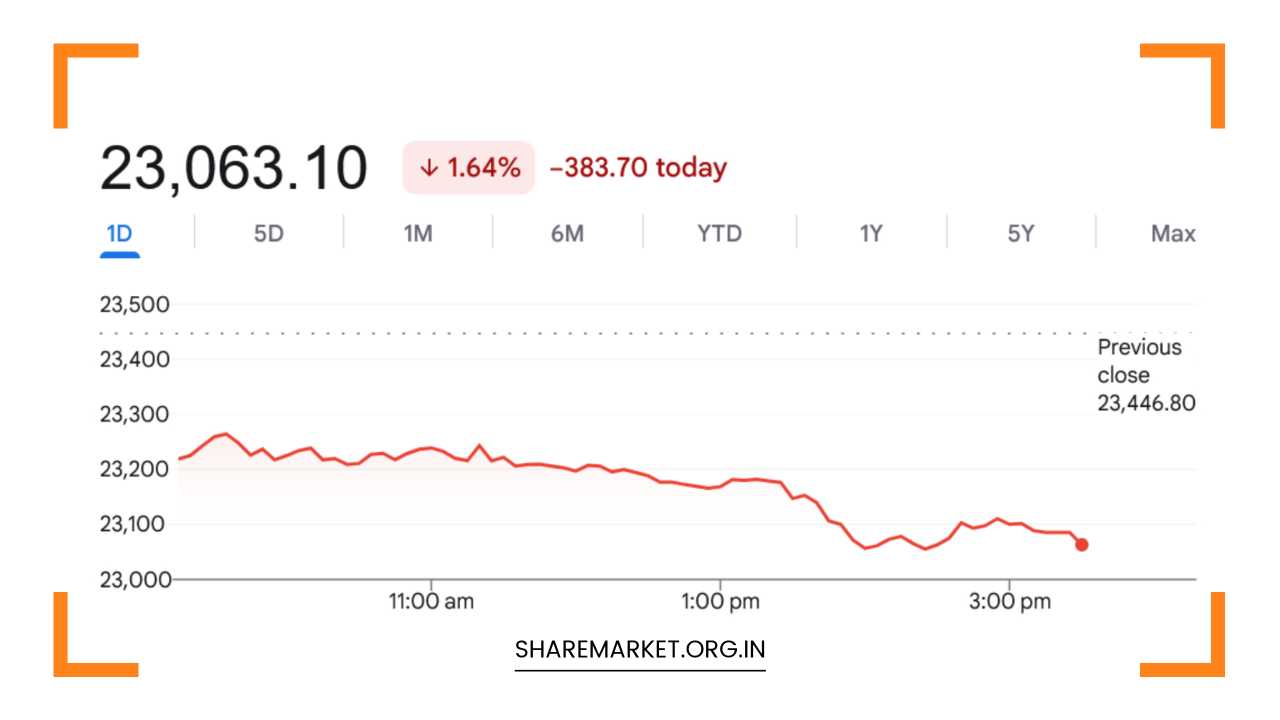
On September 24, the Indian stock exchange witnessed broad-based, aggressive liquidation that left almost no corner of the market untouched. The benchmark BSE Sensex plummeted 1,247.71 points, or 1.67 percent, to close at a fragile 73,580.54. Simultaneously, the broader NSE Nifty 50 dropped 383.70 points, or 1.64 percent, to settle at 23,063.10, slipping decisively below the crucial 23,100 threshold during the session. Market breadth heavily favored the bears by a dramatic margin: approximately 1,400 stocks advanced, while a staggering 2,772 stocks declined, and 169 remained unchanged.
-
Sectoral Carnage: Every single sectoral index ended deep in the red. Financial services and private banking entities bore the absolute brunt of the institutional selling assault. The Nifty Financial Services index slid over 4.35%, while Nifty Private Bank dropped 2.2%, Nifty Metal fell 1.9%, Nifty Bank slipped 1.7%, and both Nifty Infra and Nifty Auto retreated 1.5%. Midcaps and smallcaps were equally punished, with the Nifty Midcap index falling 2% and the Smallcap index shedding 1.5%.
-
The Insurance Shockwave: The immediate domestic catalyst was an unexpected regulatory consultation paper released by the Insurance Regulatory and Development Authority of India (IRDAI). The paper proposed tighter, highly restrictive caps on commissions and distribution payouts. This sent immediate shockwaves through financial stocks and insurance distributors—most notably PB Fintech (Policybazaar), alongside major heavyweights like HDFC Life, Bajaj Finance, Axis Bank, and Bajaj Finserv.
-
Macro & Geopolitical Pressures: Compounding the domestic policy shock were intense external triggers. Brent crude oil prices hovered persistently above $100 per barrel (surpassing $102 intraday) amid rising geopolitical flare-ups in the Middle East, while the US 10-year Treasury yield climbed toward 5.11%. Consequently, the India VIX volatility index spiked sharply by over 28%, reflecting mounting anxiety and defensive hedging among market participants.
2. Fundamental Perspective: Macro Pressures and Defensive Shifts
According to market veterans and institutional experts like Vikram Kasat (Chief Business Officer, Advisory and Dealing, PL Capital) and Vinod Nair (Head of Research, Geojit Investments), the session’s massive decline represents a fundamental, structural shift toward risk-off behavior rather than routine, healthy profit-booking.
-
Cost of Capital & Inflation Fears: Sustained crude oil prices above $100 directly threaten India’s import bill, widen the fiscal deficit, and stoke domestic inflation concerns. Combined with US yields hovering near multi-year highs, foreign institutional investor (FII) capital outflows and elevated domestic borrowing costs are expected to persist in the near term.
-
Structural Financial Headwinds: The proposed insurance commission caps fundamentally threaten the high-margin fee-based income models of major private banks and fintech-backed distributors. Until absolute clarity emerges on the final regulatory frameworks, institutional investors are likely to stay heavily underweight on these segments.
-
The Psychological Floor: With valuation cushions shrinking rapidly, future market performance will heavily rely on upcoming corporate earnings visibility rather than liquidity expansion. Investors are transitioning from a growth-at-any-cost mindset to a strict capital-preservation approach.
3. Technical View: Navigating the Breakdown Zone
From a chart perspective, technical analysts Nagaraj Shetti (Senior Technical Research Analyst, HDFC Securities) and Srikant Chauhan (Head of Equity Research, Kotak Securities) highlight that the Nifty’s gap-down opening has firmly established a bearish lower-top, lower-bottom formation on the daily charts.
-
Support and Resistance Levels:
-
Immediate Support: The psychological 23,000 level acts as the last major line of defense for the bulls. A decisive, high-volume break below 23,000 could accelerate selling pressure swiftly toward the 22,600–22,800 range.
-
Resistance on Pullbacks: Any intraday relief rally or dead-cat bounce on September 25 will face formidable overhead resistance in the 23,150–23,300 zone.
-
-
Trend Outlook: The short-term trend has decisively tilted downward. Momentum indicators suggest that the index will remain under heavy selling pressure unless bulls can reclaim and sustain levels above 23,500 in subsequent sessions.
4. Market Outlook and Action Plan for September 25
As trading opens on September 25, market participants should brace for heightened intraday volatility as institutional desks test whether the psychological 23,000 mark can hold under sustained pressure.
Actionable Portfolio Strategy & Risk Framework:
-
Avoid Aggressive Bottom-Fishing: Refrain from deploying lump-sum capital into high-beta or financial stocks until regulatory dust settles completely on the insurance commission guidelines.
-
Track Global Cues Closely: Monitor opening tick movements in crude oil futures, US bond yields, and Asian market trends to gauge if international sentiment stabilizes.
-
Focus on Defensive Allocation: Prioritize cash preservation and defensive sectors (such as pharmaceuticals or select utilities) if looking to rebalance portfolios against further systemic shocks.