Share Market Today: Investors Lose Rs 2 Lakh Crore as Markets Fall
Share Markets: ₹2 Lakh Crore Lost in a Single Day! Sensex Falls 466 Points, Nifty Slips Below 25,800
Mumbai, October 31:
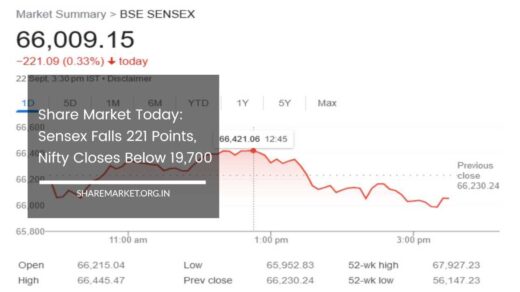
Indian equity markets continued their downward spiral for the second consecutive trading session on Thursday, October 31, as weak global cues and widespread profit-booking triggered a sell-off across most sectors. The benchmark BSE Sensex tumbled 465.75 points, or 0.55%, to close at 83,938.71, while the NSE Nifty 50 index slipped 155.75 points, or 0.60%, to settle below the psychological mark of 25,750 at 25,722.10.
The rout in the market led to a massive erosion of investor wealth — approximately ₹2.04 lakh crore vanished in a single trading session. The total market capitalization of all BSE-listed companies fell from ₹472.36 lakh crore to ₹470.32 lakh crore, underscoring the intensity of the selling pressure that gripped Dalal Street.
Global Headwinds and Domestic Factors Trigger Sell-Off
Market experts attribute the ongoing weakness to a combination of global and domestic factors. On the global front, concerns about rising U.S. bond yields, geopolitical tensions in the Middle East, and uncertainty over the timing of interest rate cuts by the U.S. Federal Reserve have dented investor sentiment. Asian and European markets also traded weak, reflecting risk aversion among global investors.
Domestically, the sentiment was dampened by mixed quarterly earnings from key Indian corporates and a sharp rise in crude oil prices earlier in the week. Additionally, foreign institutional investors (FIIs) have been net sellers for the past few sessions, further adding to the selling pressure. Analysts believe that investors chose to book profits after the strong rally seen in the past few weeks, as the benchmark indices had recently hit record highs.
“After a long stretch of gains, markets are witnessing a healthy correction. Investors are locking in profits ahead of key global central bank decisions and macroeconomic data. The correction is broad-based but should be seen as a normal phase within an ongoing bull market,” said Vinod Nair, Head of Research at Geojit Financial Services.
Sectoral Performance: Broad-Based Decline
Almost all major sectors ended in the red, reflecting broad-based selling across the market. The media index was the weakest performer of the day, falling 1.3%, followed by the metal index, which declined 1% amid lower global commodity prices. FMCG, IT, and pharma stocks also came under selling pressure, indicating that investors were offloading positions across defensive as well as cyclical sectors.
However, there were a few pockets of strength. The PSU Bank Index emerged as the top sectoral gainer, rising nearly 1.3%, thanks to buying interest in public sector lenders. The Oil & Gas Index also managed to end marginally higher, gaining 0.07%, supported by strength in select state-owned energy companies.
Market watchers believe that PSU bank stocks are benefiting from improving credit growth, better asset quality, and attractive valuations. “PSU banks are showing resilience due to solid quarterly earnings and strong loan demand. Investors are selectively accumulating these stocks despite the overall weak market,” said Ruchit Jain, Lead Research Analyst at 5paisa.com.
Top Gainers and Losers on the Sensex
Out of the 30 Sensex constituents, only five stocks managed to close in the green on Thursday. Bharat Electronics Limited (BEL) emerged as the top gainer, rallying 3.95% on the back of strong order inflows and optimistic guidance from the management. Engineering and construction giant Larsen & Toubro (L&T), software major Tata Consultancy Services (TCS), ITC, and State Bank of India (SBI) were the other gainers, with gains ranging from 0.31% to 1.09%.
On the losing side, Eternal (a placeholder for a likely Sensex constituent; possibly a typo for “Titan” or “Tech Mahindra”) was the biggest loser, plunging 3.52%. Heavyweights such as NTPC, Kotak Mahindra Bank, ICICI Bank, and Bajaj Finserv also dragged the indices lower, falling between 1.25% and 2.39%.
The sharp declines in banking and financial stocks weighed heavily on the benchmarks, as these sectors have a significant weighting in the indices.
Market Breadth and Volume Analysis
The overall market breadth on the Bombay Stock Exchange (BSE) was negative. Out of 4,309 stocks traded on the exchange, 1,784 shares advanced, while 2,370 shares declined, and 155 remained unchanged. This indicates that the bears dominated market activity throughout the session.
Despite the decline, market activity remained robust, with several midcap and smallcap stocks witnessing significant intraday volatility. The BSE Midcap and Smallcap indices both fell by around 0.50%, reflecting profit-booking even in the broader markets.
During the session, 136 stocks touched new 52-week highs, signaling that certain pockets of the market continue to show strength, while 66 stocks hit new 52-week lows, underscoring the divergence in investor sentiment across sectors.
Investors Lose Confidence, but Experts See Opportunity
The sudden erosion of ₹2.04 lakh crore in investor wealth has understandably rattled retail investors. However, market experts advise against panic selling, suggesting that short-term corrections are part of normal market behavior.
“Indian markets remain fundamentally strong. The recent fall is largely technical and sentiment-driven rather than a sign of structural weakness. Investors should use this dip to accumulate quality stocks, particularly in banking, infrastructure, and manufacturing sectors,” said Ajit Mishra, Senior Vice President at Religare Broking.
He added that India’s robust macroeconomic indicators — including strong GDP growth, resilient corporate earnings, and steady foreign exchange reserves — continue to make it one of the most attractive investment destinations among emerging markets.
Outlook for November
Looking ahead, market participants will closely monitor global developments, particularly the upcoming U.S. Federal Reserve policy meeting, crude oil price trends, and foreign fund flows. Domestically, the release of key macroeconomic data such as GST collections, PMI figures, and Q2 corporate earnings will also influence market direction.
Analysts believe that if global sentiment stabilizes and FIIs return as buyers, Indian markets could recover quickly. However, heightened volatility may persist in the near term.
For retail investors, experts recommend a stock-specific approach rather than chasing index-level moves. Defensive sectors such as healthcare, utilities, and select FMCG companies may offer relative stability during volatile phases.
Final Thoughts
The October 31 trading session was marked by caution, volatility, and widespread selling as the Sensex and Nifty extended their losses for the second consecutive day. While nearly ₹2 lakh crore in investor wealth evaporated, the correction is being viewed as a necessary breather after months of steady gains.
With global uncertainties and profit-taking dominating sentiment, investors are advised to stay patient, maintain a diversified portfolio, and focus on long-term fundamentals rather than short-term market fluctuations.