Sensex Gain 325 Points, Nifty at 23,114; Tomorrow Nifty Prediction
Market Closes with Gains; Resilience Meets Caution: What to Expect on March 23
The Indian equity markets staged a modest recovery on Friday, March 20, 2026, closing in the green after a period of intense volatility and sharp corrections. While the gains provided a temporary sigh of relief to investors, the underlying sentiment remains shadowed by a complex web of geopolitical tensions and technical vulnerabilities. As we look toward the opening bell on Monday, March 23, the tug-of-war between domestic resilience and global headwinds is expected to intensify.
Market Performance Overview: March 20 Recap
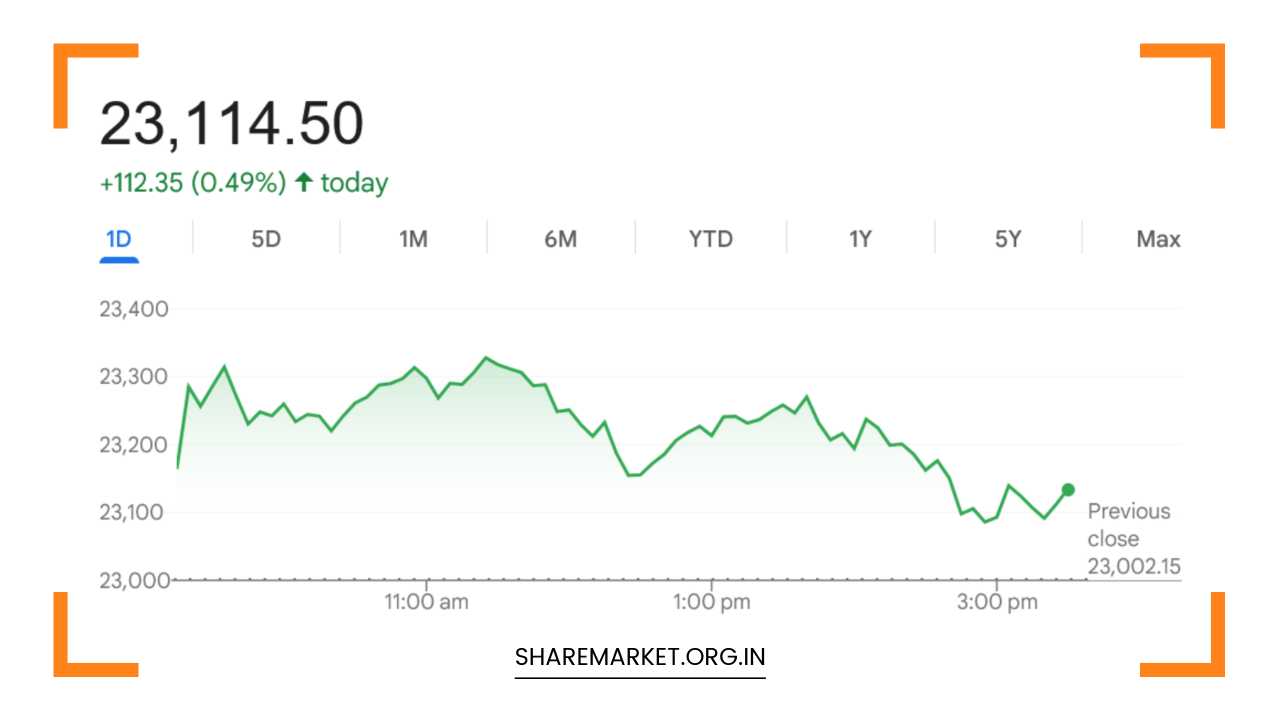
The domestic indices managed to claw back some of the losses sustained earlier in the week. By the closing bell, the BSE Sensex settled at 74,532.96, gaining 325.72 points or 0.44%. Similarly, the NSE Nifty 50 comfortably held the 23,100 mark, finishing at 23,114.50, up 112.35 points or 0.49%.
The market breadth favored the bulls, with approximately 2,330 stocks advancing against 1,764 declines, while 152 remained unchanged.
Sectoral Highlights
The recovery was broad-based but selective.
-
Leading Gains: The Telecom, IT, Metal, Pharma, and PSU Bank indices were the stars of the session, each gaining between 1% and 2%.
-
Laggards: The Media, Private Bank, and Realty sectors failed to join the party, closing in the red despite the broader market optimism.
-
Cap Segmentation: The Nifty Midcap index rose by 0.6%, outperforming the Nifty Smallcap index, which ended the day relatively flat.
Notable Movers
On the Nifty 50 leaderboard, JSW Steel, Tech Mahindra, Coal India, Tata Steel, and Infosys emerged as the top gainers. On the flip side, Hindalco Industries, HDFC Bank, HDFC Life, Shriram Finance, and ONGC faced selling pressure, limiting the day’s total upside.
Technical Analysis: Reading the “Doji”
Despite the green close, technical analysts are waving yellow flags. Nagaraj Shetty, Senior Technical Research Analyst at HDFC Securities, observed that while the Nifty staged a recovery, it failed to sustain its intraday highs. The Nifty climbed early in the session but hit a wall at the 23,350 resistance level, slipping toward the close.
The Candlestick Pattern
A small, thin-bodied candle with a long upper shadow formed on the daily chart—technically identified as a ‘Doji’ pattern.
“This signals a lack of conviction in the bullish resurgence,” Shetty noted. “The ‘lower tops’ and ‘lower bottoms’ pattern remains intact, suggesting the Nifty may still be hunting for a new lower bottom.”
Key Levels to Watch:
-
Immediate Resistance: 23,380 – 23,435
-
Immediate Support: 22,900 – 22,930
-
Critical Downside Target: 22,500
Expert Perspectives: The Bearish Undertone
Anand James, Chief Market Strategist at Geojit Investments, suggested that any further recovery might be driven by “mean reversion”—a natural bounce after an oversold period. However, he warned that a failure to cross 23,190 or a slide below 22,930 could open the floodgates for a correction toward 22,000.
Shrikant Chouhan of Kotak Securities reinforced this cautious outlook, citing the formation of a bearish candle on daily charts and lower tops on intraday charts as evidence that the structural weakness is far from over.
The FPI vs. DII Dynamic
A significant factor in the current market climate is the divergent behavior of institutional investors. Kranti Bathini, Research Director at Wealth Mills Securities, highlights a “liquidity tug-of-war”:
-
Foreign Portfolio Investors (FPIs): Remain aggressive net sellers. The combination of geopolitical instability and a weakening rupee has made emerging markets like India less attractive for short-term foreign capital.
-
Domestic Institutional Investors (DIIs): Continue to act as the market’s shock absorbers, buying on dips and preventing a total freefall.
The Macro Picture: Geopolitics and Oil
The primary catalyst for the recent “shockwaves” is the deepening crisis in the Middle East. For an import-dependent nation like India, rising crude oil prices are a double-edged sword: they stoke domestic inflation and widen the current account deficit.
As long as Brent crude remains elevated, the rupee will likely face downward pressure, further incentivizing FPI outflows. This global “apathy” toward emerging markets is expected to persist until there is a clear de-escalation in geopolitical tensions.
Strategy for March 23 and Beyond
As we head into the new trading week on March 23, investors should prepare for continued volatility. The market is currently in a “sell on rallies” phase for short-term traders.
For Short-Term Traders:
-
The “Gap-Up” Trap: Be wary of positive openings that fail to hold. Unless the Nifty decisively clears the 23,400 mark on high volume, rallies should be viewed as opportunities to trim positions.
-
Stop-Loss Discipline: With the 22,900 level acting as a pivot, strict stop-losses are non-negotiable.
For Long-Term Investors:
-
Time Horizon is Key: Kranti Bathini advises staying aligned with financial goals and maintaining a horizon of at least two to three years.
-
Focus on Quality: Use the volatility to accumulate “blue-chip” stocks in sectors with strong domestic demand, such as IT and PSU Banks, which showed resilience in the latest session.
Final Outlook
Monday’s session will likely be dictated by over-the-weekend global developments. If the Middle East situation stabilizes, we could see the Nifty attempt to break the 23,435 barrier. However, if tensions escalate, the market may retest the 22,500 support zone. In this environment, patience is the investor’s most valuable asset.