Sensex Down 141 Points, Nifty at 23,907; Tomorrow Nifty Prediction
Sensex and Nifty Close Flat; Here’s What to Expect from the Market on May 29
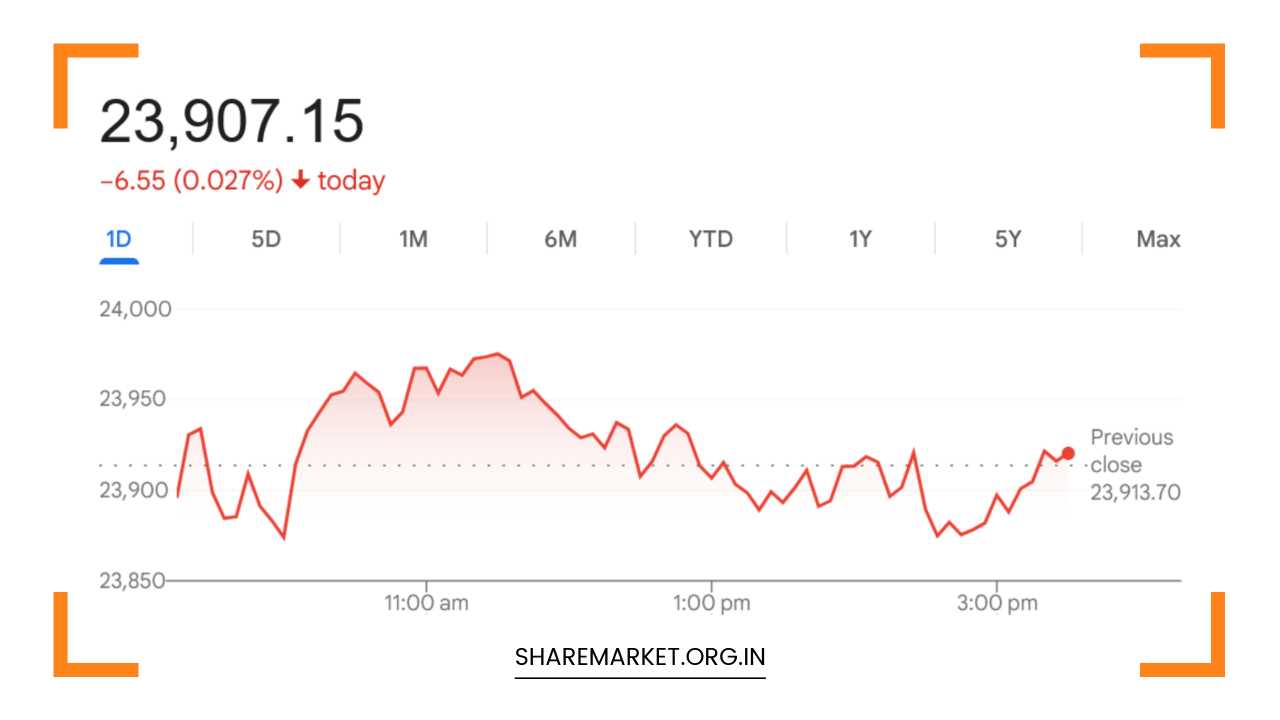
The Indian equity markets experienced a highly volatile yet ultimately flat trading session on Wednesday, May 27. Despite a notable softening in global crude oil prices—which typically provides a tailwind for import-dependent economies like India—the benchmark indices remained restricted within a well-defined, narrow consolidation range.
The primary catalyst for this cautious behavior was the prevailing geopolitical uncertainty, particularly the shifting narratives surrounding diplomatic relations between the United States and Iran. While early morning trade saw the indices slide into the red due to nervous selling, institutional buying at lower levels helped the market recover its initial losses. The benchmarks alternated between minor gains and losses before finally settling with marginal cuts, leaving market participants looking toward the final trading day of the week, Friday, May 29, for a clearer directional breakout.
Notably, Indian equity, debt, and currency markets will remain closed on Thursday, May 28, in observance of Bakrid.
Market Performance Overview: May 27 Session
Sectoral divergence was the defining characteristic of the session. The headline indices were dragged lower by systemic profit-booking in heavyweight sectors, yet the downside was robustly protected by a rotation of capital into defensive and cyclical pockets.
Benchmark Indices and Sectoral Matrix
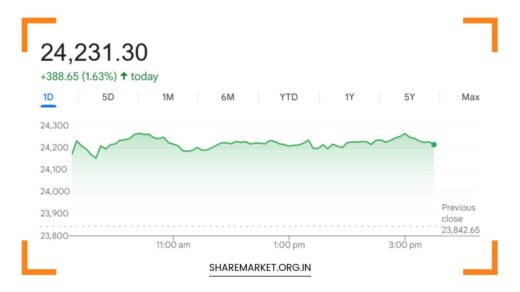
At the closing bell, the BSE Sensex shed 141.90 points, or 0.19%, to settle at 75,867.80. Concurrently, the broader NSE Nifty 50 managed to defend key psychological thresholds, dropping a mere 6.55 points, or 0.03%, to finish at 23,907.15.
The intraday cap on the upside was primarily a result of aggressive distribution in:
-
Banking and Financials: Dragged down by private banking heavyweights experiencing tactical allocation shifts.
-
Information Technology (IT): Subdued tracking of global tech peers amidst macroeconomic uncertainty.
-
Oil & Gas: Reacting dynamically to the softening of Brent crude prices and refining margin revisions.
Conversely, aggressive accumulation in several key sectors acted as a vital cushion for the index:
-
Power & Metals: Driven by strong domestic demand projections and structural capital expenditure.
-
Telecom & Auto: Buoyed by steady monthly volume expectations and defensive positioning.
-
Media: Witnessing selective value buying at lower valuations.
Broader Markets and Currency Dynamics
In stark contrast to the front-line benchmarks, the broader market space showcased immense resilience and underlying strength. The Nifty Midcap Index surged ahead with a 0.4% gain, actively entering unchartered territory, while the Nifty Smallcap Index concluded the day with a mild positive bias. This distinct outperformance indicates that risk appetite remains highly localized within domestic-oriented businesses.
On the currency front, the Indian Rupee (INR) demonstrated significant resilience. After slipping to an intraday low of 95.79 against the US dollar due to early-session systemic dollar demand, it staged a strong recovery to close virtually unchanged at 95.69 per dollar, compared to its previous close of 95.68.
Comprehensive Market Outlook for May 29
As traders return to their desks on May 29 following the mid-week holiday, several macroeconomic and structural narratives are poised to dictate market direction.
| Key Market Drivers | Market Impact and Sentiments |
| Geopolitical Trajectory | Softening US-Iran tensions easing global risk premiums and stabilizing energy markets. |
| Institutional Flows | Strong Domestic Institutional Investor (DII) inflows actively offsetting Foreign Institutional Investor (FII) distribution. |
| Sectoral Rotation | Large-cap valuations turning highly attractive as they trade below historical premiums. |
Macro and Fundamental Commentary
Vinod Nair, Head of Research at Geojit Investments, points out that while headline indices appear stuck in a lateral consolidation phase, the Midcap segment has successfully entered a new structural zone. This behavior is heavily supported by a steady, relentless influx of domestic institutional investment and retail mutual fund inflows. This domestic liquidity wall has acted as an incredibly effective counter-weight to the persistent selling pressure exerted by Foreign Institutional Investors.
Nair emphasizes that this capital rotation reflects deep structural confidence in corporate earnings growth and long-term domestic valuations. Furthermore, an improving diplomatic outlook regarding US-Iran peace talks is gradually defusing global inflationary fears, providing a stable baseline for emerging market equities. Even if the first quarter of the fiscal year 2027 exhibits a localized, subdued earnings patch, India’s robust macroeconomic framework ensures that long-term secular growth projections remain entirely uncompromised.
From a tactical asset allocation standpoint, large-cap equities are looking increasingly lucrative. Because they currently trade below their historical long-term valuation premiums, any deceleration in FII outflows is likely to spark a rapid, powerful short-covering rally across front-line stocks.
Derivatives and Technical Analysis: Nifty 50
The technical structure of the Nifty 50 points to a coiled spring scenario, where a sustained break on either side of the immediate consolidation band will trigger an aggressive trending move.
| Nifty 50 Technical Levels | Price Points / Zones | Market Significance |
| Resistance 2 | 24,350 | Extended positional target if momentum sustains. |
| Resistance 1 | 24,030 – 24,050 | Immediate critical overhead supply zone. |
| Current Level | 23,907.15 | Market baseline closing figure. |
| Support 1 | 23,700 – 23,720 | Immediate defensive floor and buying zone. |
| Support 2 | 23,650 | Positional anchor and crucial stop-loss level. |
Key Technical Levels
-
Sudeep Shah (Head of Technical and Derivatives Research, SBI Securities): Identifies the immediate, critical overhead supply zone between 24,030–24,050. A daily close above this hurdle will alter the short-term structure from sideways to bullish, opening the doors for a swift continuation toward 24,200, with an extended positional target of 24,350. On the downside, the immediate defensive floor is established in the 23,720–23,700 territory.
-
Vatsal Bhuva (Technical Analyst, LKP Securities): Observes that the combined options open interest (OI) data and price action indicate a sideways-to-mildly-positive underlying bias. Bhuva highlights 23,800 as an immediate intraday cushion, while confirming that the 24,000–24,100 band represents a formidable wall of call writing resistance. Should the market face unexpected global shocks, a crucial positional stop-loss anchor is visible at 23,650.
Derivatives and Technical Analysis: Bank Nifty
The banking index continues to exhibit higher beta characteristics, undergoing a standard retest of its previous breakout zones.
| Bank Nifty Technical Levels | Price Points / Zones | Market Significance |
| Resistance 2 | 56,100 – 56,500 | Target zone for a full bullish breakout expansion. |
| Resistance 1 | 55,200 – 55,300 | Immediate overhead supply barrier. |
| Support 1 | 54,400 – 54,500 | Crucial reclaimed base and moving average support. |
| Support 2 | 54,300 | Short-term structural floor. |
Key Technical Levels
-
Sudeep Shah (SBI Securities): Notes that the path of least resistance will turn strongly upward once Bank Nifty clears the immediate supply pocket of 55,200–55,300. Achieving a sustained breakout here would likely attract momentum traders, propelling the high-beta index toward 55,700 and potentially testing the psychological summit of 56,100. Conversely, the primary demand zone to monitor during corrective dips resides firmly between 54,400–54,300.
-
Vatsal Bhuva (LKP Securities): Adds structural context by highlighting that Bank Nifty recently completed a decisive consolidation breakout on its daily chart. In doing so, it reclaimed both its 20-day and 50-day Simple Moving Averages (SMAs), shifting the medium-term momentum back to the bulls. The minor profit-booking seen over the last two sessions is viewed as a healthy, routine retest of the breakout point.
Technical Consensus: The broader structural uptrend for Bank Nifty remains entirely intact as long as the index maintains its footing above the crucial 54,400 support cluster on a weekly closing basis.
Key Strategies for Traders on Friday, May 29
Given the mid-week holiday pause and the upcoming weekly options expiry dynamics, traders should consider a tactical approach:
-
The Wait-and-Watch Range Strategy: Avoid aggressive long or short positions within the core 23,800–24,000 Nifty corridor. Look for a clean hourly candle close outside this range before committing significant capital.
-
Focus on Large-Cap Value: With mid-caps trading at historic highs, rotating profits from extended small/mid-cap counters into underperforming, highly liquid large-caps provides a safer risk-reward ratio.
-
Strict Risk Management: Ensure stop-losses are strictly maintained at 23,650 for positional Nifty longs and 54,400 for Bank Nifty longs, as any breach of these floors could trigger an unwinding of long positions across the board.