Sensex Down 508 Points, Nifty at 23,382; Tomorrow Nifty Prediction
Sensex and Nifty Close Lower for the Fourth Consecutive Session; Here’s What to Expect from the Market on June 2
The Indian equity markets faced another grueling session on June 1, extending their losing streak to a fourth consecutive day. Investors continued to trim positions amidst a cocktail of global macroeconomic pressures, geopolitical uncertainties, and aggressive profit-booking at higher valuations.
By the end of the trading day, the benchmark BSE Sensex and NSE Nifty 50 both posted notable losses, breaching critical psychological support levels. The broader market sentiment remained decidedly risk-averse, leaving traders wondering if June 2 will bring a technical rebound or deeper corrections.
Market Performance Overview: June 1 Breakdown
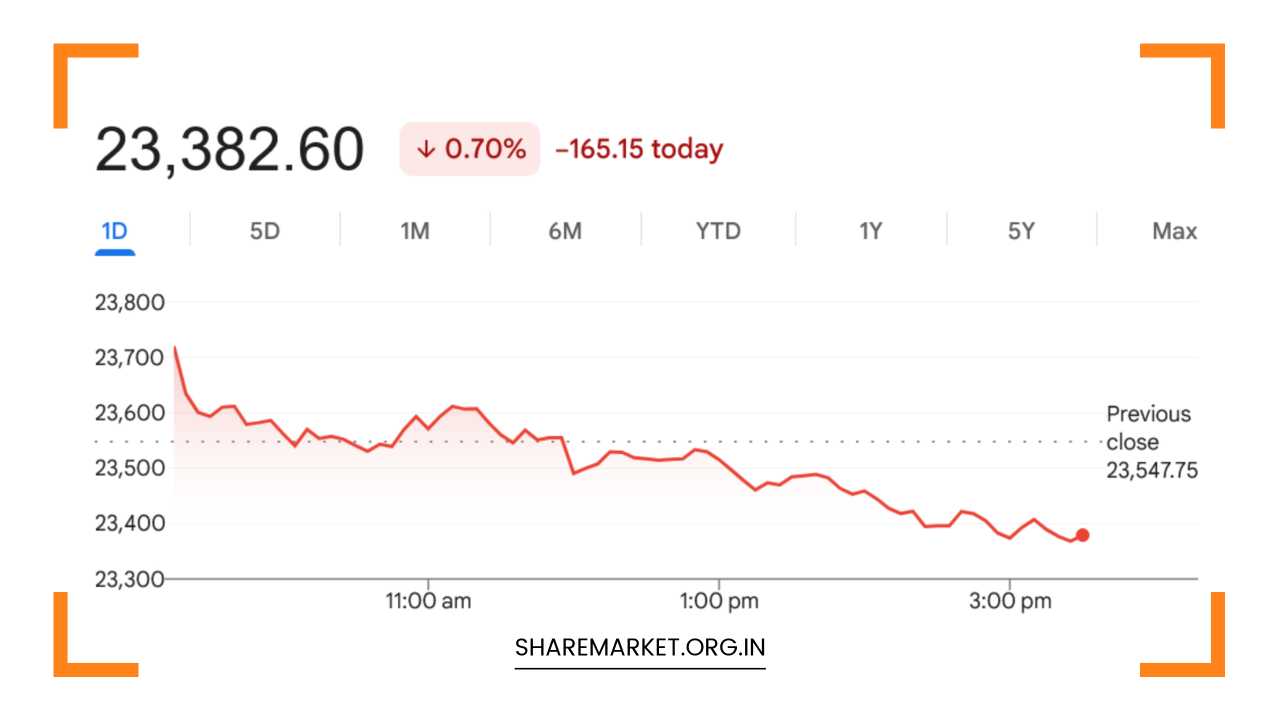
A persistent wave of selling pressure characterized the day’s trade. The BSE Sensex plunged 508.40 points (0.68%) to settle at 74,267.34. Simultaneously, the NSE Nifty 50 shed 165.15 points (0.70%) to close the doors at 23,382.60, slipping below the crucial 23,400 threshold.
The market breadth heavily favored the bears, underscoring a widespread sell-off across market capitalizations:
-
Declining Stocks: 2,665
-
Advancing Stocks: 1,505
-
Unchanged Stocks: 180
Sectoral Heatmap: IT Outperforms, FMCG and Banking Drubbed
The sectoral indices revealed a stark divergence in investor strategy. Defensive plays and rate-sensitive sectors bore the brunt of the damage, while information technology offered a lonely oasis of green.
| Sector / Index | Performance | Key Dynamics |
| FMCG & Auto | Declined 1% to 2% | Hit hard by valuation concerns and shifting consumer demand expectations. |
| PSU Banks & Realty | Declined 1% to 2% | Long-term rallies paused as investors locked in profits. |
| Nifty IT | Gained 2.6% | Heavily favored as a defensive hedge against domestic volatility. |
| Nifty Media | Gained 1.3% | Witnessed selective value buying. |
| Nifty Metal | Gained 0.5% | Supported by steady global commodity pricing. |
Top Gainers and Losers
The individual stock performance reflected this sectoral tug-of-war:
-
Top Nifty Losers: Hindustan Unilever (HUL), Tata Consumer Products, ITC, Shriram Finance, and Mahindra & Mahindra (M&M).
-
Top Nifty Gainers: Tech Mahindra, Infosys, Tata Consultancy Services (TCS), Coal India, and JSW Steel.
The pain was acutely felt in the broader markets as well. The Nifty Midcap index dropped 1.4%, while the Nifty Smallcap index recorded a 0.9% slide, signaling that retail and institutional investors alike are de-risking their portfolios.
Technical Analysis: Nifty 50 View
From a technical standpoint, June 1 was a highly damaging session for the bulls. Following a relatively optimistic open, the market met severe liquidation at higher levels. From its intraday high, the Nifty tumbled by nearly 350 points, while the Sensex violently shed over 1,100 points from its peak.
Bearish Candlestick Dynamics
Shrikant Chouhan, Head of Equity Research at Kotak Securities, pointed out that this intraday reversal resulted in a prominent bearish candle on the daily chart. Furthermore, the intraday charts established a distinct “lower top” formation—a structural price action pattern that indicates the bears are firmly in control of the short-term narrative.
“The market’s short-term trend remains structurally weak,” Chouhan noted. “However, because oversold conditions have been prevailing for some time now, a sharp technical bounce-back from these levels cannot be ruled out.”
Crucial Levels for June 2
For intraday and swing traders, Chouhan identifies 23,500 as the ultimate pivot line for the Nifty:
-
The Bearish Scenario: A failure to reclaim or sustain above 23,500 will prolong the downward trajectory. In this case, the Nifty is expected to slide toward the 23,250 to 23,200 support cluster.
-
The Bullish Scenario: If the Nifty successfully breaks and consolidates above 23,500, a short-covering rally could extend the index back toward 23,650 to 23,700.
Providing further granular data, Sudeep Shah, Head of Technical and Derivatives Research at SBI Securities, identified immediate, rigid support within the 23,250 to 23,230 zone. According to Shah, any decisive close below this mark could exacerbate panic selling, exposing the index to 23,100, and potentially dragging it down to 22,950 in the near term. Conversely, immediate overhead resistance is locked at 23,530 to 23,550.
Technical Analysis: Bank Nifty View
The banking gauge mirrored the main index’s weakness but displayed even more pronounced technical deterioration. Bank Nifty ended the session with a long, bearish candlestick, breaking below key psychological and structural barriers.
Moving Average Breakdowns and RSI Crossings
Vatsal Buva, Technical Analyst at LKP Securities, highlighted that the Bank Nifty closed below both its 20-day and 50-day Simple Moving Averages (SMAs). This dual breakdown confirms that the medium-term trend has officially tilted negative.
Momentum indicators are validating this price damage:
-
The Relative Strength Index (RSI) has locked in a bearish crossover.
-
The index continues to trade deep within a broad congestion zone, prompting analysts to suggest a “sell-on-rise” tactical approach for the upcoming sessions.
-
Buva places immediate support for Bank Nifty at 52,800, with resistance capped at 54,000.
Derivative and Momentum Drift
Sudeep Shah of SBI Securities reinforced this grim outlook, noting that the banking index has carved out a textbook “lower high–lower low” pattern over its four-day, 3.5% descent.
The underlying momentum metrics paint a stark picture:
-
RSI Compression: The RSI plunged sharply from 55 to 43, showing an accelerating loss of upward momentum.
-
MACD Bearishness: The Moving Average Convergence Divergence (MACD) line is trading stubbornly below the zero line, cementing the negative bias.
Key Bank Nifty Levels to Watch
-
Immediate Support: 53,200 to 53,100. A breakdown past this zone intensifies the bears’ grip, exposing 52,700, and potentially 52,300 shortly after.
-
Immediate Resistance: 54,000 to 54,100. The bulls must reclaim this territory to neutralize the immediate selling pressure.
Fundamental Catalysts: What is Driving the Bloodbath?
While technical charts map the damage, macroeconomic realities explain why investors are hitting the sell button. According to Abhinav Tiwari, Research Analyst at Bonanza, the market is bracing for highly influential domestic and global triggers.
-
The Upcoming RBI Monetary Policy Commentary: Market participants are anxious regarding the Reserve Bank of India’s stance on interest rates. Given global inflation persistence, any hawkish tone from the central bank could delay rate cuts, putting pressure on banking and auto sectors.
-
Geopolitical Friction in the Middle East: Escalating tensions continue to threaten global supply chains and energy prices. Any sudden spike in crude oil prices acts as a direct tax on the oil-importing Indian economy.
-
Robust Fundamentals vs. Stiff Valuations: Analysts universally agree that India’s macroeconomic fundamentals—such as GDP growth projections and corporate earnings—remain rock solid. However, because valuations had expanded to historic premiums, the market was highly vulnerable to any negative trigger, making this correction a necessary cooling-off period.
Market Prediction for June 2: What Should Investors Do?
As the market heads into the June 2 session, volatility is virtually guaranteed to remain elevated. Traders should keep a vigilant eye on the opening tick. If the global market setup remains muted, the local indices might initially retest their respective support zones (23,250 for Nifty and 53,100 for Bank Nifty).
Strategic Recommendations
-
For Intraday Traders: Avoid chasing directional moves blindly in the first 30 minutes. Let the Nifty establish its footing relative to the 23,500 pivot mark. Treat rallies toward resistance zones as potential shorting opportunities until a structural “higher high” is formed.
-
For Long-Term Investors: A four-day correction should not be viewed as a structural collapse, but rather as a healthy market normalization. Use sharp dips to gradually accumulate high-quality stocks in fundamentally sound sectors like IT, large-cap banking, and capital goods at more reasonable valuations.