Sensex Down 373 Points, Nifty at 23,914; Tomorrow Nifty Prediction
Comprehensive Market Analysis: Sensex and Nifty Wrap-Up and Outlook for September 3
Indian benchmark indices, the BSE Sensex and NSE Nifty 50, experienced a volatile and ultimately downward-sloping trading session. Pressured by a lethal mix of weak global market cues, surging geopolitical friction in the Middle East, rising global bond yields, and persistent foreign institutional investor (FII) outflows, domestic equities opened significantly lower.
While both indices managed to stage a notable intraday recovery from their lowest points—driven by bargain hunting at lower psychological levels—they failed to turn positive by the closing bell.
-
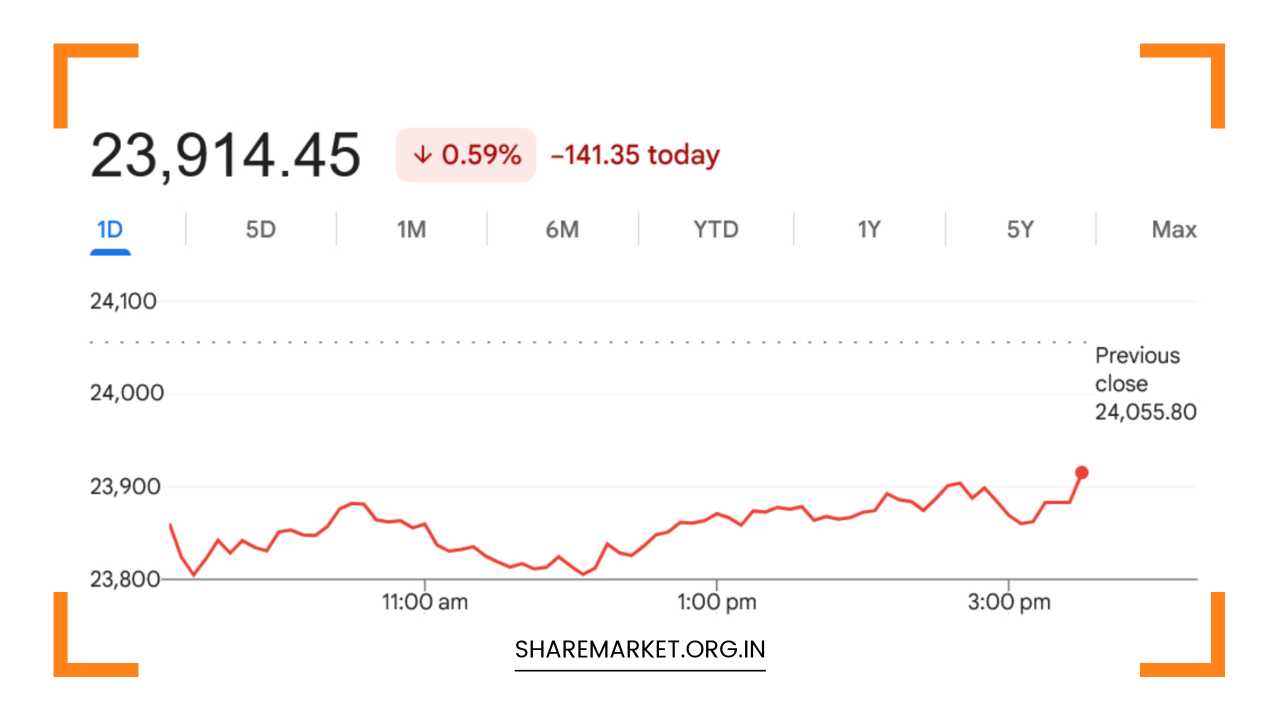
Nifty 50: Opened at 23,858, touched an intraday low of 23,786.8, staged a nearly 100-point recovery, and finally settled at 23,914.45, down 0.58%.
-
BSE Sensex: Opened at 76,471.32, slipped to an intraday low of 76,135.72, bounced back by over 400 points, and closed at 76,570.35, down 0.49%.
This deep dive examines the macroeconomic triggers, sectoral performances, expert technical evaluations, and a detailed forward-looking outlook for how these indices might behave on September 3.
Macroeconomic Drivers and Market Sentiment
The primary catalyst behind the market downturn was external rather than domestic. Investor sentiment across emerging markets has turned fragile due to several compounding macro forces:
-
Geopolitical Escalation: Heightened tensions between the United States and Iran have sent jitters through global financial markets. Any threat of conflict in the Middle East directly triggers fears of supply chain disruptions, particularly regarding petroleum.
-
Crude Oil Volatility: Escalating Middle Eastern risks have placed upward pressure on global crude oil prices. Higher oil prices act as a direct tax on India—a net importer of energy—fueling domestic inflation concerns and forcing expectations of higher-for-longer global interest rates.
-
Global Bond Yields: Rising sovereign bond yields in key developed economies like the US and Japan have drained liquidity from riskier emerging assets, leading to a steady flight of capital.
-
FII Selling: Persistent capital outflows by Foreign Institutional Investors continue to cap any aggressive upward momentum, keeping large-cap counters under constant supply pressure.
Sectoral Performance and Market Breadth
The defensive posture of investors was visible across almost all major sectors. Except for energy and oil & gas counters—which found support from rising crude prices—every other major sectoral index finished in the red.
Top Losers and Gainers
-
Nifty Laggards: Heavyweight selling was witnessed in cyclical and consumer-facing stocks. Key losers included Eicher Motors, Wipro, Bajaj Auto, Asian Paints, and Mahindra & Mahindra (M&M). The auto, information technology (IT), and media sectors bore the brunt of the selling, registering sharp declines of 1.2% to 1.8%.
-
Nifty Leaders: Bucking the broader market trend, buyers favored select energy and private financial names. Top gainers included Coal India, Adani Ports, Bajaj Finserv, Adani Enterprises, and Tata Motors Passenger Vehicles.
Broader Markets
The caution was not limited to large-caps; the broader markets mirrored the weakness. The Nifty Midcap index declined by 0.5%, while the Nifty Smallcap index drifted lower by 0.4%. This broad-based contraction indicates that retail and mid-tier participants are trimming exposure and booking profits amid rising macro uncertainty.
Expert Technical Outlook: Nifty 50
Market analysts point out that the breakdown below crucial moving averages and channels has opened up defensive trading strategies.
Ajit Mishra (Religare Broking)
Ajit Mishra highlights that the day’s sharp decline brought the Nifty directly into contact with initial downside support near the 23,800 zone.
-
Downside Risk: If the 23,800 mark is decisively breached, the corrective phase could extend rapidly toward the 23,600 milestone.
-
Upside Hurdles: The psychological level of 24,000 has now transformed from support into immediate resistance. A sustained recovery will face its next major hurdle at 24,150.
-
Strategy: Mishra advises keeping position sizes light, maintaining stringent risk management, and avoiding aggressive long trades given the high volatility.
Rupak Dey (LKP Securities)
Rupak Dey notes that the Nifty has slipped below a rising channel following continuous selling pressure.
-
Short-Term Bias: The prevailing momentum remains bearish. As long as the index trades below the 24,000 threshold, traders should prefer a “sell-on-the-bounce” strategy.
-
Expected Range: Further downward extension could drag the index toward the 23,700–23,730 support band.
Sudeep Shah (SBI Securities)
Sudeep Shah provides deep indicator-based insights:
-
Gap Closure: The Nifty successfully closed the 68-point gap formed on July 27. The creation of a small-bodied candle with a long lower shadow points to aggressive bargain hunting at lower levels, but fails to negate the overarching bearish setup.
-
Momentum Indicators:
-
The RSI (Relative Strength Index) has dipped below the 40 level, signaling a loss of buying momentum.
-
The MACD line has slipped beneath its signal line, confirming a negative trend crossover.
-
The ADX (Average Directional Index) has started turning upward, suggesting that the bearish trend is gaining strength.
-
-
Key Levels: Immediate support sits in the 23,780–23,750 zone. A breakdown below this opens doors to 23,600 and 23,450. Immediate resistance is staked between 24,030 and 24,050.
Expert Technical Outlook: Bank Nifty
The banking gauge experienced parallel pressures during the session.
-
Price Action: Bank Nifty opened with a sharp gap-down, triggering a breakdown from its August consolidation range of 1,246 points. However, late-session buying helped claw back losses, allowing the index to close back within its previous trading bounds at 57,172 (down 0.41%).
-
Volatility Indicator: The relatively stable ADX on Bank Nifty indicates an absence of sharp directional expansion for now, reflecting a consolidation phase within a broader corrective structure.
-
Support & Resistance:
-
Support: Immediate downside support is locked in the 56,800–56,700 zone, which critically coincides with the 200-day Exponential Moving Average (EMA). A breach here could accelerate declines toward 56,400 and 56,000.
-
Resistance: Immediate overhead supply is concentrated in the 57,500–57,600 band.
-
Market Outlook and Strategy for September 3
As traders prepare for the trading session on September 3, the technical landscape and external environment dictate a cautious, risk-averse framework:
1. Opening Dynamics & Price Action
Expect a tentative opening on September 3. Because global cues remain mixed and crude oil prices continue to hover at elevated levels due to US-Iran tensions, domestic indices are unlikely to stage a unilateral breakout. Watch the first 30 minutes of trade: if Nifty fails to hold above the 23,800 mark early in the session, institutional selling could accelerate toward the 23,730–23,700 support area.
2. Strategy for Traders
-
Intraday Approach: Given that oscillators like the RSI and MACD are currently leaning bearish, a fade-the-rally (sell on rise) approach remains favored near upper resistances (24,000–24,030 for Nifty; 57,500 for Bank Nifty).
-
Positional Investors: Avoid building fresh, leveraged long positions until the Nifty decisively reclaims and sustains above the 24,050 level. Cash-rich investors looking to accumulate quality large-caps can utilize sharp intraday dips into the 23,700–23,750 zone for staggered, long-term accumulation.
-
Risk Management: Keep stop-losses tight on all active trades. Portfolio hedging via index put options or reducing exposure to high-beta midcaps and smallcaps is strongly recommended until global volatility subsides.